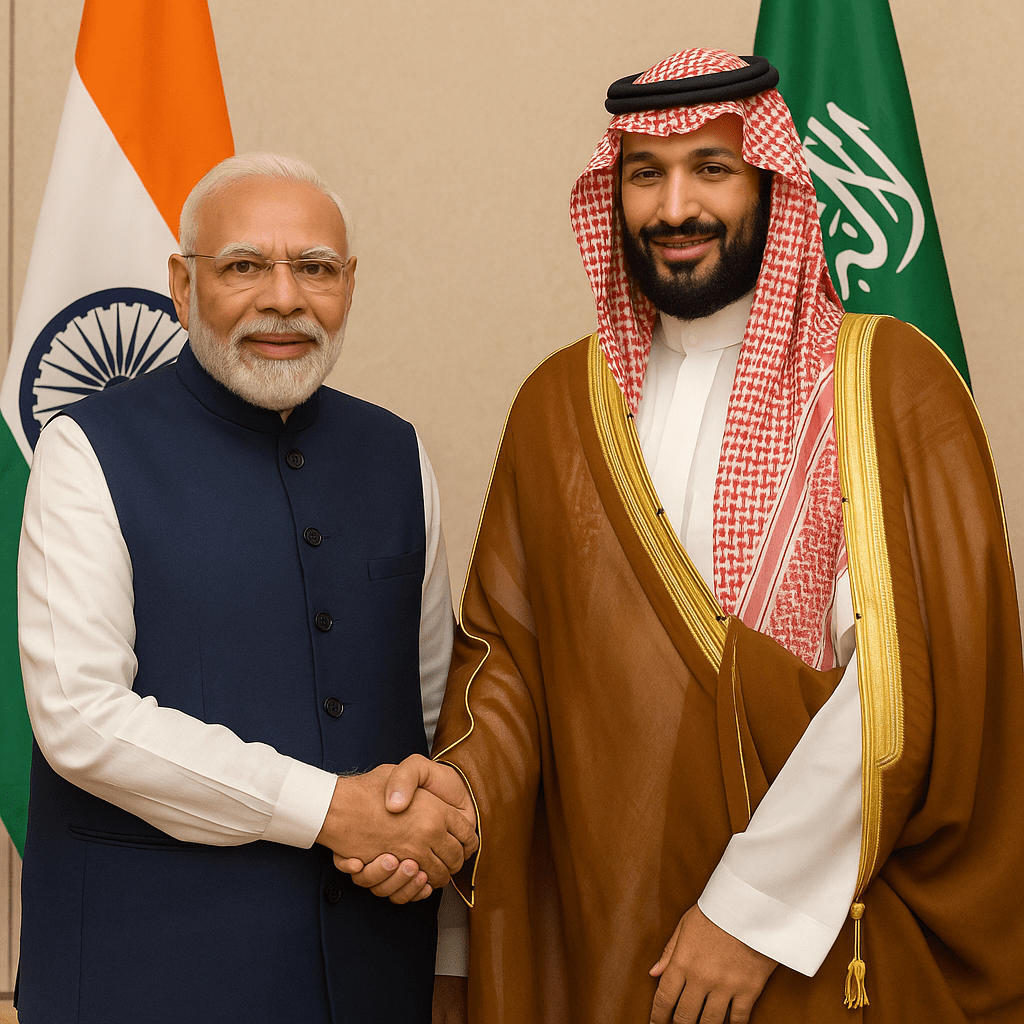
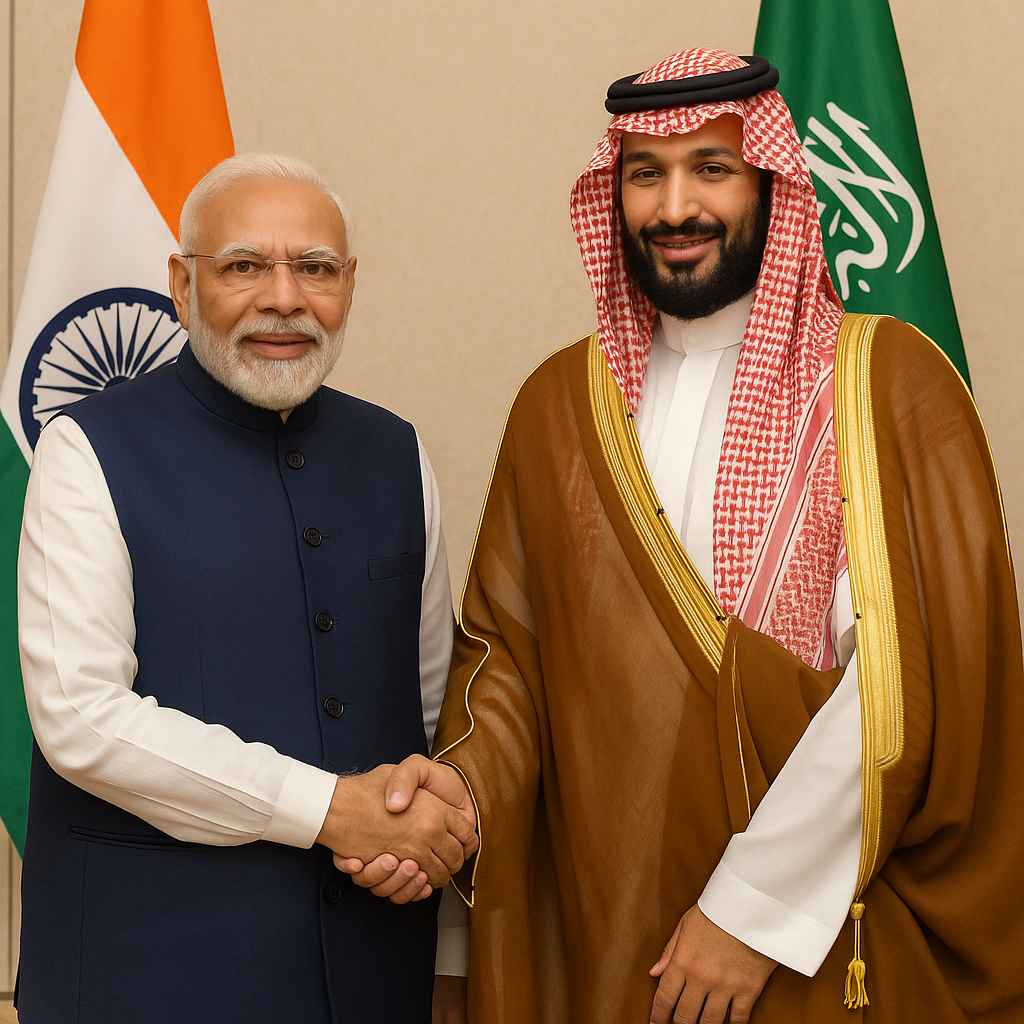
Prime Minister Narendra Modi’s visit to Saudi Arabia on April 22–23, 2025, strengthens the India-Saudi strategic partnership amid Middle East’s evolving geopolitics, particularly following the rise of the Hayat Tahrir al-Sham (HTS)-led government in Syria in December 2024.
With Saudi Arabia engaging HTS, India leverages this partnership to navigate Syria’s transition, ensuring mutual support on Kashmir and reconstruction opportunities. The analysis highlights historical ties, diplomatic engagements, and economic prospects in the Middle East.
Modi’s First Visit to Saudi Arabia (April 2–3, 2016)
Modi’s 2016 visit marked the first official trip by an Indian prime minister to Saudi Arabia in six years, and it underscored India’s intention to build robust political and economic engagement with Gulf states.
During the visit, Modi was conferred the King Abdulaziz Sash, Saudi Arabia’s highest civilian honor—an indication of Riyadh’s acknowledgment of India’s growing global stature.
The visit produced significant agreements in:
- Counterterrorism cooperation through intelligence sharing;
- Energy security, particularly around long-term oil supply and investment in India’s strategic petroleum reserves;
- Labour relations, aimed at safeguarding the rights of over two million Indian workers residing in the Kingdom.
Modi’s Second Visit (October 29, 2019): Strategic Diversification
Attending the Future Investment Initiative (FII) in Riyadh, Modi’s 2019 visit came amidst growing international scrutiny of Saudi Arabia post-Jamal Khashoggi’s murder.
India’s calibrated diplomacy enabled it to leverage this moment for economic gain without compromising ethical concerns.
A pivotal outcome was the establishment of the India–Saudi Arabia Strategic Partnership Council (SPC).
The SPC institutionalized bilateral engagement across two verticals: political-security and economic-social pillars. Twelve MoUs were signed, spanning:
- Energy and renewables;
- Civil aviation;
- Defense industry cooperation;
- Introduction of RuPay card in Saudi Arabia, symbolizing growing digital financial links.
Crown Prince Mohammed bin Salman’s Visit to India (February 2019)
Crown Prince MBS’s visit to New Delhi shortly after his Islamabad trip drew both attention and criticism. Nonetheless, the visit proved productive in redefining economic partnership parameters.
Key announcements included:
- A $100 billion investment commitment, with a focus on petrochemicals, infrastructure, and tourism;
- Raising the annual Haj quota for Indian pilgrims to 200,000;
- Promoting joint ventures in food security, technology, and housing;
- A broadening of cooperation in counterterrorism and maritime security, aligning with India’s Indo-Pacific ambitions.
The visit of Saudi Crown Prince Mohammed bin Salman (MBS) to India during the G20 Leaders’ Summit in September 2023 symbolized the strategic deepening of Indo-Saudi ties.
Held in conjunction with a formal state visit, the engagement culminated in the launch of the India–Middle East–Europe Economic Corridor (IMEC) and the first in-person meeting of the India–Saudi Strategic Partnership Council (SPC).
Modi’s Third Visit to Saudi Arabia
Prime Minister Narendra Modi’s third visit to Saudi Arabia on April 22–23, 2025, signifies India’s deepening ties with a key Gulf power, pivotal for energy security and regional influence.
As Middle East grapples with the fall of Syria’s Assad regime and the HTS-led transition, Modi’s visit to Jeddah, co-chairing the Strategic Partnership Council (SPC) with Crown Prince Mohammed bin Salman (MBS), is timely.
India-Saudi bilateral trade ($42.98 billion in 2023–24) and defense cooperation, alongside the India-Middle East-Europe Economic Corridor (IMEEC), are focal points.
India-Syria relations, rooted in Silk Road trade and Non-Aligned Movement (NAM) solidarity, face uncertainties under HTS rule. Historically, Syria supported India on Kashmir, while India backed Syria’s Golan Heights claim. Saudi Arabia’s mediation with HTS offers India a strategic channel to maintain these ties.
Modi’s SPC meeting with MBS in Jeddah, the first Indian leader’s visit there in over 40 years, finalizes defense, trade, and energy agreements.
Former diplomat Mahesh Sachdev calls Saudi Arabia a “major player” in West Asia, per Hindustan Times.
Bilateral trade ($42.98 billion, 2023–24) and Saudi Arabia’s role as India’s third-largest crude oil supplier (14.3%) highlight the visit’s stakes.
Boosting Defense and Security Cooperation
Recent defense deals ($225 million artillery contract, 2024) and naval exercises (“Al Mohed Al Hindi”) underscore growing ties.
Modi’s visit enhances counterterrorism and Red Sea security, addressing Houthi attacks impacting IMEEC.
Expanding Trade and Investment
India’s exports ($11.56 billion) and Saudi imports ($31.42 billion) drive trade. Modi’s visit resolves Saudi Arabia’s $100 billion investment pledge delays, attracting funds into energy and infrastructure. The 2.6 million Indian diaspora strengthens ties, with Modi visiting a factory employing Indian workers.
Securing Energy and Connectivity
Saudi Arabia supplies 18.2% of India’s LPG. Modi’s visit secures long-term energy deals, including green hydrogen, and advances IMEEC grid connectivity, despite Red Sea disruptions.
Countering Pakistan’s Influence
Saudi Arabia’s support for India’s 2019 Article 370 abrogation counters Pakistan’s rhetoric. Modi’s visit ensures alignment amid HTS’s Turkey-backed rule, which risks a pro-Pakistan Kashmir shift. Also, Modi’s diaspora engagement and historical gestures, like the 2016 Cheraman Juma Masjid replica, boost soft power.
Modi’s April 2025 Saudi Arabia visit is a strategic pivot, deepening India-Saudi ties in trade, energy, and defense while shaping India-Syria relations under HTS rule.



Leave a comment