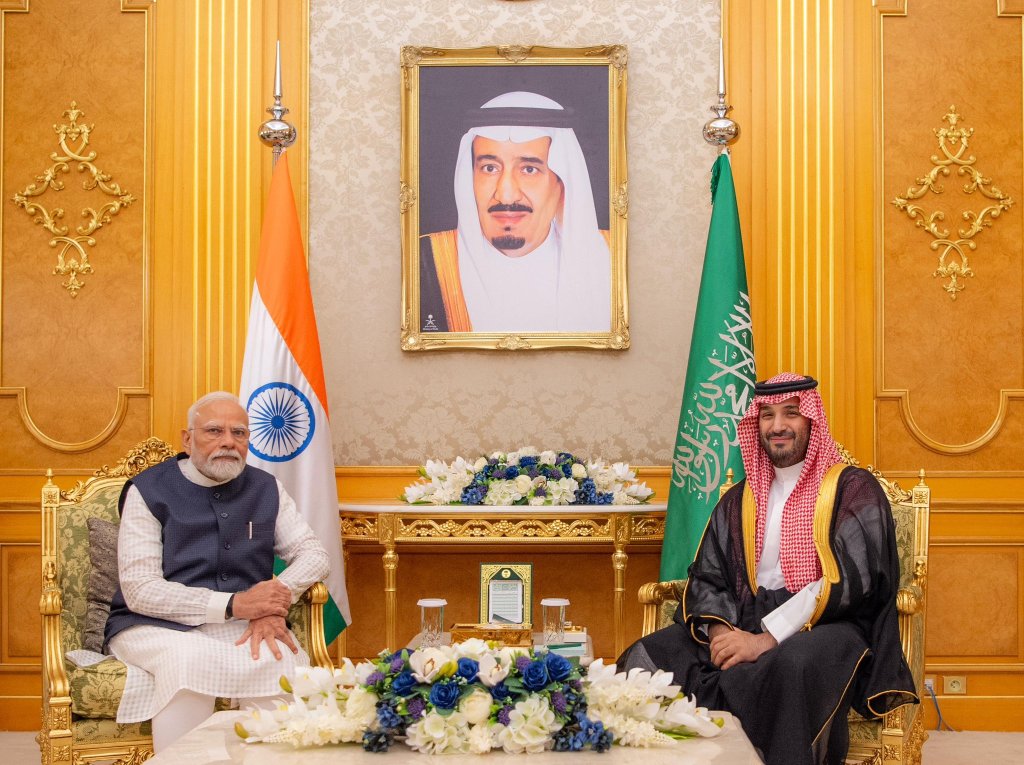
The state visit of Indian Prime Minister Narendra Modi to Saudi Arabia on April 22, 2025, marked a significant milestone in the deepening of India-Saudi Arabia relations.
The outcomes, as outlined by the Press Information Bureau (PIB) release, reflect a strategic intent to elevate bilateral ties across political, economic, cultural, and technological domains.
This analysis examines the key outcomes of the visit, focusing on the Strategic Partnership Council (SPC), the High-Level Task Force on Investment (HLTF), and the Memoranda of Understanding (MoUs) signed, while assessing their implications for both nations.
Strategic Partnership Council: A Framework for Comprehensive Cooperation
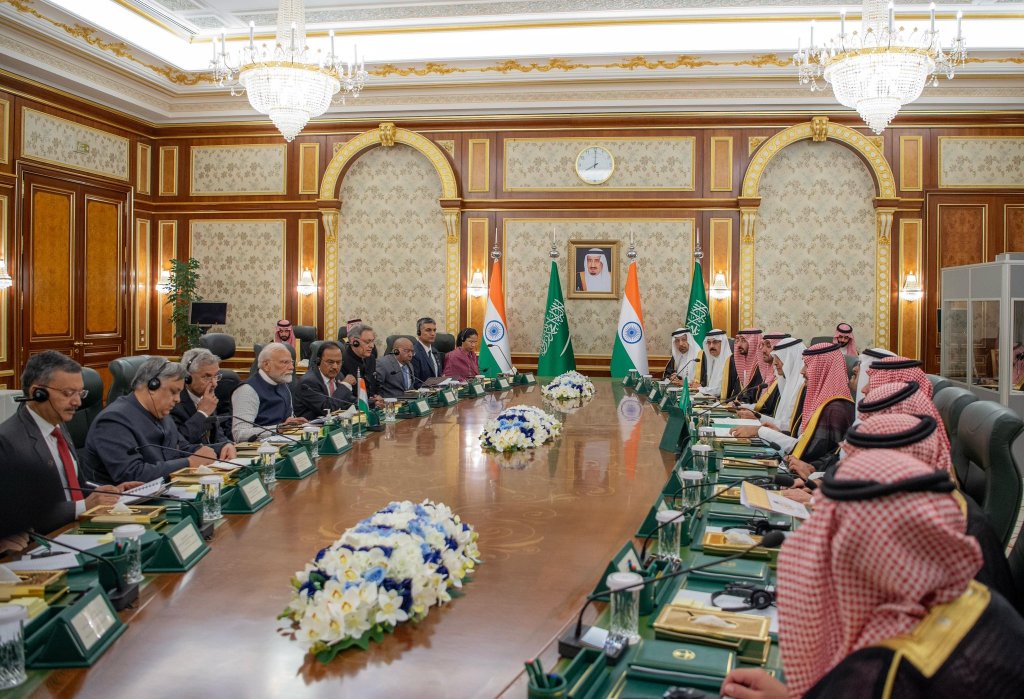
The second leaders’ meeting of the India-Saudi Arabia Strategic Partnership Council (SPC), co-chaired by Prime Minister Modi and Crown Prince Mohammed bin Salman, underscores the institutionalization of bilateral cooperation.
The SPC’s review of its committees and subcommittees highlights the breadth of engagement, spanning political, defence, security, trade, investment, energy, technology, agriculture, culture, and people-to-people ties. The signing of the minutes by the leaders formalizes the progress and sets a roadmap for future collaboration.
Creation of New Ministerial Committees
A pivotal outcome is the establishment of two new ministerial committees under the SPC: the Defence Cooperation Committee and the Tourism and Cultural Cooperation Committee. These additions reflect the evolving priorities of the partnership.
- Defence Cooperation Committee: The creation of this committee acknowledges the growing defence ties, evidenced by joint exercises, training programs, and defence industry collaboration. This move aligns with India’s push for self-reliance in defence manufacturing (Aatmanirbhar Bharat) and Saudi Arabia’s Vision 2030, which emphasizes diversification and localization of defence capabilities. The committee is likely to facilitate technology transfers, co-production, and joint ventures, potentially positioning India as a key partner in Saudi Arabia’s defence modernization.
- Tourism and Cultural Cooperation Committee: This committee capitalizes on the momentum in cultural and people-to-people ties. With Saudi Arabia opening up to tourism under Vision 2030 and India’s rich cultural heritage, the committee could boost tourism flows, promote cultural exchanges, and strengthen soft power. Initiatives like joint festivals, heritage exhibitions, or visa facilitation could emerge, fostering mutual understanding and economic benefits.

The restructured SPC, now comprising four committees—Political, Consular and Security Cooperation; Defence Cooperation; Economy, Energy, Investment and Technology; and Tourism and Cultural Cooperation—provides a robust framework to address both traditional and emerging areas of collaboration.
This structure ensures that the partnership remains dynamic and responsive to global and regional challenges.
High-Level Task Force on Investment: Catalyzing Economic Ties
The HLTF on Investment is a cornerstone of the economic dimension of the visit. Saudi Arabia’s commitment to invest USD 100 billion in India across sectors like energy, petrochemicals, infrastructure, technology, fintech, digital infrastructure, telecommunications, pharmaceuticals, manufacturing, and health signals a transformative economic partnership.
The HLTF’s progress in areas such as taxation and the agreement to establish two refineries in India are particularly noteworthy.
- Taxation Breakthroughs: Resolving taxation issues is a critical enabler for investment flows. By addressing double taxation or regulatory hurdles, the HLTF has laid the groundwork for smoother cross-border investments. This could attract more Saudi capital into India’s burgeoning market, particularly in infrastructure and technology.
- Refinery Projects: The agreement to collaborate on two refineries in India aligns with both nations’ energy strategies. For India, it supports energy security and industrial growth, while for Saudi Arabia, it strengthens downstream investments and market access. These projects could also create thousands of jobs and spur ancillary industries, amplifying economic impact.
The HLTF’s focus on rapid investment promotion reflects a mutual recognition of economic complementarities. Saudi Arabia’s capital surplus and India’s large, growing market create a synergy that could reshape bilateral trade, currently valued at over USD 50 billion annually, with potential to grow significantly.

Memoranda of Understanding: Sectoral Deepening
The four MoUs signed during the visit target specific sectors, reinforcing the strategic alignment between India and Saudi Arabia.
- Space Cooperation (Saudi Space Agency and Department of Space, India): This MoU positions India as a partner in Saudi Arabia’s nascent space ambitions. With India’s cost-effective space program and expertise in satellite launches, the collaboration could involve joint missions, technology sharing, or capacity building, aligning with India’s global space diplomacy and Saudi Arabia’s Vision 2030 goals.
- Health Cooperation (Ministry of Health, Saudi Arabia and Ministry of Health and Family Welfare, India): The health MoU reflects a shared priority on healthcare innovation and resilience, especially post-COVID-19. Potential areas include telemedicine, pharmaceutical collaboration, and medical tourism, leveraging India’s generic drug industry and Saudi Arabia’s healthcare investments.
- Anti-Doping Cooperation (Saudi Arabian Anti-Doping Committee and National Anti-Doping Agency, India): This niche MoU highlights the growing sporting ties, particularly as both nations aim to host global events. Joint education and prevention programs could enhance their reputations as responsible sporting nations.
- Postal Cooperation (Saudi Post Corporation and Department of Posts, India): The agreement on inward surface parcels strengthens logistics and e-commerce connectivity. As both nations witness booming online retail, this MoU could streamline cross-border trade, benefiting small businesses and consumers.
Broader Implications
The outcomes of the visit signal a maturing India-Saudi Arabia partnership, driven by mutual strategic interests.
For India, the visit reinforces its role as a key player in the Gulf, aligning with its “Act West” policy and energy security goals.
For Saudi Arabia, deeper ties with India support its Vision 2030 diversification agenda and reduce dependence on traditional Western partners. The partnership also has geopolitical significance, as both nations navigate a multipolar world and regional dynamics in the Indo-Pacific and Middle East.
Economically, the HLTF and MoUs pave the way for transformative investments and sectoral collaboration, potentially making Saudi Arabia one of India’s top foreign investors. Culturally, the focus on tourism and people-to-people ties could bridge civilizational connections, fostering long-term goodwill.
Challenges and Future Directions
While the outcomes are promising, challenges remain. Bureaucratic delays, regulatory complexities, and geopolitical tensions could hinder implementation. The SPC and HLTF must maintain momentum through regular reviews and clear timelines. Additionally, both nations should prioritize small and medium enterprises (SMEs) and youth engagement to ensure inclusive benefits.
Looking ahead, India and Saudi Arabia could explore cooperation in emerging areas like artificial intelligence, renewable energy, and climate resilience. Joint initiatives under global frameworks like the G20 or India-Middle East-Europe Economic Corridor could further amplify their partnership.

The state visit of Prime Minister Modi to Saudi Arabia on April 22, 2025, has laid a strong foundation for a multifaceted strategic partnership.
The SPC’s restructuring, HLTF’s investment breakthroughs, and targeted MoUs reflect a shared vision for mutual prosperity.
By leveraging their complementary strengths, India and Saudi Arabia are poised to redefine their bilateral relationship, with ripple effects across the region and beyond. Sustained commitment and agile implementation will be key to realizing the full potential of these outcomes.



Leave a comment