On April 22, 2025, a devastating terrorist attack shook Baisaran meadow near Pahalgam in the Anantnag district of Indian-administered Jammu and Kashmir. This assault, one of the deadliest in the region since the 2019 Pulwama attack, claimed at least 26 lives, primarily tourists, and injured over 20 others. Orchestrated by The Resistance Front (TRF), an offshoot of the Pakistan-based Lashkar-e-Taiba (LeT), the attack targeted civilians in a scenic tourist destination, exposing vulnerabilities in Kashmir’s security apparatus and escalating India-Pakistan tensions.

Union Home Minister and Minister of Cooperation Shri Amit Shah today paid his last respects to the deceased of yesterday’s Pahalgam terror attack. Union Home Minister said that Bharat will not bend to terror and the culprits of this dastardly terror attack will not be spared.
Source: Press Information Bureau (PIB)
Details of the Assault
The attack unfolded around 2:30–3:00 PM in Baisaran Valley, a picturesque meadow 6 km from Pahalgam, often dubbed “mini Switzerland” for its lush greenery and tourist appeal.
The timing was strategic, coinciding with peak tourist season, as the valley was crowded with visitors enjoying spring weather.
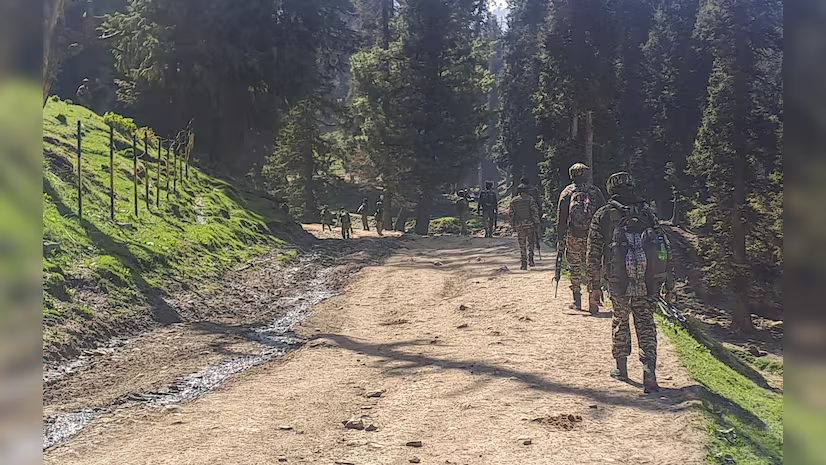
Seven militants, clad in military-style uniforms, emerged from nearby forests armed with M4 carbines and AK-47 rifles. Their approach was methodical: they opened fire indiscriminately but selectively targeted non-Muslims, reportedly asking victims to recite the Islamic kalma, checking for circumcisions, and demanding names to identify and spare Muslims.
This sectarian targeting mirrors tactics used by LeT in previous attacks, aiming to deepen communal divides.
Eyewitness accounts paint a harrowing picture. Gunshots and screams shattered the serene meadow, with tourists fleeing in panic. One survivor, a tourist from Maharashtra, described hiding behind a rock as militants fired, while another recounted the bravery of Syed Adil Hussain Shah, a local Kashmiri Shia Muslim who attempted to confront the attackers and was killed. The militants, equipped with body cameras, recorded the assault, a propaganda tactic associated with LeT to amplify fear and claim responsibility.
Perpetrators
The Resistance Front (TRF), a relatively new militant group formed in 2019, claimed responsibility.
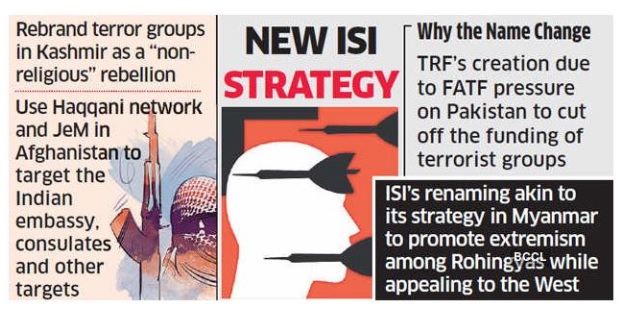
TRF is widely regarded as a front for Lashkar-e-Taiba, a Pakistan-based terrorist organization responsible for major attacks like the 2008 Mumbai assaults.
Indian intelligence sources identified three attackers—Asif Fauji, Suleman Shah, and Abu Talha—though all seven remain at large, prompting a massive cordon and search operation.
The use of body cameras and sophisticated weaponry suggests external support, with India pointing to Pakistan’s Inter-Services Intelligence (ISI) as a key enabler.
Local and Regional Dynamics
Pahalgam, a hub for tourism and the starting point for the Amarnath Yatra pilgrimage, is a symbol of Kashmir’s cultural and economic revival.
In 2024, the region welcomed 3.5 million tourists, contributing significantly to the local economy. The attack’s timing, just months before the 2025 Amarnath Yatra (scheduled for July 3), suggests an intent to disrupt this economic lifeline and deter pilgrims, who number over 600,000 annually.
Locally, the attack has sparked outrage. Kashmiri religious leaders, including the spiritual head of Ajmer Sharif Dargah, condemned it as “inhuman,” emphasizing that targeting civilians violates Islamic principles.
Residents, many of whom rely on tourism, expressed despair, with a Pahalgam chef noting, “This destroys our reputation for hospitality.” The death of a Shia Muslim local further alienated communities, as TRF’s Sunni extremist ideology clashed with Kashmir’s diverse social fabric.
Middle Eastern Countries’ Reactions
United Arab Emirates (UAE)
- Response: The UAE Ministry of Foreign Affairs issued a statement condemning the attack in the “strongest terms,” expressing “deepest condolences” to the Indian government, the victims’ families, and wishing a speedy recovery to the injured. The UAE’s embassy in New Delhi reiterated solidarity, and posts on X highlighted the death of a UAE national among the victims, underscoring the personal toll.
- Details: The UAE’s response was immediate, reflecting its close diplomatic ties with India. Foreign Minister Sheikh Abdullah bin Zayed Al Nahyan reportedly called his Indian counterpart to reaffirm support, emphasizing counter-terrorism cooperation.

Saudi Arabia
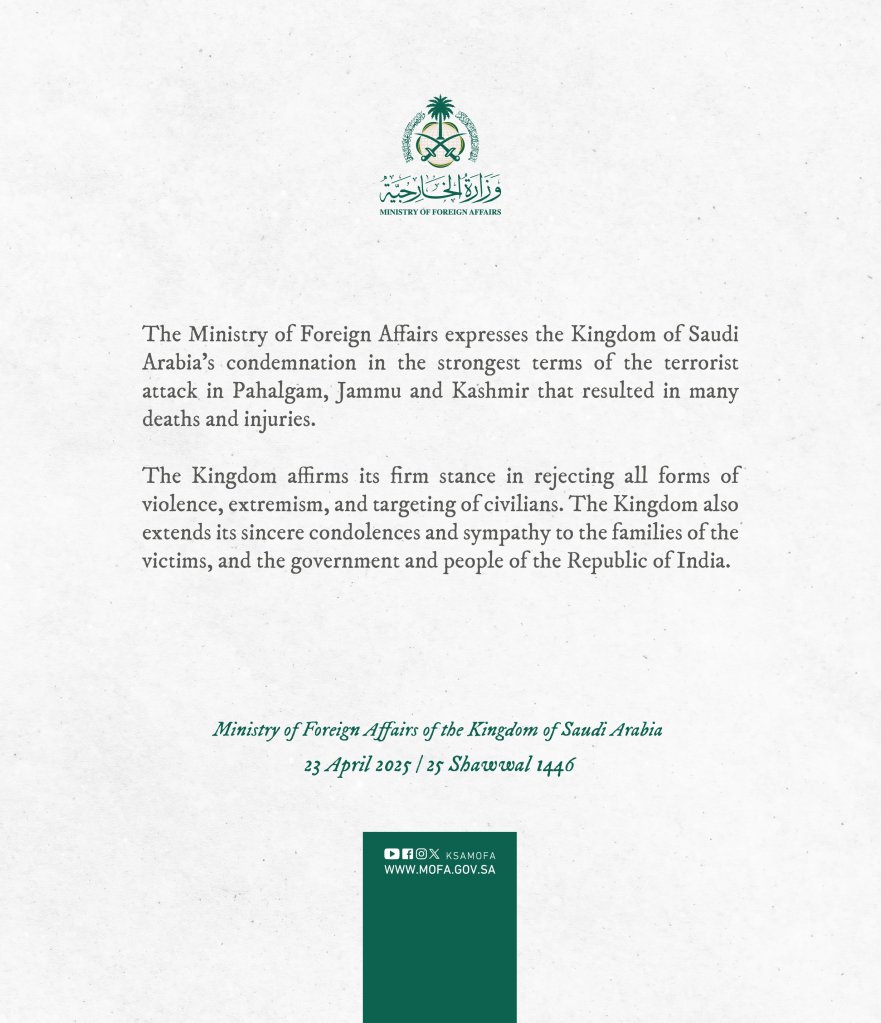
- Response: Saudi Arabia’s Foreign Ministry condemned the attack as a “heinous act,” offering condolences to India and the victims’ families. During a meeting in Jeddah on April 22, 2025, Crown Prince Mohammed bin Salman (MBS) personally conveyed condolences to Prime Minister Narendra Modi, who was visiting Saudi Arabia when the attack occurred. MBS pledged “all possible help” to combat terrorism, as noted by Indian Ambassador Suhel Ajaz Khan.
- Details: The timing of Modi’s visit amplified Saudi Arabia’s response, with MBS’s public condemnation signaling strong bilateral alignment. Saudi state media covered the attack extensively, framing it as an assault on civilian safety.
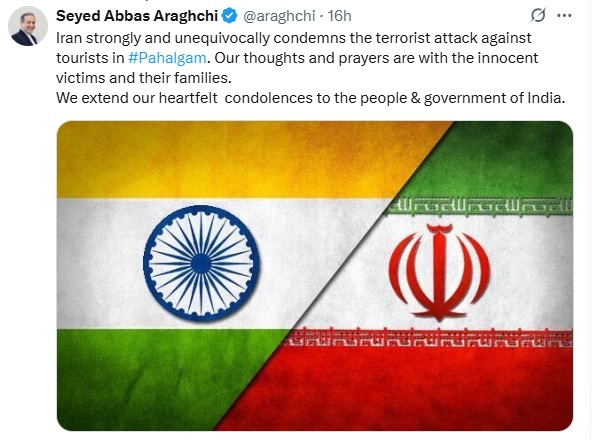
Iran
- Response: Iran’s Embassy in New Delhi issued a statement condemning the attack, describing it as a “barbaric act of terrorism.” Iran extended condolences to the Indian government and the victims’ families, with prayers for the injured. Iranian Foreign Minister Abbas Araghchi called for enhanced international coordination to counter terrorism, emphasizing the need to address its root causes.
- Details: Iran’s response was notably proactive, with state media highlighting the attack’s civilian toll. The embassy’s statement avoided direct mention of Pakistan, reflecting Iran’s delicate balancing act in regional diplomacy.
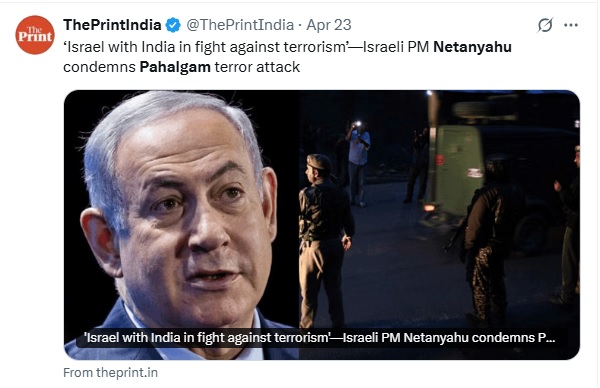
Israel
- Response: Israeli Prime Minister Benjamin Netanyahu condemned the attack, stating, “Israel stands shoulder-to-shoulder with India against terrorism.” The Israeli Foreign Ministry expressed solidarity, offering condolences and support for India’s counter-terrorism efforts.
- Details: Israel’s response was swift, with its embassy in New Delhi organizing a condolence event. Israeli media drew parallels to attacks in Israel, framing the incident as part of a global terrorist threat.
Motivations Behind Middle Eastern Responses
1. Strategic and Diplomatic Ties with India
- UAE: The UAE and India share a Comprehensive Economic Partnership Agreement (CEPA), with bilateral trade exceeding $85 billion annually. The UAE hosts over 3.5 million Indian expatriates, the largest diaspora in the Gulf, contributing to economic and cultural ties. The death of a UAE national in the attack added a personal dimension, necessitating a strong response to maintain public trust and bilateral goodwill.
- Saudi Arabia: Saudi Arabia’s strategic partnership with India, formalized through the Strategic Partnership Council in 2019, includes energy, defense, and counter-terrorism cooperation. Saudi Arabia is India’s fourth-largest trading partner, with $43 billion in trade and $100 billion in planned investments. The timing of Modi’s visit to Jeddah, where he was conferred the Grand Commander of the Order of King Abdulaziz, made a robust condemnation politically imperative to reinforce the partnership.
- Iran: India and Iran collaborate on strategic projects like the Chabahar port, which connects Iran to global markets and counters China-Pakistan influence. Iran’s condemnation aligns with its interest in deepening ties with India, especially as a counterweight to Pakistan, with which Iran has strained relations due to cross-border militancy.
- Israel: Israel and India share a robust defense partnership, with Israel supplying 42% of India’s arms imports, including drones and missile systems. Joint counter-terrorism exercises and intelligence sharing further bind the two nations, making Israel’s support a natural extension of their alliance.
2. Shared Counter-Terrorism Objectives
- UAE: The UAE has adopted a zero-tolerance policy on terrorism, shaped by its role as a global hub and its own security concerns. The attack’s civilian toll, including a UAE citizen, aligned with the UAE’s advocacy for global counter-terrorism frameworks, as seen in its support for UN initiatives.
- Saudi Arabia: Having faced domestic terrorism from groups like Al-Qaeda, Saudi Arabia shares India’s concerns about extremist networks, particularly those linked to Pakistan. The TRF-LeT connection prompted a strong Saudi response, reflecting its commitment to countering Sunni extremist groups that threaten regional stability.
- Iran: As a target of Sunni militant groups like Jaish al-Adl, some of which operate from Pakistan, Iran views terrorism as a shared threat with India. Its call for international coordination reflects a desire to position itself as a responsible actor combating extremism.
- Israel: Israel’s experience with civilian-targeted attacks, such as those by Hamas, mirrors India’s challenges with LeT. The attack’s sectarian targeting resonated with Israel, reinforcing its solidarity with India as a fellow victim of terrorism.
Economic and Diaspora Factors
- UAE and Saudi Arabia: The presence of millions of Indian workers (3.5 million in the UAE, 2 million in Saudi Arabia) creates a mutual economic stake. The attack’s impact on Indian tourists, a key demographic, threatened Gulf tourism and remittance flows, prompting strong responses to maintain confidence.
- Iran: While Iran hosts a smaller Indian diaspora, its economic reliance on India for oil exports and Chabahar investments motivated its support, ensuring continued cooperation.
- Israel: Economic ties, including tech and agriculture collaborations, and a growing Indian tourist flow to Israel, underpinned its response, as instability in India could disrupt these exchanges.
Geopolitical Context and Pakistan’s Role
India’s accusation of Pakistan’s involvement, citing TRF’s LeT links, shaped Middle Eastern responses.
The UAE and Saudi Arabia, while maintaining ties with Pakistan, have shifted closer to India due to economic and strategic priorities.
Their condemnations implicitly supported India’s narrative without directly naming Pakistan, reflecting diplomatic caution. Iran, with its own tensions with Pakistan over cross-border militancy, was more explicit in calling for global action, aligning with India’s stance. Israel, a staunch critic of Pakistan’s terrorism links, used the attack to reinforce its anti-terrorism alliance with India, indirectly critiquing Pakistan.
Implications for India-Middle East Relations
Regional Counter-Terrorism Frameworks
The attack has highlighted the need for a Middle East-South Asia counter-terrorism framework.
The UAE and Saudi Arabia, as leaders in the Islamic world, could spearhead initiatives with India to address LeT and similar groups, leveraging their influence in the Organisation of Islamic Cooperation (OIC). Iran’s call for coordination suggests potential for trilateral dialogues, though geopolitical rivalries may complicate this.
Balancing Pakistan Relations
Middle Eastern countries’ support for India may strain their ties with Pakistan, which condemned the attack but faces India’s accusations. The UAE and Saudi Arabia, key Pakistani allies, must navigate this delicately to maintain regional stability. Iran’s response, while pro-India, avoids antagonizing Pakistan due to shared borders. Israel, with no formal Pakistan ties, faces no such constraints, strengthening its India alignment.
Indian Government’s Response
In response, India’s Cabinet Committee on Security (CCS), chaired by Prime Minister Narendra Modi, convened to address the crisis, issuing a series of unprecedented measures aimed at punishing Pakistan for its alleged role in cross-border terrorism.
CCS Measures
The CCS announced five retaliatory measures:
- Suspension of the Indus Waters Treaty (IWT): The 1960 treaty, governing shared river waters, is held in abeyance until Pakistan ends support for cross-border terrorism. The IWT governs the use of six rivers, with India controlling the eastern rivers (Sutlej, Beas, Ravi) and Pakistan relying on the western rivers (Indus, Jhelum, Chenab). Suspension could disrupt Pakistan’s agriculture, which consumes 80% of its water, and hydropower, exacerbating its economic crisis (inflation hit 38% in 2023). India’s move leverages its upstream position to pressure Pakistan. The IWT move, in particular, is a high-stakes escalation, as water is a lifeline for Pakistan’s 240 million people. Suspending the IWT may draw criticism from the UN or World Bank, though India’s evidence of Pakistan’s LeT links could justify its stance. The US and EU’s support, as seen in their condemnation, may mitigate backlash. As Pakistan’s ally, China may oppose India’s measures, particularly the IWT suspension, given its $60 billion China-Pakistan Economic Corridor investments. India must navigate this to avoid a broader geopolitical confrontation.
- Closure of Attari Integrated Check Post (ICP): Effective immediately, with a grace period until May 1, 2025, for valid travelers to return. The Attari-Wagah border handles $2 billion in annual trade, including agricultural goods and cement. Its closure will hit Pakistan’s exports, already strained by a $7 billion trade deficit, and disrupt local economies in Punjab on both sides, where thousands rely on cross-border commerce.
- Ban on Pakistani Nationals under SAARC Visa Exemption Scheme (SVES): Existing visas are canceled, and those in India have 48 hours to leave. India and Pakistan have expelled diplomats before, notably in 2003 and 2016, but the CCS’s targeting of military advisors is unprecedented since the 1971 war. This reflects the attack’s severity and India’s intent to signal a military dimension to its response.
- Expulsion of Pakistani Military Advisors: Defence, Naval, and Air Advisors in Pakistan’s New Delhi High Commission are declared Persona Non Grata, with a week to leave. India will withdraw its advisors from Islamabad, annulling these posts and withdrawing five support staff from both missions.
- Reduction of High Commission Staff: Both countries’ High Commissions will reduce staff from 55 to 30 by May 1, 2025. Expelling Pakistani advisors and reducing High Commission staff risks isolating India from neutral mediators like the UAE, which maintains ties with Pakistan. India’s diplomacy must reassure such allies to sustain their support.
The attack’s context—Kashmir’s economic progress, the Amarnath Yatra’s proximity, and global counter-terrorism trends—underscores the need for a balanced approach that combines punitive actions with diplomacy and local engagement. As India pursues justice for the victims, its ability to navigate these challenges will shape the region’s security and its global standing.



Leave a comment