
On April 23, 2025, Jordan announced a comprehensive ban on the Muslim Brotherhood, a transnational Sunni Islamist organization, confiscating its assets and outlawing all its activities.
Interior Minister Mazen Fraya cited the group’s alleged involvement in a sabotage plot, including manufacturing explosives and plotting attacks with rockets and drones, as the primary reason for the crackdown.
This move marks a significant escalation in Jordan’s efforts to curb political Islam and has broader implications for regional stability and India’s strategic interests. This analysis explores the context of the ban, its significance for Jordan, and why it matters for India.

Context of the Ban
The Muslim Brotherhood, founded in Egypt in 1928, has been a prominent Islamist movement advocating for governance based on Islamic principles through democratic means, though its critics label it a terrorist organization.
In Jordan, the group has operated legally since 1946, enjoying significant grassroots support, particularly in urban centers. Its political arm, the Islamic Action Front (IAF), emerged as the largest opposition bloc in Jordan’s parliament after the September 2024 elections, capitalizing on public outrage over Israel’s war in Gaza.
The recent ban stems from allegations that 16 Brotherhood members, arrested a week prior, were trained and financed in Lebanon to orchestrate attacks within Jordan.

The government also linked the group to a foiled 2024 plot, accusing members of manufacturing short-range missiles and drones to destabilize the kingdom.
While the Brotherhood denied organizational involvement, admitting some members may have acted individually in smuggling arms to Palestinians in the West Bank, the Jordanian authorities moved decisively. The ban includes closing all Brotherhood offices, seizing assets, and prohibiting the promotion of its ideology, with legal consequences for violators.
This is not Jordan’s first attempt to restrict the Brotherhood.
A 2020 court ruling dissolved the group for failing to renew its legal status, and over the past two years, the government has tightened restrictions, banning rallies and arresting dissenters. However, the 2025 ban is unprecedented in its scope, signaling a “final divorce” between the state and the Brotherhood, as described by political analyst Mohammed Khair Rawashdeh.

Why It Matters for India
India, with its strategic interests in the Middle East and its own concerns about transnational Islamist movements, has reasons to closely monitor Jordan’s ban on the Muslim Brotherhood. The implications for India can be understood through the lenses of regional stability, counterterrorism, and bilateral relations.
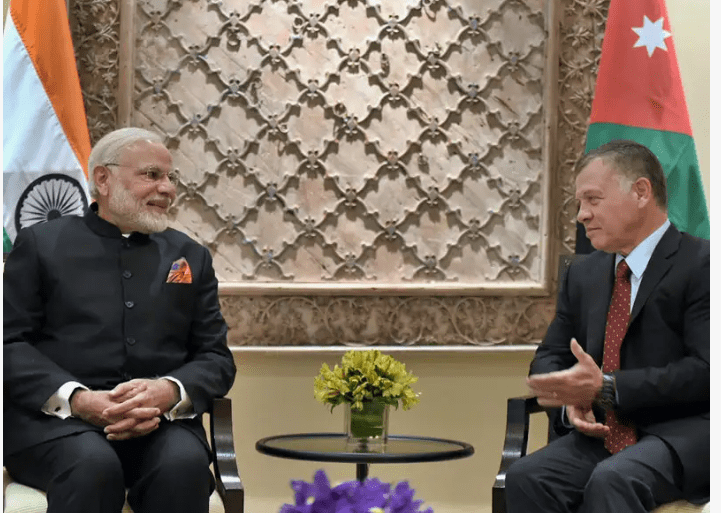
1. Regional Stability and India’s Economic Interests
Jordan’s stability is crucial for India, given the Middle East’s importance as a source of energy, trade, and remittances.
Over 50,000 Indian workers reside in Jordan, contributing to India’s economy through remittances. Any destabilization in Jordan, particularly if the Brotherhood’s ban leads to protests or violence, could disrupt these economic ties.
India’s trade with Jordan, valued at over $2 billion annually, includes significant exports of pharmaceuticals, textiles, and agricultural products. A stable Jordan ensures the continuity of these economic linkages.
Moreover, Jordan’s role as a moderating force in the Israel-Palestine conflict aligns with India’s balanced foreign policy. India supports a two-state solution while maintaining strong ties with Israel.
The Brotherhood’s support for Hamas and its anti-Israel protests have complicated Jordan’s domestic politics. By curbing the Brotherhood, Jordan reinforces its commitment to stability, which indirectly supports India’s interest in a predictable regional environment conducive to its economic and diplomatic objectives.
2. Counterterrorism and Transnational Islamist Networks
India has long been concerned about the spread of radical ideologies and transnational terrorist networks, particularly those with links to South Asia.
The Muslim Brotherhood, while not directly active in India, has ideological influence through its global network, which includes connections to groups like Jamaat-e-Islami in India and Pakistan. The Brotherhood’s alleged involvement in arms smuggling and sabotage plots in Jordan raises red flags for India, which has faced challenges from cross-border terrorism, often linked to Pakistan-based groups.
The Jordanian case highlights the risks of Islamist organizations operating under the guise of political or charitable activities.
Indian intelligence agencies have monitored groups with ideological ties to the Brotherhood, particularly in the context of radicalization and funding networks. For instance, the Popular Front of India (PFI), banned in 2022, was accused of promoting extremist ideologies with parallels to the Brotherhood’s vision of establishing Islamic governance. Jordan’s crackdown provides a case study for India in balancing legal measures against such groups while managing domestic sensitivities, given India’s large Muslim population and democratic framework.
Furthermore, the involvement of Lebanon-based financing and training in the Jordanian plot underscores the need for international cooperation in counterterrorism. India, which has strengthened its security ties with Middle Eastern countries, can benefit from intelligence-sharing with Jordan to track funding networks and prevent the spread of militancy.
Jordan’s experience also reinforces India’s advocacy for global frameworks to combat terrorism, as seen in its push for the Comprehensive Convention on International Terrorism at the United Nations.
3. Strengthening India-Jordan Bilateral Relations
The ban on the Muslim Brotherhood opens opportunities for India to deepen its partnership with Jordan.
Both countries share a commitment to combating terrorism and promoting moderate, inclusive governance. India’s External Affairs Minister S. Jaishankar visited Jordan in 2024, emphasizing cooperation in trade, defense, and counterterrorism. Jordan’s decisive action against the Brotherhood aligns with India’s zero-tolerance policy toward terrorism, providing a foundation for enhanced collaboration.
India can support Jordan through capacity-building in cybersecurity and counter-radicalization, areas where India has developed expertise.
Joint training programs for law enforcement and intelligence-sharing on transnational threats could strengthen bilateral ties. Additionally, India’s experience in managing diverse religious communities while countering extremism could offer lessons for Jordan as it navigates the domestic fallout of the ban.
4. Implications for India’s Muslim Community and Domestic Politics
The Brotherhood’s ban in Jordan may resonate in India’s domestic discourse, particularly among political and religious groups. While the Brotherhood has no formal presence in India, its ideology influences certain Islamist movements that advocate for political Islam.
Indian authorities will likely monitor any ripple effects, especially in regions like Kerala and Jammu & Kashmir, where Islamist groups have historically been active. The Jordanian ban could embolden calls in India for stricter measures against organizations perceived as promoting divisive ideologies, though such moves would require careful calibration to avoid alienating India’s Muslim community.
India’s secular framework and commitment to pluralism necessitate a nuanced approach. The government may draw lessons from Jordan’s legal and administrative measures but will need to ensure that any actions against extremist groups are transparent and inclusive to maintain social cohesion.
Public diplomacy efforts, highlighting India’s support for moderate Islam and interfaith harmony, could counter any misperceptions arising from the Jordanian developments.
Conclusion
Jordan’s ban on the Muslim Brotherhood is a pivotal moment in its efforts to safeguard national security and curb political Islam.
For India, the move signifies the importance of regional stability in the Middle East, strengthens the case for international counterterrorism cooperation, and offers opportunities to deepen bilateral ties with Jordan.
However, it also serves as a reminder of the delicate balance required in addressing extremist ideologies within democratic societies.
As India navigates its own challenges with transnational militancy and domestic pluralism, Jordan’s experience provides valuable insights into the complexities of combating ideological threats while maintaining social harmony.




Leave a comment