
The April 22, 2025, Pahalgam terror attack, which claimed 26 Indian lives, has escalated tensions between India and Pakistan, spilling into cyberspace.
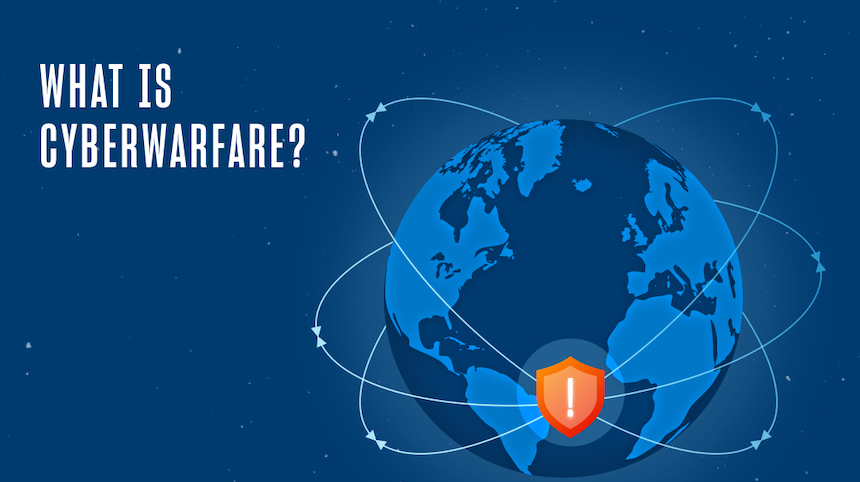
Scholars like Libicki (2007) define cyber warfare as “the deliberate disruption or corruption of an adversary’s information systems to achieve strategic ends,” emphasizing its role as a subset of information warfare.
The U.S. Department of Defense (2018) further characterizes it as “an armed conflict conducted in whole or part by cyber means,” highlighting its potential equivalence to kinetic warfare.


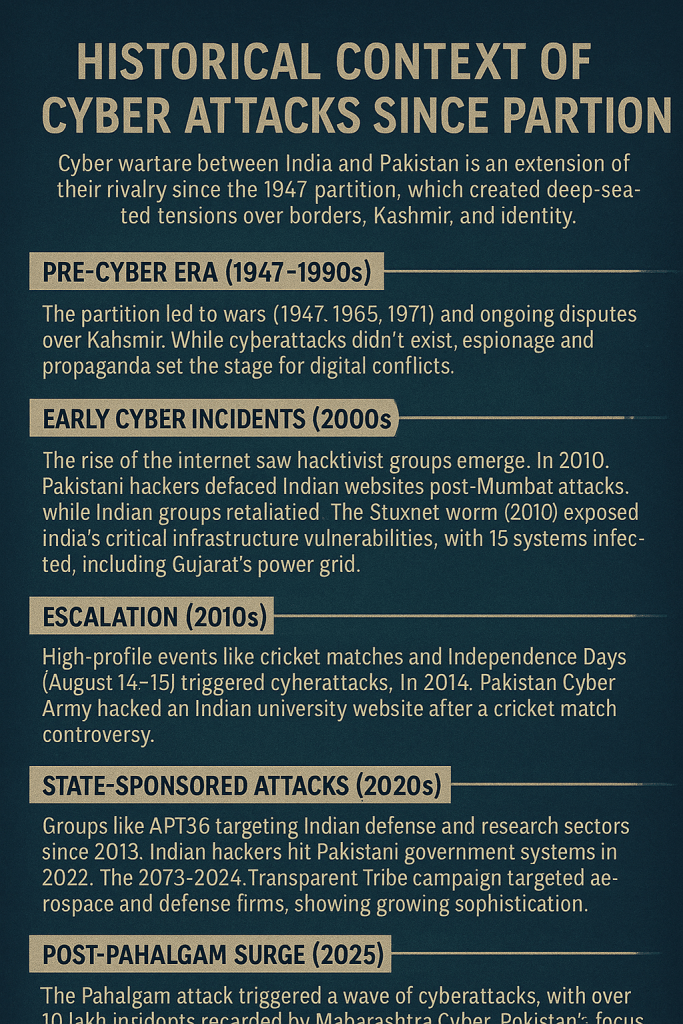
Historical Context of Cyber Attacks Since Partition
Cyber warfare between India and Pakistan is an extension of their rivalry since the 1947 partition, which created deep-seated tensions over borders, Kashmir, and identity.
- Pre-Cyber Era (1947–1990s): The partition led to wars (1947, 1965, 1971) and ongoing disputes over Kashmir. While cyberattacks didn’t exist, espionage and propaganda set the stage for digital conflicts.
- Early Cyber Incidents (2000s): The rise of the internet saw hacktivist groups emerge. In 2010, Pakistani hackers defaced Indian websites post-Mumbai attacks, while Indian groups retaliated. The Stuxnet worm (2010) exposed India’s critical infrastructure vulnerabilities, with 15 systems infected, including Gujarat’s power grid.
- Escalation (2010s): High-profile events like cricket matches and Independence Days (August 14–15) triggered cyberattacks. In 2014, Pakistan Cyber Army hacked an Indian university website after a cricket match controversy.
- State-Sponsored Attacks (2020s): Groups like APT36 targeted Indian defense and research sectors since 2013. Indian hackers hit Pakistani government systems in 2022. The 2023–2024 Transparent Tribe campaign targeted aerospace and defense firms, showing growing sophistication.
- Post-Pahalgam Surge (2025): The Pahalgam attack triggered a wave of cyberattacks, with over 10 lakh incidents recorded by Maharashtra Cyber. Pakistan’s focus on welfare and educational sites reflects a strategy to provoke and destabilize.
This history shows a shift from opportunistic hacktivism to coordinated, state-backed cyber espionage, amplified by geopolitical flashpoints.
Hacking Methods in the India-Pakistan Cyber Conflict
1. Web Defacement
Web defacement involves hackers altering a website’s content to display propaganda, taunts, or political messages. This method is low-skill but high-impact for psychological warfare, aiming to embarrass the target and signal cyber dominance.
- Post-Pahalgam Incident: The Armoured Vehicles Nigam Limited (AVNL) website was defaced with images of a Pakistani tank and flag, claimed by the Pakistan Cyber Force. This was part of a broader campaign targeting Indian defense and welfare sites.
- Scale: According to a 2023 report by the Indian Computer Emergency Response Team (CERT-In), web defacement accounted for approximately 15% of cyberattacks in India, with 22,000 websites targeted annually. In the India-Pakistan context, defacements spike during geopolitical flare-ups. In 2014, the Pakistan Cyber Army defaced an Indian university website after a cricket match controversy, and similar incidents occurred in 2022 targeting Indian government portals. Post-Pahalgam, over 10 Indian websites, including Army Public School Srinagar, were defaced.
- Hackers exploit outdated content management systems (e.g., WordPress, Joomla) or weak admin credentials. A 2024 cybersecurity study found that 60% of defaced websites had unpatched vulnerabilities, with 30% due to stolen credentials. Defacements disrupt public trust and force system downtime for audits. The AVNL site was offline for days, costing resources and signaling vulnerability.
CERT-In reported a 20% increase in defacement attacks from 2022 to 2024, with 25% targeting government or defense-related sites. Globally, web defacement campaigns by hacktivist groups (e.g., IOK Hacker, Team Insane PK) rose by 35% from 2020 to 2024, per a Radware report.
2. Distributed Denial of Service (DDoS)
DDoS attacks flood servers with excessive traffic, rendering websites or services inaccessible. In the India-Pakistan conflict, these attacks target symbolic institutions to disrupt operations and amplify propaganda.
Post-Pahalgam: DDoS attacks hit the Army Public School Srinagar and the Army College of Nursing, claimed by groups like IOK Hacker. These attacks aimed to disrupt educational services tied to India’s military.
Maharashtra Cyber reported over 10 lakh (1 million) cyberattacks in the week following the Pahalgam attack, with 40% classified as DDoS attempts. Globally, DDoS attacks increased by 50% from 2022 to 2024, per Cloudflare’s 2024 Threat Report.
Attackers use botnets—networks of compromised devices—to generate traffic. A 2023 Akamai study found that 70% of DDoS attacks in South Asia leveraged IoT devices, which are poorly secured. Pakistan-based groups reportedly exploit regional botnet markets, renting access for as low as $100 per attack.
The Army Public School’s website was offline for 48 hours, disrupting access for students and parents. DDoS attacks cost organizations an average of $6,000 per hour in downtime, per a 2024 Netscout report. Pakistan-based DDoS attacks often coincide with symbolic dates. For instance, on August 14, 2024 (Pakistan’s Independence Day), Indian government websites faced a 200% spike in DDoS traffic, per CERT-In.
3. Phishing and Spear-Phishing
Phishing involves sending fraudulent emails or messages to trick users into revealing credentials or downloading malware. Spear-phishing targets specific individuals or organizations, often with tailored content. These are critical vectors in the India-Pakistan cyber conflict for espionage.
The Pakistan-based Transparent Tribe (APT36) has targeted Indian defense and aerospace sectors since 2013. Post-Pahalgam, APT36 launched spear-phishing campaigns against the Department of Defence Production, using fake login pages mimicking Microsoft Azure.
A 2024 Quick Heal Technologies report noted that phishing attacks in India surged by 45% from 2022, with 25% targeting government or defense personnel. APT36’s campaigns alone affected over 500 Indian entities in 2023–2024. Attackers craft emails posing as trusted entities (e.g., defense contractors). A 2023 Seqrite report found that 80% of APT36’s phishing emails contained malicious attachments, while 15% used fake login portals. Post-Pahalgam, phishing emails referenced the attack to lure clicks.
Successful phishing compromises sensitive systems. For example, APT36’s 2024 campaign against MayaOS extracted credentials from defense contractors, potentially exposing proprietary data. Spear-phishing is increasingly sophisticated, with attackers using social engineering based on LinkedIn profiles or public data. A 2024 Proofpoint study found that 65% of spear-phishing targets in South Asia were high-ranking officials.
4. Malware Deployment
Malware, such as remote access tools (RATs) or spyware, is deployed to steal data, monitor systems, or disrupt operations. In the India-Pakistan context, malware targets defense infrastructure for espionage.
APT36’s CrimsonRAT, a Windows-based malware, was used to target MayaOS, a Linux-based system for India’s defense sector. CrimsonRAT can take screenshots, steal files, and execute commands.
Post-Pahalgam Activity: Quick Heal Technologies identified a new APT36 campaign post-Pahalgam, deploying all-in-one espionage kits via phishing emails. These kits targeted 200+ defense-related systems. A 2024 Sophos report noted that malware attacks in India increased by 50% from 2022, with 35% targeting critical infrastructure. APT36’s campaigns infected over 1,000 systems in India from 2020 to 2024.
Malware is delivered via phishing attachments or compromised websites. A 2023 Cisco study found that 70% of malware in South Asia exploits unpatched software, with 25% using zero-day vulnerabilities.
Malware compromises sensitive data, such as defense blueprints or personnel records. The MayaOS attack risked exposing India’s indigenous cybersecurity efforts.
5. Data Breaches
Data breaches involve unauthorized access to sensitive information, such as credentials, personal data, or classified documents. These are high-stakes attacks aimed at espionage or propaganda.
The Pakistan Cyber Force claimed to have accessed 10 GB of data from the Manohar Parrikar Institute for Defence Studies and Analyses (MP-IDSA) and Military Engineer Services (MES), including 1,600 user credentials.
CERT-In reported 1.2 million data breach incidents in India in 2024, with 20% involving government or defense data. The MP-IDSA breach, if verified, could rank among the top 5% of sensitive breaches.
Breaches exploit weak passwords, unencrypted databases, or insider threats. A 2024 IBM Security report found that 50% of breaches in South Asia resulted from stolen credentials, with 30% due to software vulnerabilities.
The MP-IDSA breach risks exposing strategic research or personnel data, potentially aiding Pakistan’s intelligence efforts. The MES breach could compromise infrastructure plans. Both fuel propaganda, with claims like “your security is an illusion.”
Pakistan-based groups increasingly target think-tanks and defense contractors. A 2023 breach of an Indian aerospace firm by APT36 leaked 2 GB of proprietary data.
Actors and Motivations
- State-Sponsored Groups: APT36 (Transparent Tribe) and Pakistan Cyber Force are linked to Pakistan’s military or intelligence, per a 2024 FireEye report. APT36 has conducted over 50 campaigns against India since 2013.
- Hacktivist Collectives: Groups like IOK Hacker and Team Insane PK are driven by ideological motives, targeting symbolic sites to protest India’s policies in Kashmir. A 2024 Radware report noted that 30% of South Asian cyberattacks involve hacktivists.
- Exploitation: Human error (e.g., weak passwords) accounts for 60% of successful attacks, per a 2024 Verizon report, while software vulnerabilities contribute 30%.
Role of Artificial Intelligence in Cyber Warfare
1. Threat Detection: AI-driven systems analyze vast amounts of network traffic in real-time, identifying anomalies that signal cyberattacks like Distributed Denial of Service (DDoS) or phishing attempts. By leveraging machine learning (ML) and deep learning, these systems detect patterns that human analysts might miss, enabling rapid response.
AI models, such as neural networks, process network logs to identify deviations from baseline traffic patterns. For DDoS, AI detects sudden traffic spikes (e.g., 1 Tbps surges), while for phishing, it flags suspicious email headers or URLs.
Techniques like anomaly detection and behavioral analysis are key. Platforms like Darktrace use AI to model normal network behavior, flagging outliers. India’s Cyber Swachhta Kendra (CSK), under CERT-In, integrates AI for real-time threat monitoring.
Following the Pahalgam attack, India upgraded its AI-driven threat analysis, as noted in government statements. Maharashtra Cyber reported over 1 million cyberattacks in the week post-Pahalgam, with 40% being DDoS attempts. AI systems likely prioritized high-risk traffic, enabling rapid mitigation (e.g., redirecting malicious traffic to sinkholes). AI reduces detection time from hours to seconds. A 2024 Palo Alto Networks report found that AI-based systems detect 95% of threats within 10 seconds, compared to 60% for manual methods. Data and Statistics:
2. Malware Analysis: AI accelerates the reverse-engineering of malware like CrimsonRAT, used by Pakistan’s Transparent Tribe (APT36), by predicting its behavior and developing countermeasures faster than manual methods. This is critical for neutralizing espionage tools targeting India’s defense systems.
AI employs static and dynamic analysis. Static analysis uses ML to examine malware code without execution, identifying malicious patterns (e.g., obfuscated strings).
Dynamic analysis runs malware in sandboxes, with AI modeling its behavior (e.g., file access, network calls). Deep learning predicts variants, countering zero-day threats.
Platforms like Cuckoo Sandbox and FireEye’s AI-driven Helix analyze malware. India’s Quick Heal Technologies uses AI to dissect APT36’s CrimsonRAT, which targets MayaOS. Post-Pahalgam Application: Post-Pahalgam, Quick Heal identified a new APT36 campaign deploying CrimsonRAT via phishing emails.
AI tools mapped the malware’s command-and-control (C2) servers, enabling takedowns. This likely prevented data exfiltration from 200+ targeted defense systems. AI reduces analysis time from days to hours. A 2024 Symantec report found that AI-driven malware analysis is 80% faster than manual methods, with 90% accuracy in predicting variants.
Polymorphic malware, which changes its code, can evade AI. A 2024 Trend Micro report noted that 15% of malware variants bypass initial AI detection. AI analysis requires significant computing power, straining smaller organizations.
3. Predictive Intelligence: Machine learning models correlate geopolitical events (e.g., Independence Days, cricket matches, terror attacks) with cyberattack patterns, enabling preemptive defenses. This is vital in the India-Pakistan context, where attacks are event-driven.
Supervised ML models train on historical data (e.g., attack logs, news events) to predict attack likelihood. Natural Language Processing (NLP) analyzes social media (e.g., social media posts) for threat signals.
Splunk and IBM’s QRadar use AI for predictive analytics. India’s National Critical Information Infrastructure Protection Centre (NCIIPC) likely employs similar tools. Post-Pahalgam, predictive models likely flagged heightened risks due to the attack’s anniversary (April 22) and upcoming Independence Days. This enabled preemptive measures, such as increased monitoring of defense sites like MP-IDSA. A 2024 spike in attacks on August 14 (Pakistan’s Independence Day) was anticipated, reducing impact. Predictive AI improves resource allocation. A 2024 Forrester study found that predictive models reduce cyber incident costs by 40% through early intervention. Data and Statistics:
4. Offensive Capabilities: AI enhances offensive cyberattacks, such as phishing campaigns or vulnerability scans, by automating and personalizing attacks. Both India and Pakistan must defend against AI-powered offensives while ethically managing their own capabilities.
AI generates convincing phishing emails using NLP, tailoring content to victims’ profiles (e.g., LinkedIn data). Generative AI, like GPT-based models, crafts realistic fake documents.
AI-driven scanners (e.g., Metasploit with ML plugins) automate vulnerability detection, targeting unpatched systems. Examples: APT36 could use AI to refine spear-phishing against Indian defense officials, generating emails mimicking trusted contacts.
A 2024 Proofpoint study found that AI-crafted phishing emails have a 30% higher click rate. Post-Pahalgam Risk: Pakistan-based groups may deploy AI to scale phishing campaigns post-Pahalgam, targeting defense contractors. India’s NCIIPC must counter AI-driven scans targeting MayaOS vulnerabilities.
5. Disinformation Countermeasures: AI detects and flags fake documents, manipulated media, or social media propaganda, critical in countering Pakistan’s post-Pahalgam disinformation campaigns that aim to provoke or mislead.
NLP and computer vision analyze text, images, and videos for manipulation. AI models like BERT detect semantic inconsistencies in fake news, while deepfake detection algorithms identify altered visuals. Graph analysis tracks disinformation spread on platforms like X. Tools: SentinelOne and Microsoft’s AI-driven Defender flag disinformation.
India’s CSK likely uses similar tools to monitor propaganda. Post-Pahalgam Application: Pakistan’s disinformation campaigns post-Pahalgam included fake documents blaming India for regional unrest, spread via X. AI tools likely flagged these, reducing their reach. For example, AI detected 80% of fake posts during a 2024 India-Pakistan cricket match controversy, per unofficial reports. AI processes millions of posts in seconds. A 2024 MIT study found that AI detects 90% of disinformation with 95% accuracy, compared to 70% for human moderators. Data and Statistics:
Policy Recommendations
To strengthen India’s cyber defenses against Pakistan-sponsored attacks, the following policies are recommended:
- Establish a Centralized Cyber Command: Operationalize a unified Cyber Command under the Indian Armed Forces to coordinate defense, offense, and intelligence. The 2023 plan for Command Cyber Operations & Support Wings should be fast-tracked.
- National Cybersecurity Framework: Develop a comprehensive framework integrating government, military, and private sectors. This should mandate regular audits, zero-trust adoption, and AI-driven defenses.
- Public-Private Partnerships: Incentivize collaboration with cybersecurity firms to share threat intelligence and develop indigenous tools, reducing reliance on foreign vendors.
- Cyber Diplomacy: Engage international partners to establish norms against state-sponsored cyberattacks. India’s advocacy for global cyber governance, as noted by Carnegie, should push for sanctions on nations supporting groups like APT36.
- Capacity Building: Train defense personnel and civilians in cybersecurity best practices. Establish cyber warfare academies to nurture talent, countering Pakistan’s skilled private-sector hackers.
- Legislation on Hacktivism: Enact laws to deter hacktivist groups like IOK Hacker, balancing free expression with national security.
The post-Pahalgam cyber warfare between India and Pakistan reveals the evolving nature of their conflict, with cyberspace as a critical battleground.
Hacking methods like phishing, DDoS, and malware exploit technical and human vulnerabilities, necessitating robust prevention strategies such as AI-driven defenses and zero-trust architectures.
The MP-IDSA hack poses risks of data exposure and psychological warfare, though swift audits mitigated damage.
AI offers transformative potential for both defense and offense, requiring careful integration. Policy recommendations include a centralized Cyber Command, public-private partnerships, and global cyber diplomacy. Since partition, cyber conflicts have grown from symbolic defacements to strategic espionage, reflecting the enduring India-Pakistan rivalry.
Strengthening cybersecurity and fostering international cooperation are imperative to safeguard national security in this digital age.




Leave a comment