
Analytical Examination of the 2025 India-Pakistan Border Skirmishes
The India-Pakistan border skirmishes of May 2025, marked by India’s military operation codenamed “Operation Sindoor,” represent a significant escalation in the long-standing conflict between the two nuclear-armed neighbors.
This operation, launched on May 6–7, 2025, was a retaliatory response to a terrorist attack on April 22, 2025, in Pahalgam, Indian-administered Kashmir, which claimed 26 civilian lives.

The operation was named “Sindoor” to symbolize justice for the wives of Hindu men killed in a terror attack in Pahalgam, Jammu and Kashmir, where only men were targeted, and women were spared.
In Hindu tradition, “sindoor” (vermilion) is a red powder applied by married women to signify their marital status and the well-being of their husbands.
The name reflects the operation’s intent to avenge the loss of these men, metaphorically restoring the “sindoor” of the widows by targeting the perpetrators.

Timeline of Operation Sindoor and Related Events
- April 22, 2025: Pahalgam Terror Attack
- Terrorists attacked tourists in Baisaran Valley, Pahalgam, Anantnag district, Jammu and Kashmir, killing 26 civilians (25 Indians and 1 Nepali). The attack targeted Hindu men, sparing women, and was linked to Pakistan-based terror groups, including Jaish-e-Mohammed (JeM) and Lashkar-e-Taiba (LeT).
- Prime Minister Narendra Modi vowed a “crushing blow to terrorism,” signaling a strong retaliatory response.
- Survivors reported terrorists taunting them to “go tell Modi,” escalating political rhetoric.
- April 24–May 6, 2025: Escalating Tensions and Skirmishes
- Pakistan Army mobilized troops and heavy equipment along the border, issuing navigational warnings and conducting exercises. India conducted military drills but avoided large-scale mobilization.
- Cross-border skirmishes intensified, with Pakistan violating the ceasefire in Poonch-Rajouri areas, including Bhimber Gali, using artillery fire. The Indian Army responded in a “calibrated manner.”
- Indian intelligence confirmed links between the Pahalgam attack and terror camps in Bahawalpur, Muridke, and PoK, prompting planning for a retaliatory operation.
- May 6, 2025 (Evening)
- Pakistan initiated heavy mortar shelling on forward villages along the Line of Control (LoC) in Poonch (Krishna Ghati, Shahpur, Mankote) and Rajouri (Laam, Manjakote, Gambeer Brahmana), escalating tensions hours before India’s strikes.
- India issued a Notice to Airmen (NOTAM) for a large air exercise along its southern border with Pakistan, signaling heightened military readiness (May 7–8, 2025).
- Prime Minister Modi and Defence Minister Rajnath Singh granted “complete operational freedom” to the armed forces to select targets and timing, following a meeting with National Security Advisor Ajit Doval and service chiefs.
- May 7, 2025 (Early Morning): Operation Sindoor
- 1:30–2:00 AM IST: The Indian Armed Forces launched Operation Sindoor, a 23-minute operation involving precision missile strikes on nine terrorist sites in Pakistan and PoK. The strikes were executed using Rafale jets equipped with SCALP cruise missiles and Hammer precision-guided munitions, with kamikaze drones also deployed.
- 1:44 AM IST: The Indian Ministry of Defence issued a statement announcing the operation, emphasizing that no Pakistani military facilities were targeted, and the strikes were “focused, measured, and non-escalatory.”
- Targets: Nine terror camps linked to Jaish-e-Mohammed (JeM), Lashkar-e-Taiba (LeT), and Hizbul Mujahideen (HM) were hit, including four in Pakistan (Bahawalpur, Muridke, Sialkot, Barnala) and five in PoK (Kotli, Muzaffarabad, Gulpur, Bhimber, Bagh).
- Execution: The Indian Air Force conducted strikes from within Indian airspace using standoff weapons to avoid violating Pakistani airspace, reflecting strategic restraint.
- Immediate Aftermath:
- Pakistan’s Inter-Services Public Relations (ISPR) confirmed strikes on six locations (Bahawalpur, Muridke, Kotli, Muzaffarabad, Chak Amru, Bhimber) with 24 impacts, reporting eight deaths and 22 injuries, including alleged civilian casualties.
- Pakistan declared an air emergency, closing major airports (Islamabad, Karachi) and suspending civilian flights.
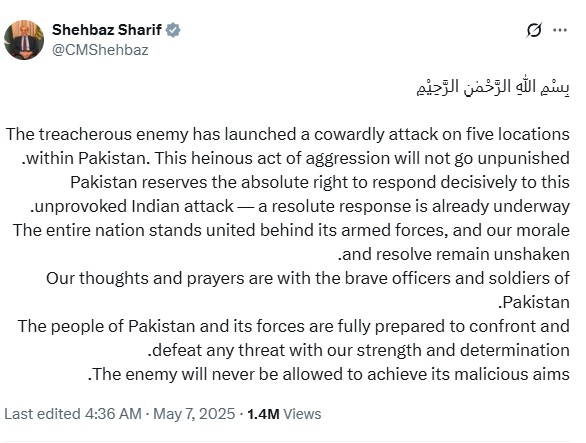
- Pakistan’s Prime Minister Shehbaz Sharif called the strikes an “act of war,” vowing a “befitting reply.”
- Indian National Security Advisor Ajit Doval briefed counterparts in the US, UK, Saudi Arabia, UAE, and Russia, emphasizing India’s restrained approach.
- May 7, 2025 (Morning and Daytime)
- Post-Strike Retaliation: Pakistan intensified artillery shelling along the LoC, targeting Indian sectors in Poonch, Rajouri, Uri, and Tangdhar. The shelling caused eight civilian casualties and injured two Jammu and Kashmir police personnel.
- Indian Response: The Indian Army retaliated proportionately, with cross-border shelling reported in Krishna Ghati, Shahpur, Mankote (Poonch), and Laam, Manjakote, Gambeer Brahmana (Rajouri).
- Security Measures in India:
- All educational institutions in Jammu, Samba, Kathua, Rajouri, and Poonch were closed, with Pathankot schools shut for 72 hours. Srinagar, Jammu, Leh, Dharamshala, and Amritsar airports suspended operations.
- The Ministry of Home Affairs ordered nationwide civil defense mock drills in 244 districts, the first since 1971, to prepare for potential hostile attacks.
- Press Briefings:
- International Reactions:
- US Secretary of State Marco Rubio and President Donald Trump called for de-escalation, with Trump describing the strikes as a “shame.”
- The UN Security Council held closed-door consultations, with envoys urging dialogue, though no statement was issued. Pakistan claimed its objectives were “largely served.”

Indian Air Force: Missiles and Military Technology

Rafale Jets
- Overview: The Dassault Rafale is a 4.5-generation, multi-role fighter jet, inducted into the IAF in 2020 as part of a €7.8 billion deal with France for 36 aircraft. By 2025, these jets were fully integrated into IAF squadrons, with an additional order for 26 Rafale-Marine variants for the Indian Navy signed in April 2025.
- Capabilities:
- Equipped with advanced avionics, including the Spectra Electronic Warfare (EW) suite, which provides radar jamming and missile threat detection, enhancing survivability against air defenses.
- Features the MICA (IR and EM variants) and Meteor beyond-visual-range (BVR) air-to-air missiles, with Meteor offering a range of over 150 km, giving the IAF an edge in air superiority.
- Supports a wide range of air-to-ground munitions, including SCALP and AASM Hammer, integrated via the Mil-Std-1760 stores management system for seamless weapon deployment.
- Role in Operation Sindoor: Rafale jets executed precision strikes from Indian airspace, launching standoff weapons to avoid Pakistani air defenses. The operation targeted nine terror camps in Pakistan (Bahawalpur, Muridke, Sialkot, Barnala) and Pakistan-occupied Jammu and Kashmir (PoK) (Kotli, Muzaffarabad, Gulpur, Bhimber, Bagh).
SCALP (Storm Shadow) Missile
- Overview: The SCALP-EG (Système de Croisière Autonome à Longue Portée – Emploi Général), also known as Storm Shadow in British service, is a long-range, air-launched cruise missile developed by MBDA. It entered IAF service with the Rafale in 2020.
- Specifications:
- Range: Over 560 km (some sources claim 290–560 km depending on configuration).
- Speed: Subsonic, approximately Mach 0.8 (~980 km/h).
- Warhead: 450 kg BROACH (Bomb Royal Ordnance Augmented Charge), designed to penetrate hardened targets like bunkers and command centers before detonating.
- Guidance: Combines Inertial Navigation System (INS), GPS, and Terrain Reference Navigation (TRN) for low-altitude, terrain-hugging flight to evade radar. Near the target, an infrared (IR) sensor with an onboard image database ensures precision, with a final steep dive to minimize collateral damage.
- Stealth Features: Low-observable design reduces radar cross-section, enhancing survivability against air defenses.
- Role in Operation Sindoor:
- Used for deep strikes against high-value targets, such as Jaish-e-Mohammed (JeM) headquarters in Bahawalpur and Lashkar-e-Taiba (LeT) facilities in Muridke.
- Launched from Rafale jets in Indian airspace, likely from central India or near the LoC, to target sites up to 500–600 km away (e.g., Bahawalpur, ~600 km from New Delhi).
- Enabled precise hits on terror infrastructure without requiring aircraft to cross the border, reducing escalation risks.
- Strategic Impact:
- The SCALP’s long range and stealth allowed the IAF to strike strategic assets in Pakistan’s hinterland (e.g., ISI-linked facilities) while remaining outside the range of Pakistan’s HQ-9 air defense systems.
- Its precision minimized collateral damage, though Pakistani claims of civilian casualties (e.g., mosques in Bahawalpur) suggest contested outcomes.
AASM Hammer (Highly Agile Modular Munition Extended Range)
- Overview: The AASM (Armement Air-Sol Modulaire), also known as Hammer, is a French precision-guided munition developed by Safran Electronics & Defense. It is a modular kit fitted to standard bombs, enhancing their range and accuracy. Integrated with IAF Rafales and in the process of integration with the indigenous Tejas fighter by 2025.
- Specifications:
- Range: Up to 70 km when launched from high altitude, ~8 nm (15 km) from low altitude.
- Weight Classes: Compatible with bombs of 125 kg, 250 kg, 500 kg, or 1,000 kg (primarily 250 kg used by IAF).
- Guidance Variants:
- Propulsion: Rocket booster and winglets for extended range and maneuverability.
- Features:
- Role in Operation Sindoor:
- Used for medium-range precision strikes against terror camps, particularly fortified positions in PoK (e.g., Kotli, Gulpur) and Pakistan (e.g., Sialkot).
- The Hammer’s versatility allowed targeting of both static infrastructure (e.g., training camps) and potentially moving targets (e.g., terrorist convoys), with laser-guided variants likely used in dynamic scenarios.
- Launched from Rafales at standoff distances, keeping aircraft beyond the range of Pakistan’s short-range air defenses like the FM-90 (15 km range).
- Strategic Impact:
- The Hammer’s modular design provided flexibility across diverse terrains (e.g., mountainous PoK), enhancing the IAF’s ability to destroy hardened targets with minimal collateral damage.
- Its combat-proven 99% success rate (demonstrated in Afghanistan and Libya) underscores its reliability, though Pakistani claims of civilian casualties suggest challenges in urban or mixed environments.
Additional Technology: Kamikaze Drones (Loitering Munitions)
- Overview: Operation Sindoor also employed loitering munitions, referred to as kamikaze drones, to target terror camps in PoK, aimed at eliminating JeM and LeT leadership.
- Capabilities:
- These drones can loiter over a target area, providing real-time surveillance and precision strikes with onboard warheads.
- Likely included indigenous systems developed by DRDO or imported platforms, though specific models (e.g., Harop from Israel) were not confirmed.
- Role: Used for secondary strikes and damage assessment, enhancing the operation’s effectiveness by targeting high-value individuals or infrastructure missed by initial missile strikes.
- Strategic Impact: Loitering munitions reduced the need for manned missions, minimizing risks to IAF pilots and improving operational efficiency in low-intensity conflicts.
Supporting Systems
- Indian Navy and Army: The operation was a joint effort, with the Navy providing sea-borne support (possibly ISR or missile launches from ships) and the Army engaging ground-based targets along the LoC.
- Intelligence, Surveillance, and Reconnaissance (ISR): The IAF likely used platforms like the Netra AEW&C (Airborne Early Warning and Control) on Embraer ERJ 145 jets for real-time targeting and situational awareness.
- S-400 Air Defense System: Deployed along the LoC, the Russian-supplied S-400 provided a protective umbrella, capable of neutralizing Pakistani aircraft and missiles up to 400 km, deterring counter-strikes.
Pakistan’s Response: Heavy Artillery and Anti-Aircraft Defenses
Heavy Artillery
- Overview: Pakistan responded to Operation Sindoor with intense artillery shelling along the Line of Control (LoC), targeting Indian sectors in Poonch (Krishna Ghati, Shahpur, Mankote, Bhimber Gali), Rajouri (Laam, Manjakote, Gambeer Brahmana), Uri, and Tangdhar.
- Details:
- Strategic Intent:
- Impact:
Anti-Aircraft Defenses
- Overview: Pakistan’s air defense network includes a mix of Chinese, French, and US-supplied systems, designed to counter aircraft, drones, and cruise missiles. During Operation Sindoor, Pakistan reported 24 missile impacts but no successful interceptions, highlighting challenges against India’s standoff weapons.
- Key Systems:
- HQ-9A (Chinese): A long-range surface-to-air missile (SAM) system with a range of ~125 km, capable of engaging aircraft and cruise missiles at speeds up to Mach 4. It is Pakistan’s most advanced system but was ineffective against SCALP’s low-altitude, stealthy flight profile.
- HQ-16FE (Chinese): A medium-range SAM with a range of ~40 km, designed for aircraft and missiles. Its limited range and radar capabilities struggled against Rafale-launched munitions.
- FM-90 (Chinese): A short-range SAM with a 15 km range, effective against low-speed targets (up to Mach 1.2) but vulnerable to high-speed or standoff weapons like SCALP and Hammer.
- Crotale (French): A command-guided SAM with a range of ~11 km and a target speed limit of Mach 2.3. Its outdated technology was ineffective against modern munitions.
- MPQ-64 Sentinel (US): A radar system for target detection, supporting Pakistan’s air defense network but lacking the integration and range of India’s AESA-based radars (e.g., S-400’s multi-AESA suite).
- Response to Operation Sindoor:
- Pakistan declared an air emergency, closing major airports (Islamabad, Karachi) and suspending civilian flights, indicating heightened alertness.
- The Pakistan Air Force (PAF) deployed JF-17 Thunder and J-10CE fighters, armed with PL-15 (BVR, ~200 km range) and PL-10 missiles, for combat air patrols (CAPs) and potential counter-strikes.
- Pakistan moved radar and electronic warfare (EW) assets forward, supported by Saab Erieye 2000 AEW&C for early warning, but failed to intercept India’s missiles or drones.
- Claims of Indian Jet Losses:
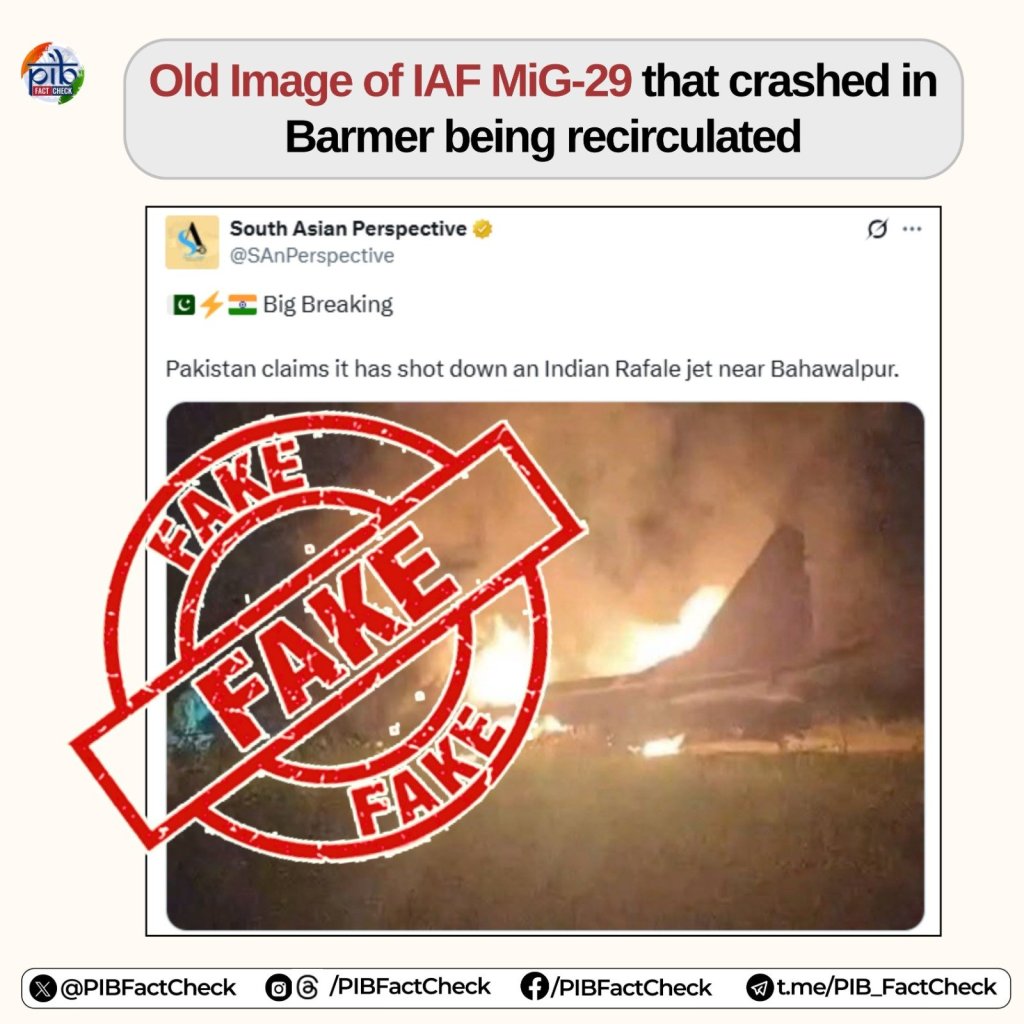
- Pakistani Narrative: Pakistan claimed to have downed five Indian jets, with one reportedly crashing near Pampore in Pulwama district, Indian-administered Kashmir, on May 7, 2025.
- Indian Narrative: India confirmed only three jets crashed on its side of the border, denying losses in Pakistani territory or PoK. The IAF stated no aircraft were lost to enemy action, attributing crashes to technical failures or friendly fire.
- Analysis:
- The discrepancy suggests propaganda efforts by both sides. Pakistan’s claim of five downed jets lacks independent verification, and the Pampore crash may involve misidentification (e.g., a drone or debris).
- India’s S-400 and SPYDER systems, capable of engaging targets at 400 km and 15–20 km respectively, would have deterred PAF jets from crossing the LoC, making aerial engagements unlikely.
Pakistan’s Air Force Assets
- JF-17 Thunder: A 4.5-generation fighter, comparable to India’s LCA Tejas Mk.1A, equipped with PL-15 BVR missiles. Used for CAPs and defensive counter-air missions but limited by shorter-range radars compared to Rafale’s AESA.
- J-10CE: China’s equivalent to the Rafale, armed with PL-15 and PL-10 missiles. At least 20 J-10CEs were in PAF service by 2025, providing a credible counter to India’s Rafales.
- F-16 Block 52+: Reportedly hidden in Balochistan to avoid India’s S-400 reach, indicating Pakistan’s caution against India’s air defense superiority.
- Strategic Constraints:
- Pakistan’s air defenses, reliant on Chinese technology (e.g., HQ-9, LY-80), lack the radar integration and range of India’s S-400 and Barak-8 systems.
- The PAF’s inability to intercept SCALP or Hammer suggests gaps in detecting low-altitude, stealthy munitions, exacerbated by the standoff ranges (70–560 km) of India’s weapons.
Discrepancies in Military Narratives
- Jet Losses:
- Pakistan’s Claim: Five Indian jets downed, including one near Pampore. This aligns with Pakistan’s narrative of a robust air defense response but lacks corroboration from neutral sources or imagery.
- India’s Claim: Three jets crashed on Indian soil due to non-combat causes (e.g., mechanical issues). India denies losses to Pakistani action, emphasizing the operation’s success in avoiding airspace violations.
- Critical Analysis:
- The Pampore crash claim may stem from misidentification of a drone, missile debris, or a training accident, as Pulwama is deep within Indian territory (~600 km from Pakistan’s border).
- Pakistan’s HQ-9 and HQ-16FE systems are not deployed near Pulwama, and their ranges (125 km and 40 km) cannot reach Indian-administered Kashmir from Pakistani territory.
- India’s S-400 and Rafale-Meteor combo would have neutralized PAF jets attempting cross-border engagements, making Pakistan’s claim improbable without evidence.
- Casualties and Damage:
- Pakistan’s Claim: Eight deaths (including civilians) and 22 injuries, with strikes hitting civilian targets like mosques in Bahawalpur and Muzaffarabad.
- India’s Claim: No civilian or military targets were hit; strikes were surgical, targeting only terror infrastructure.
- Analysis:
- The SCALP and Hammer’s precision (within 1–3 meters) supports India’s claim of minimal collateral damage, but urban targets (e.g., Muridke, 30 km from Lahore) increase risks of civilian impact.
- Pakistan’s civilian casualty claims may be exaggerated for propaganda, as no independent verification (e.g., satellite imagery) confirms mosque strikes.


Country and Organization Responses
United States
- Response:
- Diplomatic Calls for De-escalation: U.S. Secretary of State Marco Rubio urged both India and Pakistan to de-escalate tensions and cooperate against terrorism, emphasizing a “responsible solution” (April 30–May 7, 2025). Rubio spoke with Indian Foreign Minister Subrahmanyam Jaishankar, reaffirming U.S. support for India’s fight against terrorism, and with Pakistani officials, pressing for cooperation in investigating the Pahalgam attack.
- Support for India: Vice President J.D. Vance reiterated U.S. support for India post-Pahalgam, stating Washington would provide “all assistance” in the joint fight against terrorism. President Donald Trump, however, called India’s strikes a “shame” and expressed hope that hostilities would “end very quickly,” reflecting a mixed stance.
- UN Security Council Role: The U.S., as the penholder on counterterrorism, drafted a press statement on April 25, 2025, condemning the Pahalgam attack and reaffirming terrorism as a threat to global peace. The statement avoided naming TRF as the perpetrator at Pakistan’s request, supported by China, to achieve consensus.
- Motivations:
- The U.S. seeks to balance its strategic partnership with India, a key Indo-Pacific ally against China, with its need to engage Pakistan for counterterrorism and Afghanistan-related interests.
- Washington’s cautious mediation reflects awareness of nuclear risks, as highlighted in declassified U.S. intelligence from the 1980s–90s warning of potential nuclear escalation in India-Pakistan conflicts.
- Trump’s “peace broker” persona and domestic focus may limit U.S. willingness to deeply mediate, as noted by Foreign Policy, despite historical interventions (e.g., 1999 Kargil, 2019 Balakot).
- Implications:
China
- Response:
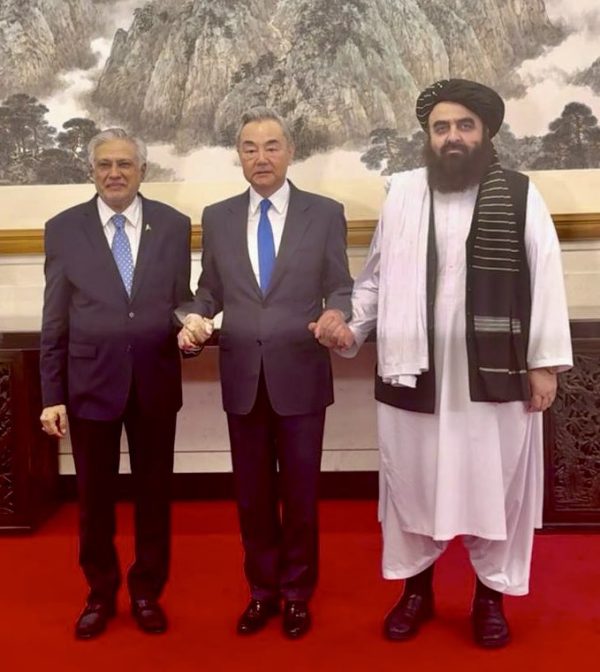
- Guarded Support for Pakistan: On April 27, 2025, Chinese Foreign Minister Wang Yi spoke with Pakistan’s Deputy Prime Minister Ishaq Dar, backing Pakistan’s call for an “impartial probe” into the Pahalgam attack. On May 2, Chinese Ambassador Jiang Zaidong met Prime Minister Shehbaz Sharif, emphasizing China’s support for Pakistan’s “legitimate security concerns” and urging restraint and dialogue.
- UNSC Influence: China supported Pakistan’s request to remove references to TRF in the UN Security Council’s April 25 press statement, ensuring a neutral tone.
- Measured Condemnation: China’s ambassador to India tweeted condolences for the Pahalgam attack, urging opposition to “all forms of terrorism,” but avoided explicit criticism of India.
- Motivations:
- China’s close alliance with Pakistan, cemented by the China-Pakistan Economic Corridor (CPEC), drives its support. A conflict risks disrupting CPEC projects, already threatened by Baloch militancy and attacks on Chinese nationals.
- Beijing seeks to counter India’s growing ties with the U.S. and Gulf nations, positioning itself as a mediator to enhance its South Asian influence.
- China’s restrained response reflects its improving ties with India post-2020 LAC disengagement and economic concerns, including U.S. tariffs under Trump, which make alienating India undesirable.
- Implications:
- China’s backing bolsters Pakistan’s diplomatic position but avoids escalation, prioritizing regional stability for CPEC and trade with India.
- The China-India-Pakistan nuclear trilemma complicates Beijing’s role, as India views China as a long-term nuclear rival, potentially escalating tensions if China’s support for Pakistan intensifies.
Organisation of Islamic Cooperation (OIC)
- Response:
- Limited Engagement: The OIC has not issued a strong condemnation of India’s actions or explicitly supported Pakistan, unlike its historical backing on Kashmir (e.g., pre-2020). Pakistan sought OIC support to highlight India’s “escalatory tactics,” but no significant statement emerged by May 7, 2025.
- Past Context: In 2020, the OIC refused Pakistan’s request to condemn India’s abrogation of Article 370, signaling a shift in Islamic nations’ stance due to India’s growing ties with Gulf countries.
- Motivations:
- The OIC’s muted response reflects the growing influence of Gulf nations like Saudi Arabia and the UAE, which prioritize economic and security ties with India over Pakistan’s Kashmir agenda.
- Pakistan’s declining leverage within the OIC, coupled with its internal challenges (e.g., economic strain, military unpopularity), limits its ability to rally Islamic support.
- Implications:
Saudi Arabia and United Arab Emirates (UAE)
- Response:
- Support for India: A joint India-Saudi Arabia statement post-Pahalgam condemned “all forms of violence, extremism, and targeting of civilians,” using strong language against terrorism. This marks a shift from Saudi Arabia’s historical support for Pakistan during the 1965 and 1971 wars.
- Neutral Stance: The UAE, alongside Saudi Arabia, has not explicitly criticized India’s strikes or endorsed Pakistan’s claims of civilian casualties. Both nations maintain silence on Operation Sindoor, focusing on broader counterterrorism cooperation with India.
- Motivations:
- India’s emergence as a lucrative investment destination and energy partner has deepened ties with Gulf nations. Saudi Arabia and the UAE view India as a strategic counterbalance to Iran and a key market for their sovereign wealth funds.
- Pakistan’s economic instability and reduced geopolitical clout diminish its appeal compared to India’s rising global influence.
- Implications:
Turkey
- Response:
- Active Support for Pakistan: On April 22, 2025, Prime Minister Shehbaz Sharif, visiting Ankara, thanked President Recep Tayyip Erdogan for Turkey’s “unwavering support” on Kashmir. On April 27, a Turkish Air Force C-130 landed in Karachi, followed by the Turkish naval ship TCG Buyukada docking at Karachi port, described as “goodwill gestures” but timed suspiciously post-Pahalgam.
- Military Cooperation: Reports suggest Turkey supplied weapons to Pakistan, reinforcing its military preparedness amid tensions with India.
- Motivations:
- Turkey’s support aligns with its ambition to lead the Islamic world and counter India’s influence, particularly after India’s abrogation of Article 370 in 2019, which Turkey vocally opposed.
- Ankara’s military and ideological alignment with Pakistan strengthens its South Asian foothold, balancing against India’s Gulf and U.S. ties.
- Implications:
Russia
- Response:
- Support for India: Russia pledged “full support” to India following Operation Sindoor, aligning with its historical alliance. Indian National Security Advisor Ajit Doval briefed Russian counterparts, emphasizing India’s restrained approach.
- Diplomatic Engagement: On April 28, Pakistan’s Ambassador to Russia, Muhammad Khalid Jamali, met Deputy Foreign Minister Andrey Rudenko, seeking Moscow’s support, but no public endorsement followed.
- Motivations:
- Russia’s strategic partnership with India, driven by defense cooperation (e.g., S-400 systems) and energy ties (discounted oil imports), outweighs its limited engagement with Pakistan.
- Moscow’s support counters China’s influence in South Asia and aligns with its rivalry with the West, viewing India as a key non-aligned partner.
- Implications:
United Nations and Other International Bodies
- Response:
- UN Security Council: On May 5, 2025, the UNSC held closed consultations at Pakistan’s request to discuss the India-Pakistan crisis. Assistant Secretary-General Mohamed Khaled Khiari briefed members, but no formal resolution or statement followed, reflecting divisions among members. The April 25 press statement condemned the Pahalgam attack but avoided attributing responsibility due to Pakistan-China objections.
- UN General Calls: UN Secretary-General António Guterres urged “maximum military restraint” on May 7, 2025, echoing earlier calls (April 25) for both sides to resolve issues diplomatically and avoid further deterioration.
- Iran’s Mediation Offer: On April 25, Iran proposed to mediate between India and Pakistan to de-escalate tensions, but no progress was reported.
- Motivations:
- The UN seeks to prevent nuclear escalation and maintain global stability, but its effectiveness is limited by veto powers (e.g., China supporting Pakistan, U.S./Russia backing India).
- Iran’s mediation offer aligns with its regional ambitions and desire to counter U.S. influence, but its limited clout with India reduces its impact.
- Implications:
Other Notable Actors
- Afghanistan:
- Response: Despite Pakistan’s historical support for the Taliban, Afghanistan condemned the Pahalgam attack, stating it undermines regional security, implicitly criticizing Pakistan.
- Motivations: The Taliban’s condemnation reflects strained ties with Pakistan due to cross-border militancy (e.g., TTP attacks) and Afghanistan’s desire for international legitimacy, even without India’s official recognition.
- Implications: Afghanistan’s stance further isolates Pakistan, highlighting its diminishing regional influence.
- United Kingdom:
- Response: British Foreign Secretary David Lammy spoke with Pakistan’s Ishaq Dar on April 27, 2025, but no public stance was articulated, suggesting a neutral approach. India briefed UK counterparts post-Sindoor, emphasizing restraint.
- Motivations: The UK balances historical ties with Pakistan and growing economic-security partnerships with India, avoiding entanglement in the conflict.
- Implications: The UK’s neutrality limits its role but maintains diplomatic flexibility with both nations.
Will Pakistan Retaliate, and How?
Likelihood of Retaliation
Pakistan is highly likely to retaliate due to a combination of strategic, political, and domestic pressures, though the scale and nature of the response will be shaped by its military and economic constraints. Key factors supporting this assessment include:
- Official Statements and Rhetoric:
- Pakistan’s Prime Minister Shehbaz Sharif labeled Operation Sindoor an “act of war,” vowing a “befitting reply” and asserting Pakistan’s right to a “strong response.”
- The Inter-Services Public Relations (ISPR), led by Lt. Gen. Ahmed Sharif Chaudhary, stated that the strikes “will not go unanswered” and that Pakistan would respond “at a time and place of its own choosing.”
- Defence Minister Khawaja Asif warned of “massive retaliation” but suggested restraint if India halts further actions, indicating a conditional but firm intent to respond.
- These statements reflect a need to project strength domestically and deter further Indian strikes, making retaliation almost inevitable to maintain credibility.
- Historical Precedent:
- Pakistan has consistently retaliated to Indian strikes, as seen in 2019 after the Balakot airstrike, when the Pakistan Air Force (PAF) conducted retaliatory raids, leading to an aerial dogfight and the capture of Indian pilot Wing Commander Abhinandan Varthaman.
- The 2016 surgical strikes and 2019 Balakot operation prompted cross-border shelling and diplomatic escalations, establishing a pattern of tit-for-tat responses.
- Operation Sindoor’s scale—targeting nine sites, including deep in Pakistan’s Punjab province (e.g., Bahawalpur, Muridke)—is larger than Balakot, increasing pressure for a significant counteraction.
- Domestic and Regional Pressures:
- Pakistan’s military, particularly the Inter-Services Intelligence (ISI) and Army, faces domestic scrutiny for failing to prevent India’s strikes, especially in Punjab, a politically sensitive region. X posts highlight public sentiment demanding a response, with some framing India’s actions as a “cowardly attack.”
- Pakistan’s alliance with China, which condemned India’s strikes as “regrettable,” adds expectations for a robust response to maintain regional credibility.
- Failure to retaliate risks signaling weakness to India and domestic audiences, potentially undermining the military’s dominance in Pakistani politics.
- Geopolitical Constraints:
- International calls for restraint from the U.S., UN, China, and UAE limit Pakistan’s room for overt escalation, as a disproportionate response could alienate allies and invite sanctions.
- Pakistan’s economic fragility—marked by high inflation, a weak rupee, and reliance on IMF bailouts—makes prolonged conflict unsustainable, pushing for a calculated rather than all-out response.
Conclusion
Pakistan’s leadership and military are under intense pressure to retaliate to restore deterrence and domestic legitimacy.
The conditional nature of Asif’s statement suggests a preference for de-escalation if India refrains from further strikes, but the scale of Operation Sindoor and public rhetoric make a response highly probable, likely within days or weeks to avoid appearing weak.



Leave a comment