
By Dr. Shubhda Chaudhary, MEI News, 12 May 2025

The Arabian Sea, a vital maritime corridor for global trade and energy supplies, has emerged as a flashpoint in the escalating tensions between India and Pakistan following India’s Operation Sindoor.
Launched on 7 May 2025, the operation was a response to a deadly militant attack in Pahalgam, Indian-administered Kashmir, which killed 26 civilians.
India accused Pakistan of supporting the attackers, prompting a series of missile strikes targeting alleged terrorist infrastructure. Pakistan retaliated with drone and missile attacks, and the Arabian Sea quickly became a theatre of military posturing, raising fears of a broader conflict between two nuclear-armed neighbours.
Military Escalation in the Arabian Sea
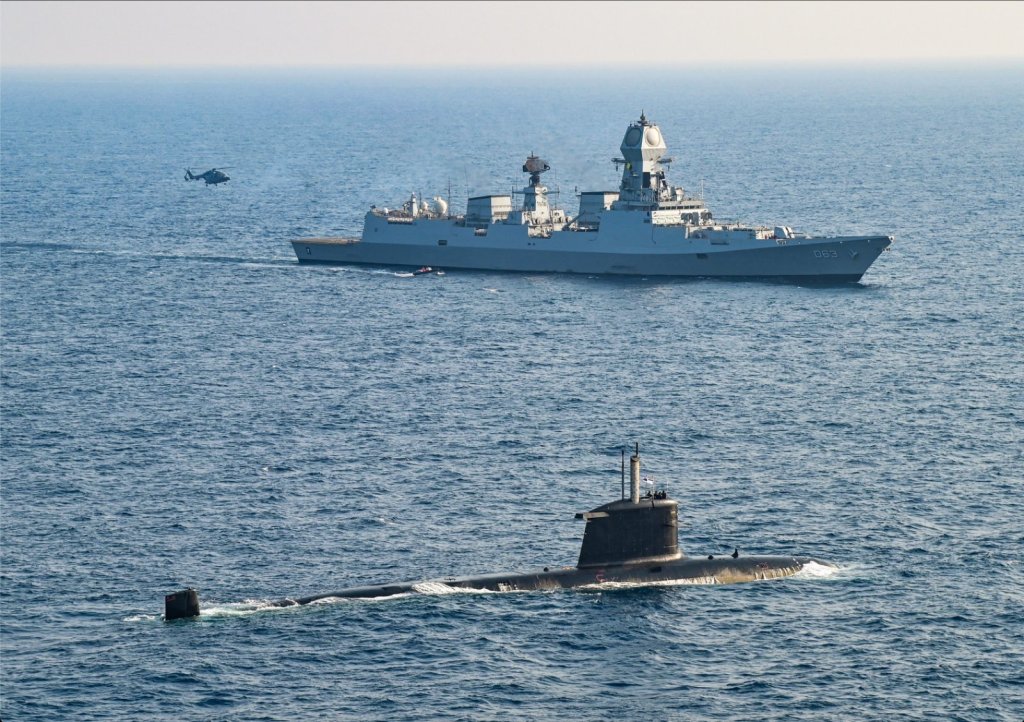
India’s Operation Sindoor marked a significant escalation, with the Indian Navy deploying advanced warships, including the INS Vikrant aircraft carrier and INS Kolkata destroyer, to conduct missile-firing drills in the Arabian Sea.
The Navy test-fired BrahMos supersonic cruise missiles, capable of striking targets 450km away, and medium-range surface-to-air missiles, showcasing its combat readiness.

Vice Admiral AN Pramod stated that the Navy’s forward deployment forced Pakistani naval units into a defensive posture, largely confined to their harbours.
Pakistan, meanwhile, conducted its own naval exercises in the northern Arabian Sea, issuing warnings to ships near its drill zones. The Pakistan Navy, bolstered by Chinese-supplied Type 054A/P frigates and plans for Yuan-class submarines, aimed to counter India’s maritime dominance. A Pakistani general claimed that India’s strikes avoided direct hits on military facilities, but border skirmishes and drone incursions intensified, with Pakistan reporting the downing of 12 Indian drones, including one near Lahore.
The Arabian Sea’s strategic importance lies in its proximity to key shipping routes and Pakistan’s ports, such as Karachi. India’s naval operations, conducted within its Exclusive Economic Zone (EEZ), were described as “focused, measured, and non-escalatory,” but their proximity to Pakistani waters—80-85 nautical miles from Pakistan’s drill zones—heightened tensions. Both navies have agreed to avoid major exercises in close proximity under past confidence-building measures, but these protocols frayed as each side accused the other of provocations.

Economic Implications
The Arabian Sea is a lifeline for global trade, with 30% of the world’s oil shipments passing through nearby routes like the Strait of Hormuz. The India-Pakistan conflict disrupted maritime activities, with India issuing warnings to ships to avoid its firing zones and Pakistan temporarily closing its airspace, affecting regional shipping. The suspension of bilateral trade agreements and the Indus Water Treaty, which governs shared river resources, further strained Pakistan’s economy, heavily reliant on Indus waters for agriculture.
Pakistan, already grappling with economic challenges, faces increased pressure. The World Bank has warned that Pakistan could face water scarcity by 2025, and the treaty’s suspension could exacerbate this crisis, potentially costing billions in agricultural losses. India, while economically stronger, risks disruptions to its western ports, such as Mumbai and Gujarat, which handle significant trade volumes. The Indian Premier League (IPL) and Pakistan Super League were suspended, reflecting the conflict’s ripple effects on commercial activities.
Global markets felt the strain, with oil prices rising 3% in early May 2025 due to fears of disruptions in the Arabian Sea. Analysts warn that prolonged conflict could spike energy costs and delay trade routes, impacting economies far beyond South Asia.
Arms Race and Nuclear Risks
Both nations’ military advancements have heightened the stakes.
India’s arsenal includes the BrahMos missile, Rafale fighter jets armed with SCALP missiles, and the S-400 air defence system, giving it a technological edge. Pakistan counters with Chinese J-10 jets, HQ-9 air defences, and a growing stockpile of 170 nuclear warheads, slightly outnumbering India’s 164. Both countries tested nuclear weapons in 1998, and their no-first-use policies (India’s now under review) offer little reassurance given the rapid escalation.
The Arabian Sea’s role as a nuclear theatre is particularly concerning. India’s nuclear-powered submarines and Pakistan’s planned Yuan-class submarines enhance their second-strike capabilities, making the sea a potential arena for deterrence or catastrophic miscalculation. A 2019 study estimated that a nuclear exchange could kill 50 million people and cause global food shortages, underscoring the stakes.
Geopolitical Dynamics
The conflict has drawn international attention, with the United States brokering a fragile ceasefire on 10 May 2025, effective from 5:00 PM IST. However, violations were reported hours later, with explosions in Srinagar and Jammu. US Secretary of State Marco Rubio engaged both Indian Prime Minister Narendra Modi and Pakistani Prime Minister Shehbaz Sharif, urging de-escalation. China, a key ally of Pakistan, has remained cautious, providing military support but avoiding direct involvement.
The Kashmir dispute, at the heart of the conflict, remains unresolved since the 1947 partition. India’s Operation Sindoor targeted alleged terrorist camps linked to Jaish-e-Mohammed and Lashkar-e-Taiba, groups Pakistan denies supporting. Pakistan’s Operation Bunyan al-Marsus retaliated against Indian military bases, marking the first drone battle between the two nations. The international community, led by the UN, has called for restraint, but diplomatic efforts are hampered by mutual distrust.
Humanitarian and Social Impact
The conflict has displaced thousands along the Line of Control (LoC), with tourists and villagers fleeing border zones. In Kashmir, curfews and blackouts have disrupted daily life, while Pakistan reported 31 civilian deaths from Indian strikes, a claim India disputes. The psychological toll is significant, with residents in Srinagar and Jammu reporting fear amid nightly explosions.
Social media reflects polarized narratives. Pakistan’s declaration of a “Day of Gratitude” on 11 May sparked domestic celebrations but drew Indian criticism as provocative. These competing narratives complicate peace efforts.
What Next?
The ceasefire, already strained, hangs by a thread. Military experts warn that even a limited conflict risks escalation, given both nations’ advanced arsenals and nuclear capabilities. Economically, prolonged disruptions could cripple Pakistan’s fragile economy and strain India’s trade hubs. Diplomatically, the US and UN face an uphill battle to mediate between two rivals with a history of mistrust.
For now, the Arabian Sea remains a tense frontier, where naval drills and missile tests signal both deterrence and danger.
As one Indian officer told the BBC, “We are ready for peace, but prepared for war.” The world watches, hoping cooler heads prevail.



Leave a comment