

Sugandhi, MEI Platform, May 13, 2025
Democracy is often imagined as a grand staircase—each step forward marking progress, a climb toward freedom, justice, and representation. But what happens when the ascent is interrupted—when a nation stumbles backward, slipping into old patterns of control?
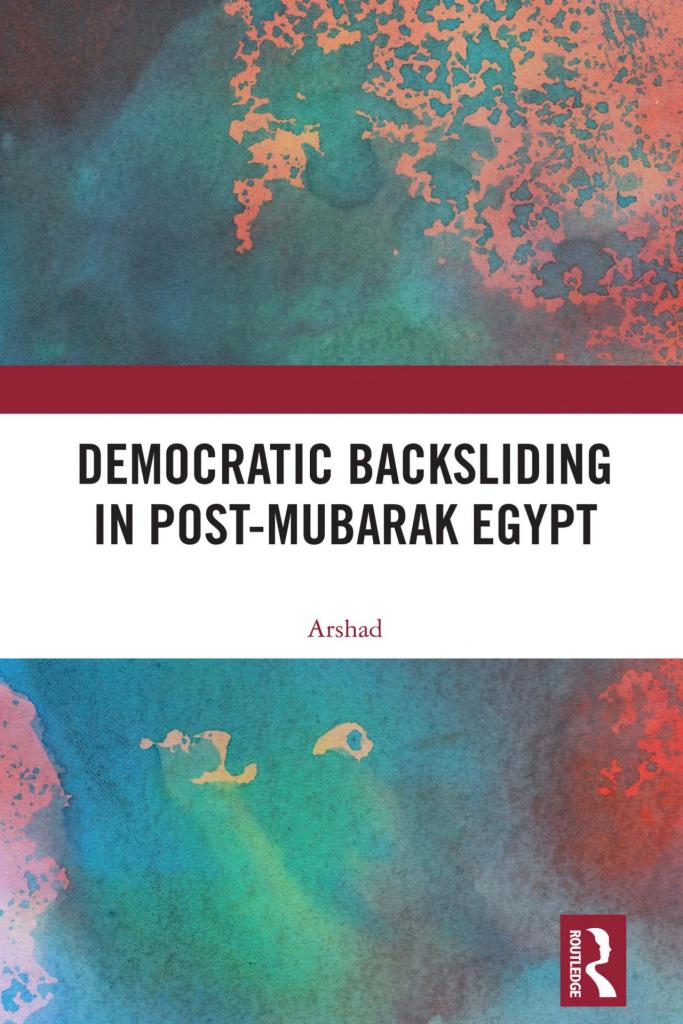
Democratic Backsliding in Post-Mubarak Egypt by Dr. Arshad meticulously explains this phenomenon, illustrating how, after the Arab Spring protests and the arrival of democratic promises, Egypt faltered in its process of democratic transition.
Using a robust theoretical framework grounded in the concept of transitology, the author analyzes the stages of transition from an authoritarian state to a democracy.
He critiques the teleological approach of transitology—which presumes all transitions naturally lead to democracy—arguing instead for an open-ended transformation.
The book emphasizes the importance of both structural and agential factors in shaping democratic outcomes. Citing thinkers like Samuel Huntington, who famously asserted that “history is not unidirectional,” Arshad explains that when democratic transition fails to reach its final stage—democratic consolidation—the result is democratic backsliding.
The book thoroughly examines both structural and agency-centered factors, seeking to determine the role of the latter—particularly civilian and political elites—in Egypt’s democratic regression.
It poses a crucial question: Was Egypt’s backsliding the result of structural impediments (such as the military establishment) or the failure of political agency?
Dr. Arshad contends that Egypt’s return to authoritarianism cannot be solely attributed to military intervention. Rather, civilian and political failures were equally culpable. While political structures and social conditions undeniably influence transitions, the author asserts that leadership choices and political agency can significantly shape outcomes. By scrutinizing the behaviors, attitudes, and decisions of political actors, the book highlights how these factors ultimately undermined Egypt’s democratic experiment.
Breaking Down the Backslide
The book is structured into three key themes:
Theme 1: Military Establishment in Egypt
This chapter explores the entrenched role of the military in Egypt’s political and economic life, portraying Egypt as a “praetorian state” since the Free Officers’ Coup of 1952.
From Nasser’s personalized rule to Sadat’s corporate praetorianism and Mubarak’s calibrated control, the military has remained central.
The chapter analyzes the evolution of the intelligence apparatus and military’s deep economic entanglements, emphasizing that even during moments of democratic opening, the military retained decisive power. It concludes that the military’s dominance critically obstructed Egypt’s democratic transition.
Chapter 2: Political Party System and Civil Society in Egypt
This chapter examines the historical trajectory and limitations of Egypt’s political parties and civil society under praetorianism. It traces how Nasser’s centralized control, Sadat’s Infitah policies, and Mubarak’s superficial reforms fostered a “liberalized autocracy” rather than genuine pluralism.
The chapter discusses the Muslim Brotherhood’s ascendancy, the marginalization of secular-liberal groups, and the post-Arab Spring polarization. It argues that a fragmented opposition and weak civil society further undermined democratic transition, enabling the military to reassert control.
Chapter 3: Role of President Mohammed Morsi in Political Transition
This chapter focuses on political agency, analyzing the role of President Mohammed Morsi within the constraints of Egypt’s political structure.
It narrates Morsi’s rise—despite the Muslim Brotherhood’s initial reluctance—and examines his controversial decisions, including constitutional decrees that shielded his authority from judicial oversight and his appointments favoring Brotherhood loyalists.
The chapter evaluates Morsi’s governance across domestic, economic, and foreign policy arenas, highlighting his failure to bridge societal divides and effectively govern. His inability to navigate Egypt’s complex political landscape ultimately led to his ouster and contributed to the collapse of the democratic transition.
Reflections on Reversal
The concluding sections of the book analyze the consequences of Egypt’s reversion to authoritarianism. The author offers a critical appraisal of the 2014 Constitution, which entrenched military authority, restricted political dissent, curtailed media freedom, and weakened civil society.
The narrative illustrates how Egypt’s democratic hopes were systematically dismantled through both internal fractures and external influences.
The book also addresses the structural weaknesses of the revolution itself—for example, the sequencing of elections before constitution-making. This evokes Fareed Zakaria’s poignant question: Should democracy come before liberalism, or vice versa?
One of the book’s major strengths is its integrated theoretical approach.
By combining structural and agential perspectives, Arshad convincingly argues that democratic backsliding results not only from institutional fragility but also from elite decision-making.
The historical context enriches the analysis, showing how Egypt’s political culture has long been shaped by militarized governance. Moreover, the book assesses the role of external actors such as the United States, Gulf states, and international organizations, providing further depth. It also critiques the West’s inconsistent commitment to democratization, exposing how strategic interests often override democratic ideals.
However, the book could have explored more deeply why many citizens and activists opted to support a return to military rule over continued Islamist governance—especially after initially opposing authoritarianism. The public’s response to Al-Sisi’s rise and the subsequent suppression of dissent deserves greater attention.
Conclusion
Democratic Backsliding in Post-Mubarak Egypt is a compelling and essential read for scholars of Middle East and North African politics, democratization studies, and civil-military relations.
Dr. Arshad presents a balanced, well-researched account of why Egypt’s democratic transition faltered and how authoritarian institutions reclaimed power.
When placed alongside other works—such as Marc Lynch’s The New Arab Wars, which offers a regional view of post-Arab Spring turmoil—this book stands out for its singular focus on Egypt’s internal political dynamics. It offers a rich, case-specific analysis that is crucial for understanding democratic erosion in transitional states.
For policymakers, academics, and students, it is a timely and valuable contribution to the study of democracy’s fragility in the modern Middle East.
INFORMATION ABOUT THE BOOK
ISBN: 978-1-032-79255-2 (hbk) | 978-1-032-79256-9 (pb) | 978-1-003-49121-7 (ebk)
DOI: 10.4324/9781003491217
Author: Dr. Arshad, Research Fellow at the Indian Council of World Affairs
Publisher: Routledge (Taylor and Francis Group), 2025




Leave a comment