
By Dr. Shubhda Chaudhary, MEI NEWS
13 May 2025
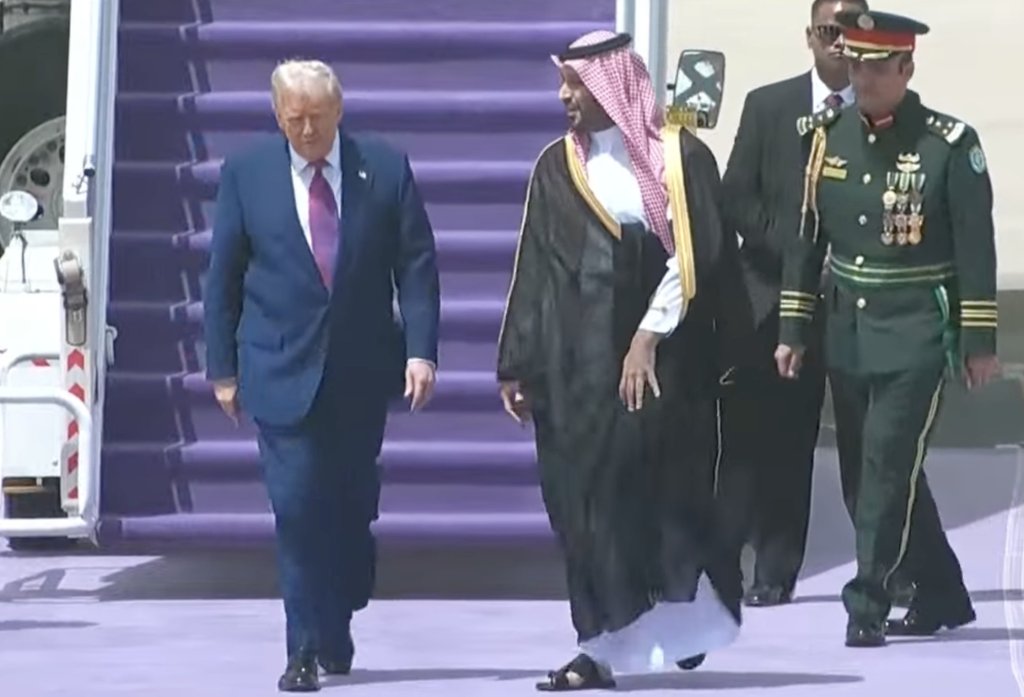
As US President Donald Trump lands in Riyadh today, kicking off a three-day tour of the Gulf, the visit signals a return to his trademark deal-making diplomacy.
The itinerary—Saudi Arabia, Qatar, and the United Arab Emirates (UAE)—highlights the region’s growing economic and geopolitical clout. But with Middle East tensions simmering and Trump’s “America First” agenda in sharp focus, what can we expect from this high-stakes trip?
A Focus on Economic Wins
Trump’s visit is framed as an economic mission, with the president aiming to secure billions—if not trillions—in Gulf investments for the US economy.
Saudi Arabia has already pledged $600 billion over four years, while the UAE has committed to $1.4 trillion over a decade.
A Saudi-US investment forum in Riyadh today, attended by CEOs from BlackRock, Alphabet, and IBM, is expected to yield announcements in energy, technology, and manufacturing.
Artificial intelligence (AI) is a key talking point.
The UAE and Saudi Arabia, keen to diversify from oil, are investing heavily in tech. Trump is likely to push for Gulf funding into US AI firms while offering access to advanced American semiconductors. Saudi Arabia may also seek progress on a civilian nuclear programme, a long-standing ambition no longer tied to normalising ties with Israel, according to reports.
Arms deals are another priority. Saudi Arabia is eyeing a $100 billion-plus package, with assurances of a streamlined US procurement process for military equipment. These deals align with Trump’s goal of boosting US jobs and manufacturing, but they also raise questions about regional stability amid ongoing conflicts.
Geopolitical Tensions in the Background
While business dominates the agenda, the Gulf’s volatile geopolitics cannot be ignored.
The Israel-Gaza conflict looms large, with Saudi Arabia insisting on a clear path to a two-state solution before considering normalisation with Israel.
Trump’s decision to exclude Israel from this trip—a departure from his 2017 visit—suggests a pragmatic focus on achievable outcomes.
Iran is another flashpoint.
Trump’s team is engaged in indirect nuclear talks with Tehran, quietly supported by Saudi Arabia and the UAE. However, Trump’s reported plan to rename the Persian Gulf the “Arabian Gulf” during this trip has sparked outrage in Iran, with Foreign Minister Abbas Araghchi calling it “hostile intent.”
Such a move could complicate delicate negotiations and inflame regional rivalries, though Gulf leaders are likely to welcome it.
Syria’s post-Assad transition is also on the table.
Gulf states, particularly Saudi Arabia, are leading outreach to Syria’s interim president, Ahmed al-Sharaa, offering reconstruction aid. They will likely press Trump to ease US sanctions on Syria to support redevelopment, a move that could counter Iran and Russia’s influence.
Oil Prices and Global Markets
With oil prices sliding towards $60 per barrel after OPEC+ increased production, energy talks will be critical.
Trump, who has linked high US inflation to costly oil, is expected to urge Saudi Arabia to pump more to lower prices for American consumers.
However, Saudi Arabia’s ambitious domestic projects rely on higher oil revenues, creating a delicate balancing act. Discussions may also touch on renewables, as Gulf states invest in green energy.
Trump’s recent tariffs, which have disrupted global trade and contributed to a US economic contraction in early 2025, will cast a shadow. Gulf states, largely unaffected by these tariffs, may seek exemptions for aluminium and steel exports to the US.
A Transactional Approach
Trump’s Gulf visit reflects his transactional foreign policy, prioritising economic deals over traditional diplomacy. Unlike past US presidents who visited Canada or Europe first, Trump’s choice of the Gulf—echoing his 2017 trip—highlights its strategic importance and his personal comfort in the region.
Yet, this approach risks oversimplifying complex regional challenges.
Gulf leaders, wielding vast sovereign wealth funds, are not just economic partners but savvy geopolitical players. They will seek US assurances on security, particularly against Iran, and clarity on Washington’s role in a region courted by China and Russia.
Risks and Opportunities
The visit offers Trump a chance to project strength amid domestic economic woes and deliver on his “America First” promises.
But missteps—such as the Persian Gulf naming controversy or failure to address Gulf concerns on Gaza and Syria—could strain ties. Gulf leaders, wary of Trump’s unpredictable style, will be keen to avoid public embarrassment.
For the Gulf states, the visit is an opportunity to cement their global influence.
Saudi Arabia aims to strengthen its alliance with the US after strained Biden years, while Qatar and the UAE position themselves as mediators and tech hubs.
As Trump navigates opulent ceremonies and high-stakes summits, the world will watch whether his deal-driven vision can deliver strategic wins—or if regional complexities will overshadow his ambitions.
One thing is certain: in the Gulf, business and politics are inseparable, and this trip will test Trump’s ability to balance both



Leave a comment