
6 May 2025
US President Donald Trump has repeatedly claimed his administration brokered a “historic” ceasefire between India and Pakistan, crediting trade incentives and threats as key to halting the recent escalation.
The claims, made in speeches, social media posts, and interviews, have sparked debate, with India firmly denying any US mediation involving trade. So, what is the ground reality, and why is Trump so focused on this narrative?
The Ceasefire and Trump’s Claims
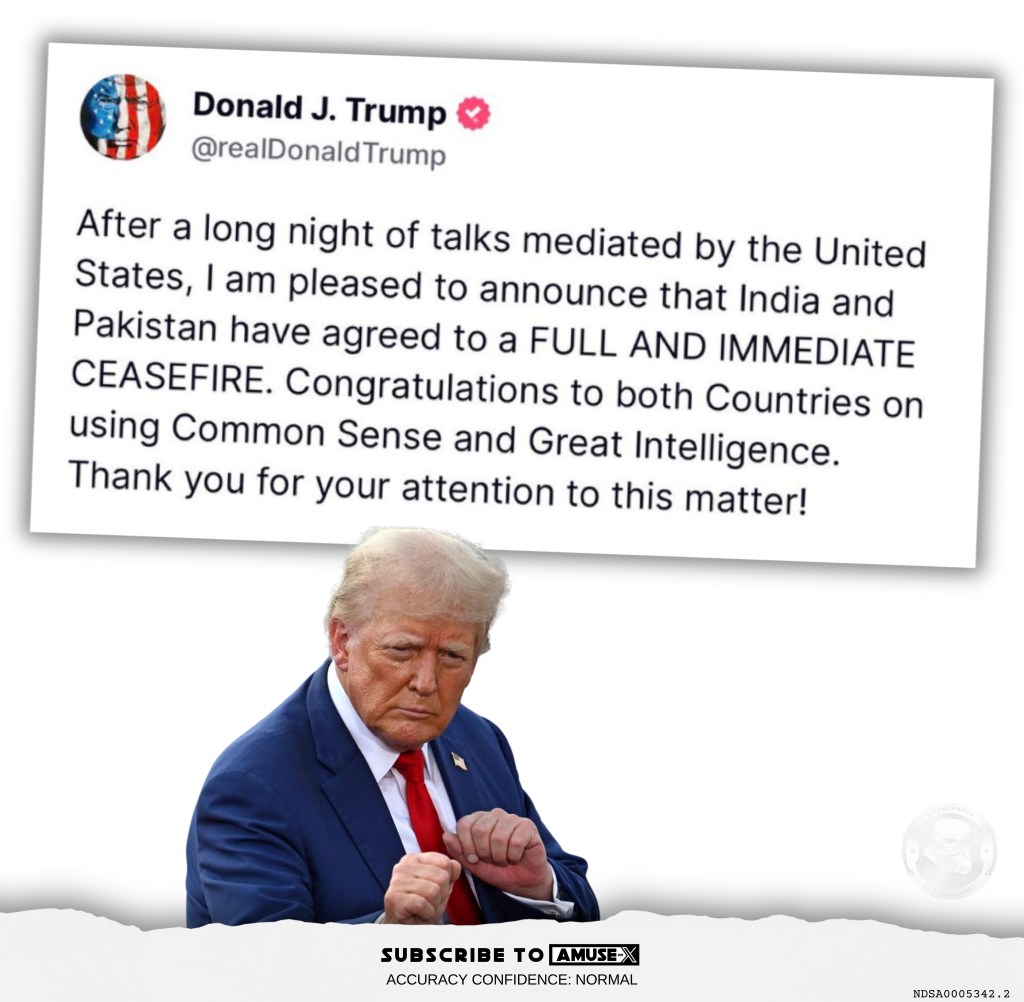
On 10 May 2025, Trump announced on Truth Social that India and Pakistan had agreed to a “full and immediate ceasefire” following US-mediated talks, describing it as a triumph of “common sense and great intelligence.” He later elaborated, stating he told both nations, “If you stop it, we’ll do trade. If you don’t stop it, we’re not going to do any trade,” suggesting trade leverage was pivotal. Speaking in Riyadh on 13 May, he reiterated that his administration averted a potential “nuclear war” that could have killed millions, praising the leadership of both countries.

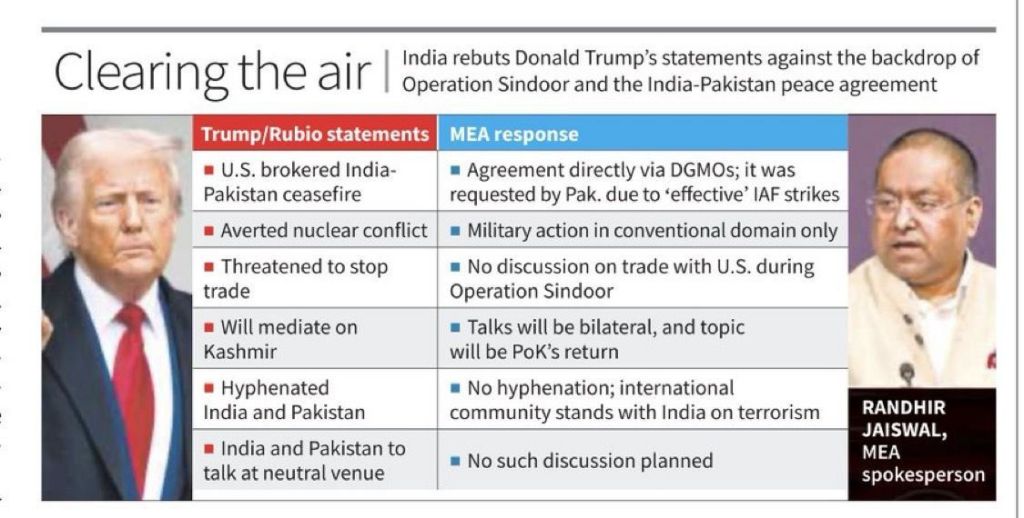
However, India’s Ministry of External Affairs (MEA) has consistently rebutted these claims.
Spokesperson Randhir Jaiswal stated that no trade discussions occurred during talks between Indian and US leaders, including Prime Minister Narendra Modi, Vice President JD Vance, and Secretary of State Marco Rubio. Instead, India maintains that the ceasefire was negotiated directly between the Directors General of Military Operations (DGMOs) of both countries on 10 May, following India’s Operation Sindoor—a response to a deadly attack on 22 April in Indian-administered Kashmir that killed 26 tourists.
Ground Reality: A Fragile Truce
The ceasefire followed four days of intense cross-border hostilities, the worst in decades, involving missile and drone strikes on military installations. India’s strikes targeted alleged militant bases in Pakistan, which Islamabad denied supporting.
Pakistan retaliated with its own operation, “Iron Wall,” and both sides accused each other of violations hours after the truce was announced. Residents in Indian-administered Kashmir reported explosions and drone activity overnight on 10 May, though no major casualties were reported by Sunday.
Analysts suggest the ceasefire is fragile. “It was cobbled together hastily when tensions were at their peak,” said Michael Kugelman, a South Asia expert at the Wilson Center in Washington. Both nations face domestic pressures: India to maintain a strong stance against terrorism, and Pakistan to address economic challenges and internal security threats. The ceasefire may serve as a face-saving measure, allowing India to claim a military victory and Pakistan to avoid further escalation against a stronger adversary.
India’s Restrained Response
India’s rejection of Trump’s claims has been firm but measured.
New Delhi has reiterated that the Kashmir issue is a bilateral matter, ruling out third-party mediation—a stance rooted in the 1972 Simla Agreement.
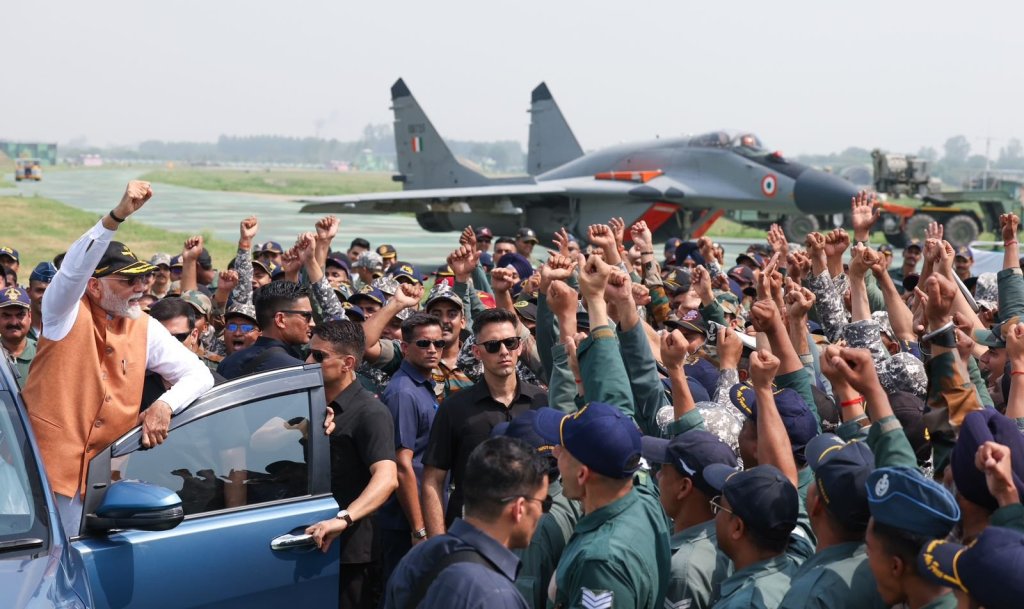
The MEA emphasized that the ceasefire resulted from direct DGMO talks, prompted by Pakistan’s request after India’s strikes on 10 May. Prime Minister Modi, speaking at an airbase in Adampur on 13 May, lauded India’s armed forces without acknowledging US involvement.
India’s restraint in criticizing Trump’s narrative may stem from diplomatic considerations.
The US is India’s largest trading partner, with bilateral trade reaching $130 billion (£98bn) in 2024. Modi’s government is negotiating a trade deal to avoid Trump’s proposed 10% tariffs on imports, which could impact India’s economy.
“Delhi is walking a tightrope,” said Kanwal Sibal, a former Indian foreign secretary. “It wants to maintain strong US ties for economic and strategic reasons, particularly against China, but it cannot appear to cede ground on Kashmir.”
Domestic politics also play a role.
The opposition Congress party has demanded clarity on whether India has “opened the door” to third-party mediation, a sensitive issue. Any perception that Modi’s government acquiesced to US pressure could invite criticism from nationalist voters, especially after Operation Sindoor was framed as a decisive response to terrorism.

American Interests in India and Pakistan
The US has strategic interests in both nations, but its priorities differ. India is a key partner in countering China’s influence in the Indo-Pacific, with initiatives like the Quad (US, India, Japan, Australia) central to Washington’s strategy. The US also values India’s growing market for trade and investment, particularly as companies shift manufacturing from China amid Trump’s tariff policies.
Pakistan, meanwhile, remains critical for its role in regional stability, particularly in Afghanistan and counterterrorism efforts. The US relies on Pakistan’s cooperation to manage Taliban dynamics and secure intelligence in the region. However, Pakistan’s economic woes and reliance on IMF loans make it more vulnerable to US influence, including trade concessions.
Trump’s emphasis on trade tariffs reflects his broader economic agenda.
In April 2025, he imposed a 10% tariff on most countries, later suspended, and has vowed to increase trade with both India and Pakistan post-ceasefire. This aligns with his “America First” policy, using trade as leverage to secure geopolitical wins. However, India’s denial of trade discussions suggests Trump’s narrative may be more about domestic optics than reality.
Why Trump’s Focus?
Trump’s repeated claims may serve multiple purposes.
Domestically, they bolster his image as a global peacemaker, a contrast to ongoing conflicts in Ukraine and Gaza where his administration has struggled to deliver results. The ceasefire announcement, made before India or Pakistan confirmed it, caught New Delhi off guard, suggesting an attempt to claim a quick foreign policy victory.
Analysts also point to Trump’s personal style. “He thrives on taking credit, even when the facts are murky,” said Christopher Clary, a South Asia expert at the Stimson Center.
By framing the ceasefire as a US triumph, Trump reinforces his narrative of decisive leadership, appealing to his base ahead of future political battles.
What Next?
The ceasefire’s longevity remains uncertain.
India’s suspension of the Indus Waters Treaty, a critical resource for Pakistan, and ongoing tensions over Kashmir could reignite hostilities. Trump’s offer to mediate on Kashmir, swiftly rejected by India, underscores the challenges of third-party involvement in a deeply bilateral dispute.
For now, both nations appear committed to de-escalation, but the underlying issues—terrorism, Kashmir, and regional rivalry—remain unresolved.
As Trump continues to tout his role, India and Pakistan will likely prioritize their own narratives, leaving the US president’s claims as a footnote in a complex geopolitical saga.



Leave a comment