
By MEI News Analysis
19 May 2025
The India-Pakistan conflict, reignited by the deadly terror attack in Pahalgam, Jammu and Kashmir, on April 22, 2025, which killed 26 civilians, has once again brought the volatile dynamics between these nuclear-armed neighbors into sharp focus.
The four-day escalation, marked by missile strikes and drone attacks, ended with a US-brokered ceasefire on May 10.
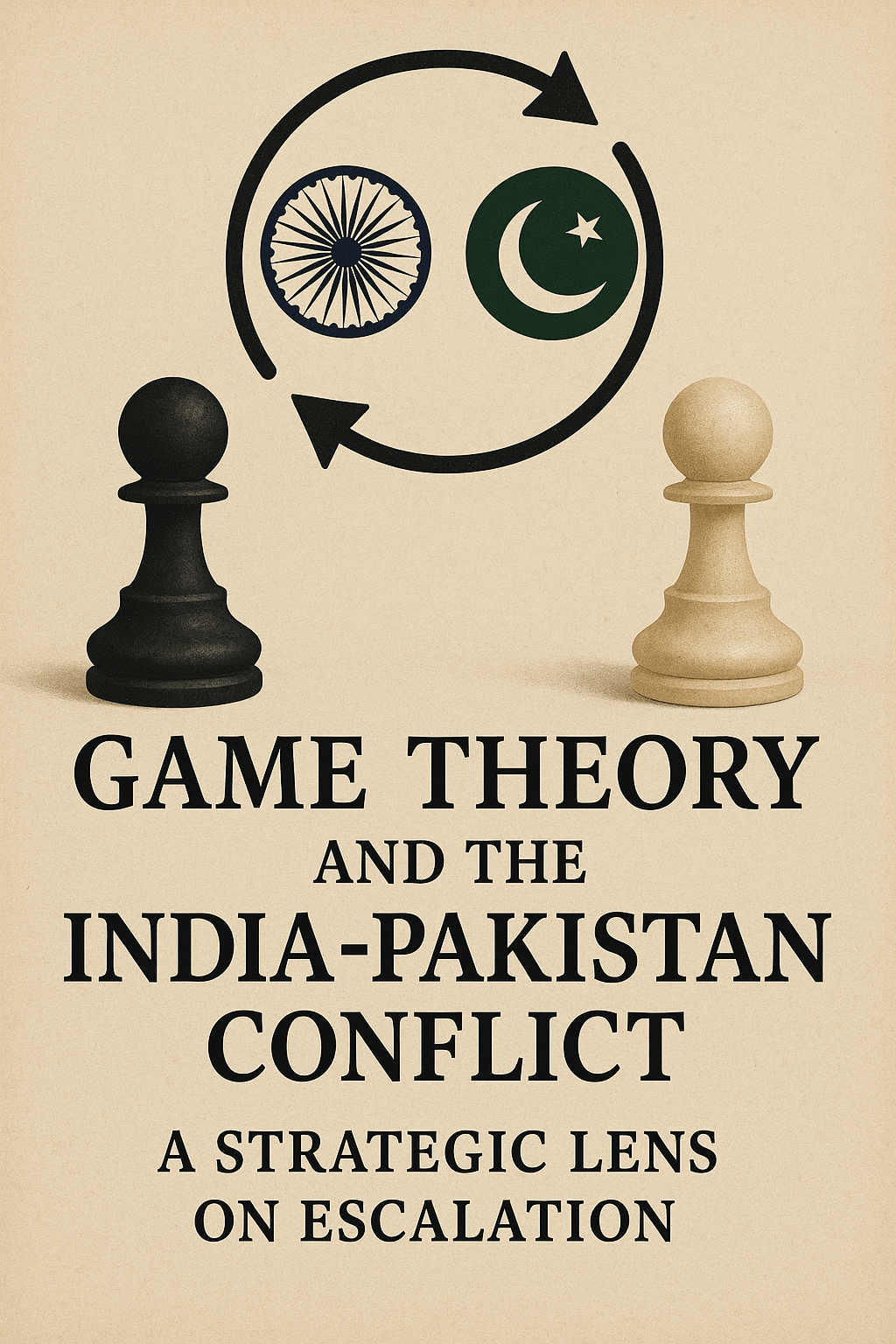
To understand why this conflict persists and how both nations navigate high-stakes brinkmanship, game theory—a mathematical framework for analyzing strategic interactions—provides critical insights into their decision-making processes.

What is Game Theory?
Game theory is a mathematical framework for analyzing strategic interactions between rational decision-makers, where the outcome for each depends on the choices of all. It studies how individuals, firms, or nations make decisions in situations of conflict or cooperation, assuming they aim to maximize their own benefits (or “payoffs”).
Key Concepts
- Players: The decision-makers (e.g., India and Pakistan in a conflict).
- Strategies: The possible actions each player can take (e.g., escalate, de-escalate, cooperate).
- Payoffs: The outcomes or rewards each player receives based on the combination of strategies chosen (e.g., political support, territorial control, economic costs).
- Rules: The structure of the interaction, including what players know and when they act.
Core Models
- Prisoner’s Dilemma: Players face a choice between cooperation and defection. Mutual cooperation yields moderate benefits, but distrust often leads to defection, resulting in worse outcomes for both. Example: India and Pakistan could benefit from peace but escalate due to mutual suspicion.
- Chicken Game: Players risk catastrophic outcomes (e.g., nuclear war) unless one “swerves” (backs down). It models brinkmanship, like military standoffs.
- Zero-Sum Game: One player’s gain is another’s loss, common in competitive scenarios like resource disputes.
- Repeated Games: Players interact multiple times, encouraging cooperation to avoid long-term losses, as seen in ongoing India-Pakistan ceasefires.
Types of Games
- Cooperative vs. Non-Cooperative: Cooperative games involve binding agreements (e.g., treaties); non-cooperative games assume no enforceable commitments.
- Simultaneous vs. Sequential: Players act at the same time (e.g., secret military plans) or in turn (e.g., retaliatory strikes).
- Perfect vs. Imperfect Information: Players know (or don’t know) others’ prior moves or intentions, like Pakistan’s uncertainty about India’s strike plans.
Applications to India-Pakistan Conflict
In the India-Pakistan context, game theory explains why both nations often choose escalation over cooperation. For instance, after the April 22, 2025, Pahalgam attack, India’s strikes (Operation Sindoor) and Pakistan’s retaliation reflect a tit-for-tat strategy in a Prisoner’s Dilemma.
Both could gain from de-escalation, but distrust and domestic pressures (payoffs like public support) drive conflict. Nuclear deterrence adds a Chicken Game dynamic, where both signal strength but avoid crossing catastrophic thresholds.
Real-World Relevance
Game theory extends beyond conflicts to economics (e.g., pricing wars), politics (e.g., voting strategies), and biology (e.g., animal behavior). It assumes rational actors but can account for imperfect information or bounded rationality, making it versatile for analyzing complex scenarios like Kashmir disputes or ceasefire negotiations.
The Game: Players, Strategies, and Payoffs
In the India-Pakistan conflict, the two nations are players in a repeated, non-cooperative game centered on the disputed region of Kashmir. Their strategies range from diplomacy and restraint to military escalation, with payoffs tied to domestic political support, international legitimacy, and territorial or strategic gains.
The recent escalation illustrates a tit-for-tat strategy, where India’s Operation Sindoor—targeting terrorist infrastructure in Pakistan—prompted retaliatory strikes from Islamabad.
India’s move, following the Pahalgam attack, aligns with a strategy of preemptive retaliation to deter future terrorism, which New Delhi attributes to Pakistan-based groups like Lashkar-e-Taiba. Prime Minister Narendra Modi’s warning of further strikes on “terrorist hideouts” signals a commitment to this approach, bolstered by domestic nationalist fervor.
Pakistan, denying involvement, countered with strikes on Indian military targets, framing its response as defensive while highlighting its nuclear capabilities to deter deeper Indian incursions.
This dynamic resembles the Prisoner’s Dilemma, where mutual cooperation (e.g., sustained ceasefire) could yield stability, but distrust drives both to defect (escalate), fearing the other will act first. The payoff matrix is skewed by asymmetric capabilities—India’s stronger conventional forces versus Pakistan’s nuclear signaling—and domestic pressures, where leaders face political costs for appearing weak.
Escalation and the Shadow of Nuclear Risk
Described as the most expansive in decades, the recent conflict saw India strike six Pakistani airfields, damaging runways and hangars, while Pakistan claimed to have shot down five Indian aircraft. Both sides’ narratives—India’s claim of degrading Pakistan’s capabilities and Pakistan’s assertion of effective defense—highlight a battle for perception, a key game-theoretical outcome. Yet, the proximity of strikes to sensitive sites, like Pakistan’s Nur Khan airbase near its nuclear planning body, raised fears of miscalculation spiraling into nuclear conflict.
Game theory suggests that nuclear deterrence relies on “credible threats.”
Pakistan’s defense minister, Khawaja Asif, emphasized restraint in not supporting terrorism, while implicitly leveraging nuclear signaling to cap escalation. India, aware of this “nuclear overhang,” calibrated its strikes to avoid crossing Pakistan’s red lines, though analysts warn that compressed decision timelines and advanced weaponry lower the threshold for future conflicts.
Ejaz Haider, a Lahore-based analyst, told the BBC that “strategic signaling” reminds the world of the stakes, but neither side is actively threatening nuclear use—yet.
The Role of External Players
The US-brokered ceasefire, announced by President Donald Trump on May 10, illustrates the influence of external actors in this game.
The US, acting as a mediator, altered the payoff structure by offering trade incentives for peace and threatening economic penalties for continued fighting.
This intervention reveals a multi-player game, where global powers like the US and China shape outcomes. China, for instance, benefited by testing military hardware and securing trade deals while India was distracted, highlighting how regional conflicts serve broader geopolitical strategies.
However, the ceasefire has not addressed underlying grievances, such as Kashmir’s status or mutual accusations of supporting insurgencies.
Praveen Donthi of the International Crisis Group notes that India and Pakistan are in “armed coexistence,” with little room for diplomacy and a high risk of accidental escalation.
The suspension of India’s water-sharing treaty and trade bans further entrench this stalemate, as both sides prioritize short-term domestic gains over long-term cooperation.
Information Warfare and Media Control
Game theory also explains the parallel battle over narratives.
India’s blocking of 8,000 X accounts, including those of BBC Urdu and critical journalists, aimed to control the information space and suppress dissent.
Pakistan, lifting its X ban during the crisis, sought to amplify its voice globally.
Both actions reflect strategies to maximize domestic support and international legitimacy, but they also fuel disinformation, as AI-generated content and restricted media access create a “fog of war.”
What Lies Ahead?
As of May 19, 2025, the ceasefire holds, but it remains a temporary pause, not a resolution.
Game theory suggests that repeated interactions could foster cooperation if trust is built, but the India-Pakistan game lacks robust mechanisms for de-escalation.
The 2003 ceasefire, largely effective until recently, shows that agreements are fragile without addressing root causes like Kashmir.
For now, both nations remain locked in a high-stakes game where the costs of miscalculation are unthinkable.
As Professor Manjari Chatterjee Miller notes, India’s triumphalism masks vulnerabilities exposed by Pakistan, while Islamabad’s defiance comes at the cost of international scrutiny over terrorism. The challenge lies in finding a path to cooperation in a game where neither side can afford to lose face—or trigger the ultimate escalation.”



Leave a comment