
Dr. Shubhda Chaudhary, May 22, 2025
The safety of diplomats and embassy staff is a cornerstone of international relations, enshrined in treaties like the Vienna Convention on Diplomatic Relations (1961).
However, recent events—such as the targeted killing of Israeli embassy workers Yaron Lischinsky and Sarah Milgrim in Washington, D.C., on May 21, 2025, and the Israeli military’s firing of warning shots at a diplomatic delegation near the Jenin refugee camp in the West Bank on the same day—raise serious questions about whether these protections hold in today’s polarized world.
This analysis explores both incidents, evaluates the risks to diplomatic personnel, and examines arguments from multiple perspectives to assess whether diplomats and embassy staff are truly safe.
Incident 1: Warning Shots at Jenin
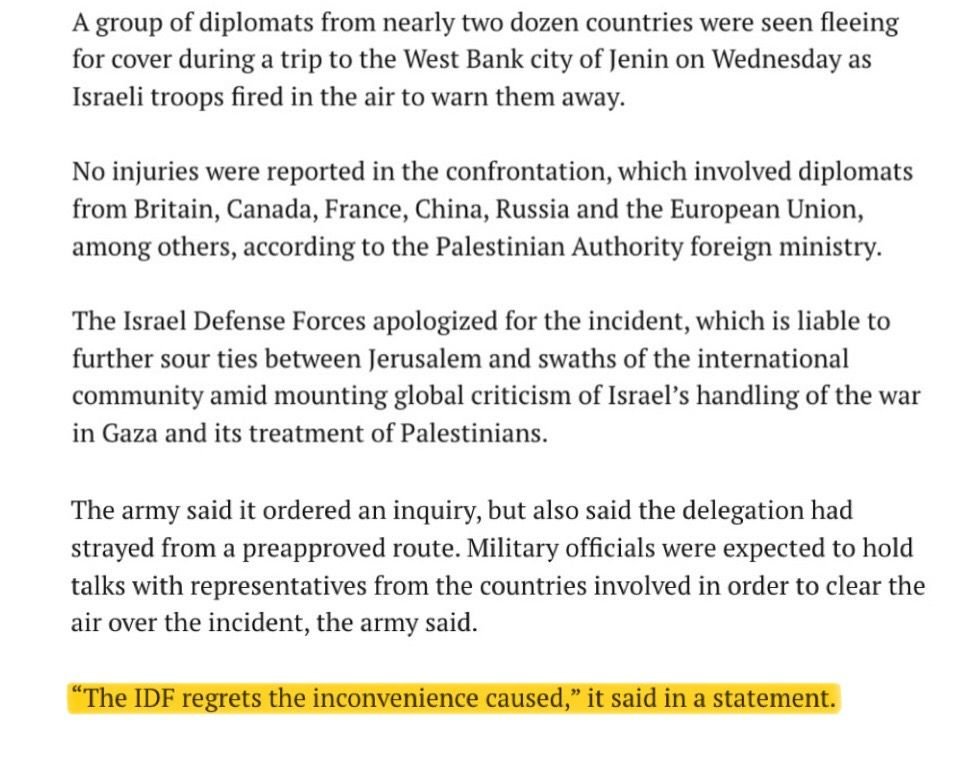
On May 21, 2025, Israeli Occupation Forces (IOF) fired warning shots at a delegation of approximately 35 diplomats from countries including the UK, Canada, France, Russia, and several EU and Arab nations near the Jenin refugee camp in the occupied West Bank.
The delegation was on an official mission to assess the humanitarian situation amid a large-scale Israeli military operation that began in January 2025. No injuries were reported, but the incident drew widespread international condemnation.
Context of the Incident
- Jenin Operation: Since January 21, 2025, the IOF has conducted a major operation in Jenin, Tulkarem, and Nur Shams, targeting Palestinian armed groups. The UN reports 40,000 residents displaced, over 100 buildings destroyed, and 124 Palestinians killed since the year began. The operation has intensified tensions, with accusations of mass displacement and home demolitions.
- Delegation’s Purpose: The diplomats, including representatives from Egypt, Jordan, Spain, and others, aimed to witness the humanitarian crisis firsthand. The Palestinian Authority’s Ministry of Foreign Affairs described the IOF’s actions as a “deliberate and unlawful act” to intimidate the delegation.
- Israeli Military’s Explanation: The Israel Defense Forces (IDF) claimed the delegation deviated from an approved route, entering an unauthorized area near a checkpoint. Warning shots were fired into the air to “distance” the group, with the IDF expressing “regret for the inconvenience” and promising an investigation.
- International Response: Countries like France, Spain, Canada, and Finland summoned Israeli ambassadors, demanding explanations. Canadian Prime Minister Mark Carney called the incident “totally unacceptable,” while the Palestinian Authority condemned it as a “heinous crime.”
Incident 2: The Washington, D.C. Shooting
Same day on May 21, 2025, Yaron Lischinsky, 28, and Sarah Milgrim, a Jewish American employee of the Israeli Embassy, were shot and killed at close range outside the Capital Jewish Museum in Washington, D.C., as they left an American Jewish Committee (AJC) Young Diplomats Reception.

The suspect, Elias Rodriguez, a 30-year-old from Chicago, allegedly shouted “Free, free Palestine” and “I did it for Gaza” after his arrest, with some reports indicating he also yelled, “There’s only one solution, Intifada revolution,” while pulling a red keffiyeh from his pocket.
Rodriguez, reportedly a member of the People’s Congress of Resistance and associated with the Party for Socialism and Liberation (PSL), a Marxist-Leninist group, had no prior police record in D.C. but was linked to a 2017 protest outside the home of then-Chicago Mayor Rahm Emanuel. The attack was widely condemned as an act of antisemitic terrorism by Israeli officials, U.S. leaders, and Jewish organizations.
Context of the Attack
- Event Details: The AJC’s Young Diplomats Reception, themed “Turning pain into purpose,” brought together Jewish professionals aged 22–45 and diplomats to discuss humanitarian responses in the Middle East. The museum, located near federal buildings, had recently received a security grant due to rising concerns about antisemitism.
- Victims: Lischinsky, who worked in the embassy’s political department, and Milgrim, his fiancée, were described as a couple planning to get engaged. Lischinsky had purchased a ring with plans to propose in Jerusalem the following week.
- Suspect’s Actions: Rodriguez was observed pacing outside the museum before approaching a group of four people, firing a handgun, and killing the couple. He then entered the museum, initially posing as a distressed bystander, before admitting to the crime and leading police to his discarded weapon.
- Official Reactions: Israeli Prime Minister Benjamin Netanyahu called it a “heinous act of antisemitic terrorism,” ordering increased security at Israeli missions worldwide. U.S. President Donald Trump condemned the attack as “obviously based on antisemitism,” and Attorney General Pam Bondi vowed to work with federal and local authorities. The FBI’s Joint Terrorism Task Force is investigating.
Are Diplomats and Embassy Staff Really Safe?
The Washington shooting and Jenin incident highlight significant risks to diplomatic personnel, driven by political polarization, ideological extremism, and military operations in conflict zones.
Washington Shooting: Targeted Violence
- Antisemitic Motive: The attack on Lischinsky and Milgrim was framed by Rodriguez’s pro-Palestinian slogans and reported ties to the People’s Congress of Resistance and PSL, suggesting ideological motivations. Israeli officials, including Netanyahu and Ambassador Danny Danon, labeled it antisemitic terrorism, pointing to a broader climate of “wild incitement” against Israel and Jewish communities.
- Vulnerability of Embassy Staff: The close-range shooting outside a cultural event reveals the exposure of embassy staff, even in secure capitals like Washington, D.C. The Capital Jewish Museum’s proximity to federal buildings did not prevent the attack, raising concerns about the adequacy of security for diplomatic personnel attending public events.
- Rising Antisemitism: The Capital Jewish Museum had recently received a security grant due to “scary incidents” and a “climate of antisemitism.” This incident follows a pattern of increasing threats to Jewish institutions and diplomats, exacerbated by tensions over the Israel-Palestine conflict.
- Global Implications: Netanyahu’s order to bolster security at Israeli missions worldwide reflects fears that such attacks could inspire copycat incidents, particularly in countries with strong pro-Palestinian sentiments or weak security infrastructure.
Jenin Incident: Risks in Conflict Zones
- Direct Threat to Diplomats: The firing of warning shots at a delegation of 35 diplomats, including senior envoys, indicates a disregard for diplomatic immunity in active conflict zones. The Palestinian Authority’s claim of deliberate targeting suggests a willingness to use force to deter international scrutiny. Rodriguez was detained by event security and led police to his weapon, indicating effective coordination between private security and law enforcement. D.C. Mayor Muriel Bowser and Homeland Security Secretary Kristi Noem confirmed no ongoing threat, suggesting the incident was contained.
- Escalating Tensions: The Jenin operation, described as one of the largest in the West Bank since January 2025, has heightened global criticism of Israel’s actions. Firing on diplomats risks alienating allies and escalating diplomatic fallout, as seen in the summoning of Israeli ambassadors by multiple nations.
- Precedent for Danger: Historical attacks on diplomats, such as the 2012 Benghazi attack on U.S. personnel, show that conflict zones pose unique risks. The Jenin incident, while non-lethal, reinforces the vulnerability of diplomats in areas of active military engagement.
Broader Context
- Polarization and Ideological Violence: The Washington attack reflects how global conflicts, particularly the Israel-Palestine issue, spill into Western capitals, fueling extremist actions. Rodriguez’s reported affiliations suggest that ideological groups may increasingly target diplomats to make political statements.
- Erosion of Diplomatic Norms: The Jenin incident suggests that even accredited delegations face risks when engaging with contested regions. The IDF’s justification (deviation from an approved route) raises questions about whether military priorities override diplomatic protections under international law.
Conclusion
The murder of Yaron Lischinsky and Sarah Milgrim and the warning shots fired at diplomats near Jenin highlight real threats to diplomatic safety, driven by ideological extremism and military operations in conflict zones. While the Washington attack reveals the risk of targeted violence in even the most secure capitals, the Jenin incident reveals the dangers of operating in active conflict areas.
However, robust legal frameworks, rapid law enforcement responses, and international cooperation provide significant protections, as seen in the U.S.’s handling of the shooting and the diplomatic channels addressing the Jenin incident.
Diplomats and embassy staff are not entirely safe—particularly in contexts of heightened political tension—but systemic safeguards and global norms still offer substantial security. The challenge lies in balancing diplomatic engagement with the realities of polarized conflicts, ensuring that protections evolve to meet emerging threats.
In the end, violence, wherever it occurs and to whomever it is directed, is not simply a political rupture—it is a wound in the moral fabric that binds us. It extinguishes not only lives, but also the possibilities they carried: of empathy, of coexistence, of reaching across the divides we are too often told are insurmountable.
When we kill, we betray not only justice, but the delicate promise of humanity itself.
Let us mourn this loss not with silence alone, but with resolve: to resist the pull of hatred, to reaffirm the dignity of every life, and to build—however slowly, however painfully—a world where the pursuit of peace is more dangerous than the pursuit of war no longer.



Leave a comment