Nestled at the mouth of the Kaladan River in Myanmar’s Rakhine State, Sittwe Port has emerged as a pivotal asset in India’s quest to bolster its strategic and economic presence in the Indo-Pacific.
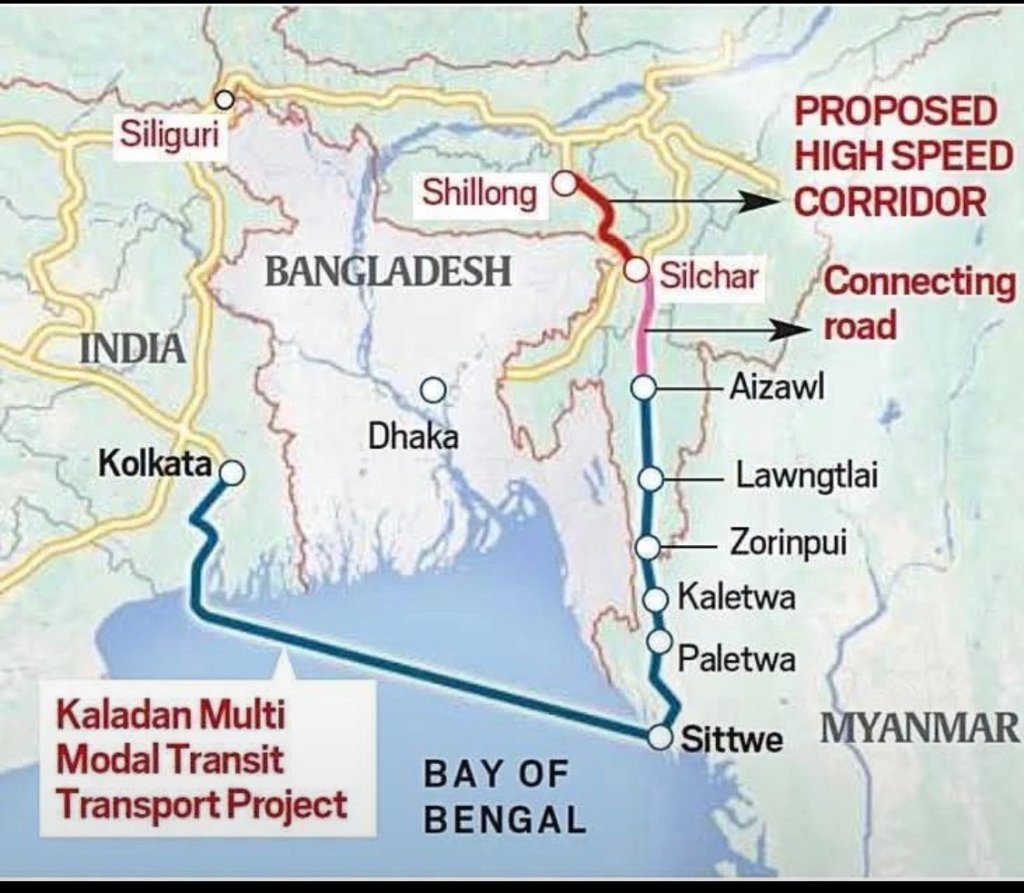
As a cornerstone of the $484 million Kaladan Multi-Modal Transit Transport Project (KMMTTP), the port connects India’s landlocked northeastern states to the Bay of Bengal, bypassing the vulnerable Siliguri Corridor, or “Chicken’s Neck.” Operational since May 2023, Sittwe Port is not just a trade conduit but a geopolitical linchpin, strengthening India-Myanmar relations and countering China’s expanding influence in the region. Yet, its success hinges on navigating Myanmar’s political turmoil and regional rivalries.
The Kaladan Project and Sittwe’s Role
The KMMTTP, launched in 2008, aims to create a multi-modal transport corridor linking Kolkata in eastern India to Sittwe Port via a 539 km sea route. From Sittwe, goods travel 158 km up the Kaladan River to Paletwa in Chin State by barge, then 108 km by road to Zorinpui on the India-Myanmar border, connecting to Mizoram. The project, funded by India’s Ministry of External Affairs, reduces the transport distance to India’s northeast by approximately 1,328 km compared to the Siliguri Corridor, cutting costs and time.
Sittwe Port, built with Indian assistance and managed by India Ports Global Ltd (IPGL) since April 2024, has handled over 109,000 tonnes of cargo, including cement, steel, and bricks, with Myanmar exporting rice, timber, and seafood.
The port’s capacity was upgraded in 2017 to handle 40,000-tonne vessels, doubling its previous limit. However, the final 108 km road from Paletwa to Zorinpui remains incomplete, delayed by Myanmar’s civil conflict and rugged terrain, with full operationalization now expected by late 2025.
India-Myanmar Relations: A Delicate Balance
India and Myanmar share a 1,643 km border, with ethnic and cultural ties binding Myanmar’s Rakhine and Chin States to India’s northeastern states like Mizoram and Manipur. The KMMTTP reflects India’s “Act East” policy, a proactive shift from the earlier “Look East” approach, aiming to deepen economic and strategic ties with Southeast Asia.
Since Myanmar’s 2021 military coup, India has maintained pragmatic engagement with the junta, including military cooperation to secure Sittwe Port, despite global criticism.
In 2020, Myanmar handed over 22 Indian insurgents to India, underscoring security collaboration. India has also invested $5 million annually since 2017 in Rakhine’s socio-economic development, including housing for displaced Rohingya, though this has sparked controversy given the junta’s role in the Rohingya crisis.
However, the Arakan Army (AA), which controls much of Rakhine, including Ponnagyun and Paletwa, poses a challenge. While the AA claims to support the KMMTTP, ongoing clashes with the junta and attacks near Sittwe have prompted India to relocate its consulate and issue safety advisories. India’s reluctance to engage directly with the AA, due to its insurgent status, complicates project security.
Strategic Importance in the Indo-Pacific
The Indo-Pacific, a geopolitical construct spanning the Indian and Pacific Oceans, has become a theater of competition between India, China, and other powers like Japan and the US.
For India, Sittwe Port, alongside the militarized Andaman and Nicobar Islands, strengthens its maritime influence in the Bay of Bengal, a critical node for trade and energy routes. The port’s proximity to China’s Kyaukpyu Port, 85 km south, part of the Belt and Road Initiative’s China-Myanmar Economic Corridor (CMEC), positions it as a counterweight to Beijing’s “String of Pearls” strategy, which includes ports like Hambantota and Djibouti.
Sittwe reduces India’s reliance on the Malacca Strait, a chokepoint where 80% of global oil trade passes, and enhances energy security through potential imports from Myanmar, such as power from the 1,800 MW Thathay Chaung Hydropower Project. It also aligns with regional frameworks like BIMSTEC and SAFTA, fostering trade integration.
Economic Gains for India’s Northeast
India’s northeastern states—Mizoram, Manipur, Nagaland, and others—are rich in biodiversity and hydropower but hampered by poor connectivity. The KMMTTP offers an alternative route to global markets, reducing transport costs and delays. The planned Sittwe Special Economic Zone (SEZ) at Ponnagyun, 60 km upstream, could attract investment, create jobs, and boost industries like agriculture and handicrafts. For instance, Tripura is developing links to Sittwe to export goods via the Kaladan River, potentially transforming local economies.
A proposed 166.8 km highway from Shillong to Silchar, extendable to Zorinpui, will further integrate the northeast with the KMMTTP, enhancing trade with Southeast Asia. In 2023, India allocated ₹1.76 lakh crore for northeastern connectivity projects, reflecting a commitment to regional development.
China’s Likely Response
China, with its $1.7 billion Kyaukpyu Port and CMEC, views Sittwe as a direct challenge.
Beijing may deepen its engagement with Myanmar’s junta or ethnic groups to secure its interests, as seen in its revival of Kyaukpyu in December 2023 after years of delays. China could also leverage its influence in Bangladesh, where relations with India have soured since the August 2024 fall of the Awami League, to disrupt alternative routes like the Agartala-Akhaura railway.
China sees Sittwe as a “checkmate” to its Indian Ocean ambitions, though these claims lack official confirmation.
Challenges and the Road Ahead
Sittwe’s potential is tempered by Myanmar’s instability.
The AA’s control over key KMMTTP routes and ongoing fighting risk further delays. Infrastructure gaps, such as the incomplete Paletwa-Zorinpui road, and irregular shipping schedules limit the port’s efficiency. Environmental concerns and local opposition in Rakhine, exacerbated by the Rohingya crisis, also demand careful management.
For India, Sittwe Port is a bold step toward regional leadership, but its success depends on diplomatic finesse and robust security measures.
As the Indo-Pacific becomes a battleground for influence, Sittwe stands as a testament to India’s ambition to reshape connectivity and counter China’s reach—provided it can navigate the turbulent waters of Myanmar’s conflict.



Leave a comment