
29 May 2025
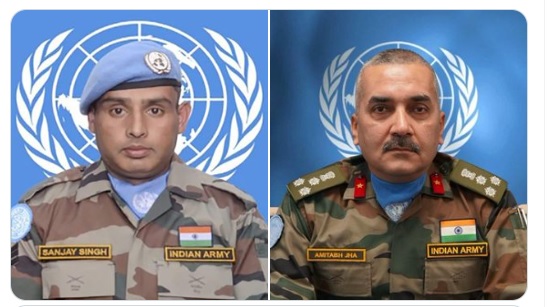
On the International Day of United Nations Peacekeepers, the UN will posthumously award the prestigious Dag Hammarskjöld Medal to two Indian peacekeepers, Brigadier Amitabh Jha and Havildar Sanjay Singh, in a solemn ceremony at its New York headquarters.
The event, marking the sacrifices of over 4,300 peacekeepers since 1948, reveals the vital yet perilous role of UN peacekeeping missions in conflict zones worldwide. The recognition of Jha and Singh highlights India’s longstanding commitment to global peace.

A Legacy of Service
Brigadier Amitabh Jha, who served as Deputy Force Commander and briefly as acting Force Commander of the United Nations Disengagement Observer Force (UNDOF) in the Golan Heights, was instrumental in overseeing ceasefire arrangements between Israel and Syria in a region fraught with tension since the Yom Kippur War. His leadership in this sensitive area was praised by UN Secretary-General António Guterres, who noted Jha’s “unwavering commitment” to peacekeeping, including his earlier role as a military observer in the Democratic Republic of Congo (DRC) from 2005 to 2006.
Havildar Sanjay Singh, deployed with the United Nations Stabilisation Mission in the Democratic Republic of Congo (MONUSCO), worked to stabilise conflict-affected regions in one of Africa’s most volatile areas. His efforts were part of India’s broader contribution to UN missions, which tackle complex challenges from armed insurgencies to humanitarian crises. Both peacekeepers lost their lives in 2024, joining the ranks of over 179 Indian personnel who have made the ultimate sacrifice since India began participating in UN peacekeeping in 1948.
India’s Pivotal Role
India stands as the fourth-largest contributor of uniformed personnel to UN peacekeeping, with over 5,300 troops and police currently deployed across missions in Abyei, the Central African Republic, the DRC, Lebanon, Somalia, South Sudan, and Western Sahara.
Since 1948, India has contributed over 200,000 personnel to 49 missions, a testament to its commitment to the UN’s mission of preventing conflict and fostering stability. The Indian Army marked the 77th International Day of UN Peacekeepers with a wreath-laying ceremony at the National War Memorial in New Delhi, led by Lieutenant General Rakesh Kapoor, reflecting the nation’s pride in its peacekeepers.
The posthumous honoring of Jha and Singh follows a tradition of recognizing Indian contributions. In 2023, three Indian peacekeepers, including two Border Security Force personnel, received the Dag Hammarskjöld Medal, and in 2024, Naik Dhananjay Kumar Singh was similarly honored for his service in MONUSCO. This consistent recognition reveals India’s role as a cornerstone of UN peacekeeping, symbolized by its emblem of crossed swords beneath the Ashoka Pillar and the motto “Satyameva Jayate” (Truth Alone Triumphs).
A Global and National Tribute
The posthumous recognition of Jha and Singh has resonated widely, reflecting national pride and solemnity.
In India, the ceremony coincides with domestic commemorations, including the Indian Army’s wreath-laying event, which underscores the personal and national significance of these losses.
For the families of Jha and Singh, the Dag Hammarskjöld Medal is a bittersweet acknowledgment of their loved ones’ courage.
For the international community, it is a reminder of the human cost of peace.
As the UN continues to navigate complex global conflicts, the sacrifices of peacekeepers like Jha and Singh remain a powerful symbol of hope and resilience—but also a call to ensure that their efforts are matched by robust support and clear strategies.
The legacy of these Indian peacekeepers, etched in the annals of UN history, reflects both the pride of a nation and the enduring challenge of securing peace in a fractured world.



Leave a comment