
By MEI News Analysis Team, 1 June 2025
The escalating tensions between Iran and Israel have brought their military capabilities into sharp focus, raising concerns about the potential for a broader conflict in the Middle East. Both nations possess sophisticated arsenals, with advanced missile systems, air defenses, and support from international suppliers.
This analysis examines their respective military equipment, the range and impact of their weaponry, the implications for the Iran-Iraq border, and the global actors supplying these capabilities, drawing on recent developments and expert insights.

Iran’s Military Arsenal
Iran’s military strategy emphasizes deterrence through a robust missile program, drones, and asymmetric warfare via proxy groups. Despite international sanctions, Iran has developed significant self-sufficiency in arms production since the Iran-Iraq War (1980–1988), when embargoes forced it to innovate domestically.
Ballistic Missiles
Iran’s ballistic missile arsenal is one of the largest in the Middle East, with over 3,000 missiles, according to US estimates. Key systems include:
- Shahab-3: A liquid-fueled, medium-range ballistic missile (MRBM) with a range of 1,000–2,000 km, capable of striking Israel from western Iran. Its variants, the Ghadr and Emad, offer improved accuracy (within 300 meters) and payloads of up to 1,200 kg. These are Iran’s workhorse MRBMs, capable of reaching all parts of Israel from within Iranian territory. Their relatively large payload capacity allows delivery of conventional or theoretical unconventional warheads. While not stealthy or highly mobile, their psychological and strategic impact remains significant, especially in Iran’s deterrence doctrine.
- Khorramshahr-4: A liquid-fueled MRBM with a 2,000 km range and a 2,000 kg warhead, designed for high-impact strikes. Originates from North Korea’s Musudan missile technology but extensively redesigned. Designed to deliver high-impact blows to hardened or strategic targets (e.g., military bases, command centers). Designed to evade modern missile defense systems such as Israel’s Arrow-3, by avoiding predictable ballistic paths.
- Fattah-1: Marketed as a hypersonic missile, with a 1,400 km range and speeds of Mach 13–15, it features a maneuverable reentry vehicle to evade defenses. Analysts question its operational readiness, as its use risks revealing capabilities to adversaries. Western analysts are skeptical of the operational readiness of Fattah-1, citing lack of credible testing, satellite imagery, and footage confirming maneuverability.
- Qasem Basir: A recently unveiled MRBM with a 1,200 km range, designed to target deep inside Israel.
These missiles are deployed from mobile launchers and silos, enhancing survivability. Iran’s Islamic Revolutionary Guard Corps (IRGC) controls most strategic missiles, with underground “missile megacities” ensuring rapid deployment.

Drones
Iran’s unmanned aerial vehicles (UAVs) are cost-effective and battle-tested, used by proxies like Hezbollah, Hamas, and the Houthis. The Shahed-136, a loitering munition with a 2,000 km range, costs $20,000–$50,000 per unit and is designed to overwhelm air defenses through swarm tactics. Iran has also supplied drones to Russia for use in Ukraine, demonstrating their global reach.

Air Defense Systems
Iran’s air defenses have been upgraded to counter Israeli and US airstrikes:
- Bavar-373: Iran’s flagship high-altitude system, comparable to Russia’s S-300, with a range of over 300 km.
- S-300: Four Russian-supplied batteries were reportedly damaged in Israeli strikes in October 2024, though Iran claims replacements are operational.
- 15-Khordad, Arman, and Tondar: Mid- and short-range systems for intercepting drones and missiles. The new 358 loitering missile targets low-altitude threats at 400 km.

Air and Naval Forces
Iran’s air force includes 336 combat-capable aircraft, such as MiG-29s and aging US-made F-5s, but maintenance issues limit effectiveness. The IRGC’s naval forces operate 17 tactical submarines, 68 patrol vessels, and seven corvettes, armed with anti-ship missiles like the C-802 and Tondar.
Proxy Forces
Iran’s “Axis of Resistance” includes Hezbollah in Lebanon, Shia militias in Iraq, and the Houthis in Yemen, all equipped with Iranian missiles and drones. These groups extend Iran’s reach, enabling attacks on US bases and Israeli targets without direct engagement.
Israel’s Military Arsenal
Israel’s military is the region’s most advanced, bolstered by significant US support, including $3 billion annually in aid and technical collaboration. Its focus is on precision strikes, air superiority, and multi-layered missile defense.
Ballistic Missiles
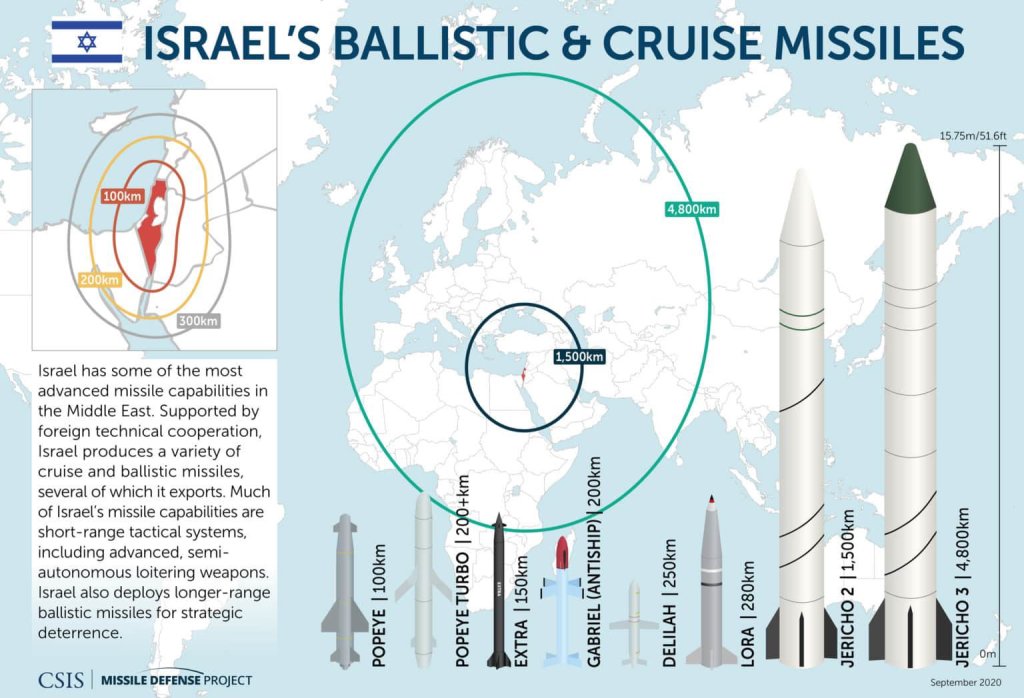
Israel’s missile arsenal is smaller but highly precise, with an estimated 90 nuclear warheads, though it maintains ambiguity about its nuclear capabilities. Key systems include:
- Jericho-3: An intermediate-range ballistic missile (IRBM) with a 4,800–6,500 km range, capable of reaching Iran.
- LORA: A short-range missile (280 km) for tactical strikes.
Air Defense Systems
Israel’s multi-layered air defense is among the world’s most effective:
- Iron Dome: Intercepts short-range rockets and missiles (up to 70 km), with a 90% success rate against Hamas and Hezbollah projectiles.
- Arrow 2 and Arrow 3: Designed for ballistic missiles, Arrow 2 operates within the atmosphere (56-mile range), while Arrow 3 uses hit-to-kill technology in space. Both were critical in intercepting Iran’s October 2024 missile barrage.
- David’s Sling: Targets mid-range threats (40–300 km), bridging Iron Dome and Arrow systems.
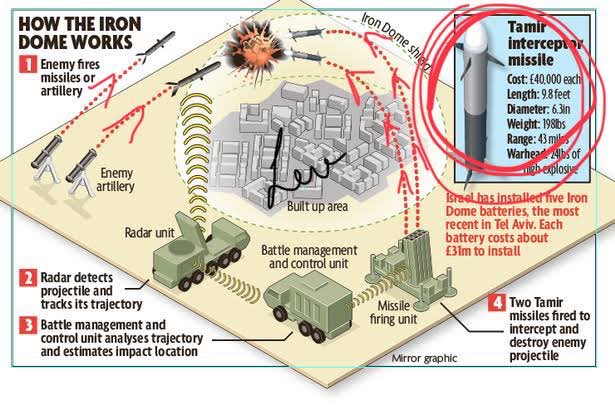
In April and October 2024, Israel, with US, UK, French, and Jordanian support, intercepted 99% of Iran’s drones and missiles, demonstrating robust coalition defense.

Air and Naval Forces
Israel’s air force boasts 345 combat-capable aircraft, including F-35 stealth fighters, and 43 attack helicopters like the Apache. Its navy includes five submarines and 49 patrol vessels, equipped for coastal defense and precision strikes.
Ground Forces
Israel’s army operates over 3,000 tanks, including the advanced Merkava MkIV, and 10,484 armored personnel carriers, providing significant ground superiority.
Range and Impact on the Iran-Iraq Border
Iran’s missiles, with ranges up to 2,000 km, can strike Israel from its western border with Iraq, approximately 700 km away. The Khorramshahr and Sejjil could target Tel Aviv or Jerusalem, while shorter-range Fateh-110 missiles (200–300 km) are suited for regional proxies like Iraqi militias. Israel’s Jericho-3 can reach Tehran, 1,500–2,000 km from Israel, enabling retaliatory strikes deep into Iran.
The Iran-Iraq border is a critical flashpoint.
Iran has used Iraqi territory to stage attacks, with missiles and drones launched from or through Iraq targeting Israel or US bases.
In 2022, Iran fired missiles at a US consulate in Erbil, Iraq, in retaliation for Israeli strikes on its drone facilities in Syria. Israeli airstrikes have targeted Iranian-backed militias in Iraq’s Albu Kamal region, near the Syrian border, to disrupt arms transfers to Hezbollah. These actions risk destabilizing Iraq, drawing it into a broader conflict, and straining its delicate balance between US and Iranian influence.
Suppliers and International Support
Iran’s Suppliers
Sanctions have limited Iran’s access to advanced weaponry, but it has secured support from:
- Russia: Supplies S-300 systems and may provide Su-35 jets and Iskander missiles. Iran’s drone exports to Russia for Ukraine have strengthened this partnership.
- China: Historically supplied anti-ship missiles like the C-801 and C-802 during the Iran-Iraq War. Recent reports suggest limited ongoing support, with China halting some missile sales in the 1990s under US pressure.
- North Korea: Provided Scud missile technology in the 1980s, forming the basis for Iran’s Shahab series.
Iran’s domestic industry, led by the IRGC, produces most of its missiles, drones, and air defense systems, reducing reliance on foreign suppliers.
Israel’s Suppliers
Israel’s arsenal is heavily supported by Western allies:
- United States: The primary supplier, providing $38 billion in military aid (2018–2028), including F-35s, bunker-busting bombs, and Arrow missile defense systems.
- Germany: Supplies components for air defense and communications, including 3,000 anti-tank weapons in 2023.
- United Kingdom: Provides munitions, UAV components, and small arms, with £42 million in exports in 2023.
Regional and Global Implications
A direct Iran-Israel conflict would have profound consequences.
Iran’s reliance on proxies allows it to strike Israel indirectly, but its missile barrages in April and October 2024 showed limited success, with most projectiles intercepted.
Israel’s October 2024 strikes on Iranian missile production sites and air defenses near the Iraq border exposed vulnerabilities in Iran’s defenses, potentially shifting the balance of power.
The Iran-Iraq border remains a volatile zone, with Iranian-backed militias and Israeli airstrikes risking escalation. Iraq’s government, caught between US and Iranian pressures, struggles to maintain neutrality.
A wider war could draw in the US, Russia, and regional actors, destabilizing the Middle East and global energy markets, given Iran’s proximity to the Strait of Hormuz.
Conclusion
Israel holds a qualitative edge with advanced technology, US-backed defenses, and precise strike capabilities, while Iran’s strength lies in its vast missile arsenal, proxy network, and asymmetric tactics.
The Iran-Iraq border is a critical theater, where Iranian operations and Israeli counterstrikes heighten the risk of spillover.
International suppliers, particularly the US for Israel and Russia for Iran, shape the balance of power.
As both nations prepare for potential conflict, the region braces for a precarious future, with diplomacy remaining the only path to avert catastrophe.




Leave a comment