The ongoing crisis in Syria’s Suwayda province represents a critical juncture in the country’s post-Assad reconstruction, with far-reaching implications for regional stability and international relations. This analysis examines the complex power struggles within Syria’s Druze community, the role of external actors, and the broader geopolitical stakes involved in this sectarian conflict that has claimed over 169 lives as of July 2025.
Introduction
Syria’s Druze community, comprising approximately 3% of the nation’s population, has emerged as a pivotal actor in the country’s post-Assad political landscape. The southern province of Suwayda, home to the majority of Syria’s Druze population, has become the epicenter of a multifaceted crisis that combines internal community divisions, external geopolitical interventions, and the broader challenges of Syrian state reconstruction.
The conflict has evolved from local disputes into a significant test case for Syria’s new government under Ahmed al-Sharaa, while simultaneously providing opportunities for external powers to advance their regional interests. The involvement of Israel, the United States, and other regional actors has transformed what began as internal Druze factional disputes into a complex international crisis with implications far beyond Syria’s borders.
Historical Context and Community Dynamics
The Druze in Syrian Politics
The Druze community has historically played a disproportionately influential role in Syrian politics relative to its numerical size.
Concentrated primarily in the Jebel al-Druze region of southern Syria, the community has maintained semi-autonomous governance structures and distinct cultural identity throughout various political transformations. During the Assad era, the Druze navigated a complex relationship with the central government, maintaining relative autonomy while avoiding direct confrontation with Damascus.
The fall of the Assad regime in late 2024 created unprecedented opportunities and challenges for the Druze community. The collapse of centralized authority initially provided space for increased local autonomy, but also exposed the community to external pressures and internal divisions that had been suppressed under the previous system.
Religious and Social Structure
The Druze religious and social hierarchy, led by spiritual leaders known as “Sheikh al-Aql,” has traditionally provided community governance and conflict resolution mechanisms. This system, while maintaining cultural continuity, has become a source of division in the post-Assad era as different leaders pursue divergent political strategies.
Current Crisis Analysis
Factional Divisions
The current crisis centers on three primary factions within the Druze community, each representing different approaches to post-Assad governance:
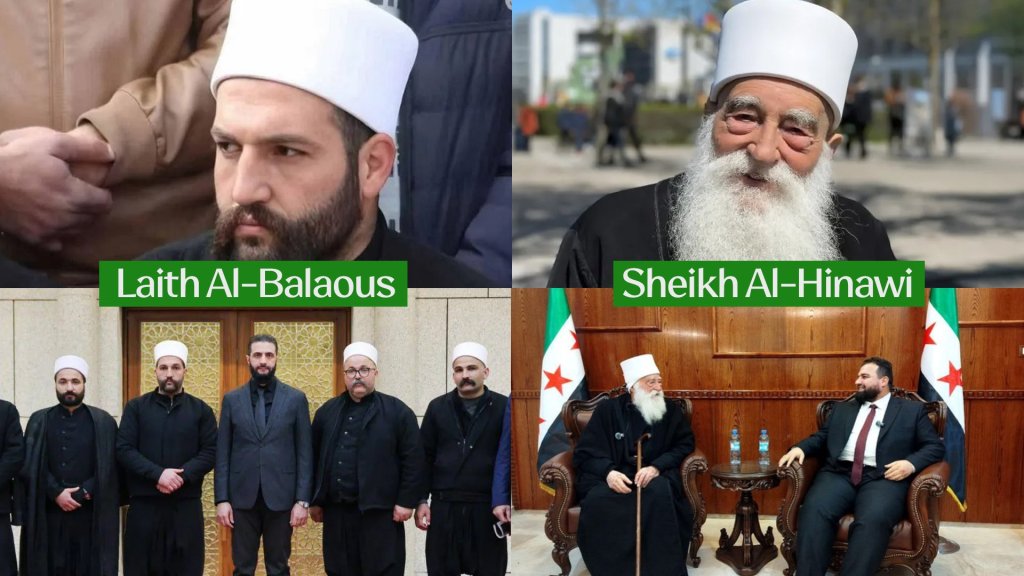
1. The Integration Faction Led by Sheikh Al-Hinawi and Laith Al-Balaous, this faction advocates for full integration with the new Syrian government. Al-Balaous, son of assassinated anti-Assad activist Wahid Al-Balaous, represents a younger generation of Druze leadership that seeks to work within the new Syrian political framework. This faction supports:
- Disarmament of local militias
- Integration of Druze regions into the broader Syrian state structure
- Cooperation with Damascus on security and governance issues
- Rejection of external interference in community affairs
2. The Autonomy Faction The most controversial faction is led by Sheikh Hikmat Al-Hijri, who has emerged as a polarizing figure both within the Druze community and in Syrian politics more broadly. Al-Hijri’s faction advocates for:
- Maximum autonomy for Druze regions
- Rejection of central government authority
- Acceptance of international support, including from Israel
- Maintenance of armed militias for community defense

3. The Moderate Opposition A third, less organized faction consists of community members who oppose both full integration and radical autonomy, seeking a middle path that preserves Druze identity while maintaining Syrian unity.
Hikmat Al-Hijri: A Controversial Figure
Sheikh Hikmat Al-Hijri has become the most contentious figure in the current crisis. Born in Venezuela in 1965, Al-Hijri returned to Syria for his education and assumed spiritual leadership of the Druze community in 2012 following his brother’s death. His political positions have evolved significantly since the fall of the Assad regime:
- December 2024: Condemned Israeli invasion of Syria and called for Syrian unity
- May 2025: Welcomed Israeli support, stating “Israel is not the enemy”
- July 2025: Called on international leaders including Trump and Netanyahu to “save Al-Suwayda”
This dramatic shift in position reflects the complex pressures facing Druze leadership and has contributed to community divisions.
External Interventions and Geopolitical Implications
Israeli Involvement
Israel’s military intervention in the Suwayda crisis represents a significant escalation in its post-Assad Syria policy. Israeli justifications for intervention include:
Official Rationale:
- Protection of Druze minority rights
- Prevention of sectarian massacres
- Humanitarian intervention
Strategic Considerations:
- Establishment of buffer zones along the Syrian border
- Support for client groups within Syria
- Disruption of Syrian state consolidation efforts
- Demonstration of Israeli military capabilities
Israeli airstrikes on Damascus and Suwayda on July 16, 2025, marked a significant escalation, targeting Syrian government facilities and military installations. The strikes, which killed at least three people and wounded 34 others, were justified by Israeli Defense Minister Israel Katz as necessary to protect Druze civilians.
United States Position
The U.S. response to the crisis has emphasized Syrian territorial integrity and opposition to fragmentation. Key elements of the American position include:
- Support for Syrian unity under a single government
- Rejection of ethnic or sectarian partition
- Calls for peaceful resolution of internal disputes
- Implicit criticism of Israeli military intervention
This position reflects broader U.S. concerns about regional stability and the prevention of state collapse that could create opportunities for extremist groups.
Regional Reactions
Lebanon: Druze leader Walid Jumblatt has advocated for political solutions within the Syrian framework, reflecting Lebanese Druze concerns about spillover effects.
Jordan: Maintains cautious neutrality while monitoring potential refugee flows and security implications.
Turkey: Supports Syrian territorial integrity while pursuing its own interests in northern Syria.
Humanitarian Crisis and Social Impact
Casualty Figures
The conflict has exacted a significant humanitarian toll:
- Over 169 confirmed deaths as of July 17, 2025
- 200+ wounded in various clashes
- Displacement of civilian populations
- Disruption of medical services and infrastructure
Economic Consequences
The crisis has severely impacted the local economy:
- Collapse of government services in contested areas
- Disruption of trade routes
- Damage to agricultural activities
- Decline in local business operations
Social Fragmentation
The conflict has created deep divisions within Druze society:
- Family and tribal loyalties divided along factional lines
- Generational splits between older and younger community members
- Religious authority challenged by political considerations
- Traditional dispute resolution mechanisms undermined
International Law and Sovereignty Issues
Legal Framework
The crisis raises significant questions about international law and state sovereignty:
Syrian Government Position:
- Assertion of legitimate authority over all Syrian territory
- Right to restore order and disarm illegal militias
- Condemnation of Israeli military intervention as violation of sovereignty
Israeli Justification:
- Responsibility to Protect (R2P) doctrine
- Prevention of genocide and ethnic cleansing
- Self-defense against potential threats
International Law Considerations:
- Prohibition on use of force in international relations
- Principle of non-intervention in internal affairs
- Humanitarian exception to sovereignty principles
UN and International Response
The United Nations has called for cessation of violence and respect for Syrian sovereignty, but has been limited in its ability to influence events on the ground. The UN Secretary-General has specifically condemned violations of Syrian sovereignty while calling for protection of minority rights.

Strategic Implications and Analysis
For Syrian State Building
The Suwayda crisis represents a crucial test for Syria’s new government:
Challenges:
- Demonstrating effective governance across diverse communities
- Balancing minority rights with state unity
- Countering external interference
- Rebuilding trust between communities
Opportunities:
- Establishing precedent for peaceful conflict resolution
- Demonstrating commitment to inclusive governance
- Building international legitimacy through responsible leadership
For Regional Stability
The conflict has implications beyond Syria’s borders:
Precedent Setting: The resolution of the Druze crisis could establish patterns for handling minority disputes throughout the region.
Spillover Effects: Violence could spread to neighboring areas or inspire similar conflicts in other diverse societies.
External Power Competition: The crisis has become a proxy for broader regional power struggles between Israel, Iran, and other actors.
For International Relations
The crisis has strained relationships between multiple actors:
US-Israel Relations: Differences over appropriate responses to the crisis have created tensions between traditional allies.
Regional Diplomatic Networks: The conflict has complicated efforts to build new regional diplomatic arrangements.
International Law: The crisis has raised questions about the application of international law in complex internal conflicts.
Comparative Analysis: Lessons from Similar Conflicts
Lebanon’s Druze Experience
Lebanon’s Druze community, led by Walid Jumblatt, has navigated similar challenges of minority rights within a fragmented state system. Key lessons include:
- Importance of maintaining unity within the community
- Benefits of engaging with state institutions rather than opposing them
- Risks of external dependence for community security
Iraqi Minority Protection
Iraq’s experience with minority protection offers both positive and negative examples:
Positive: Constitutional protection for minority rights Negative: Exploitation of minority grievances by external actors
Kurdish Autonomy Models
The Kurdish experience in Iraq and Syria provides examples of minority autonomy arrangements:
Successful Elements: Institutional autonomy with state recognition Challenges: Balancing autonomy with national unity
Economic Factors and Resource Competition
Resource Control
The Suwayda crisis involves significant economic dimensions:
Agricultural Resources: Control over fertile land and water resources Trade Routes: Access to commercial corridors between Syria and Jordan Government Resources: Distribution of state funds and development projects
Economic Grievances
Long-standing economic grievances have contributed to the crisis:
- Underdevelopment of Druze regions relative to other areas
- Limited access to government employment and contracts
- Informal economy and lack of formal business opportunities
Future Scenarios and Projections
Scenario 1: Successful Integration
Conditions: Moderate Druze leaders maintain influence; Syrian government demonstrates inclusive governance; external interference diminishes.
Outcomes: Gradual integration of Druze regions into Syrian state structure; preservation of cultural autonomy within unified framework; economic development and stability.
Probability: Moderate (40-50%)
Scenario 2: Continued Fragmentation
Conditions: Al-Hijri faction maintains control; Israeli support continues; Syrian government unable to establish authority.
Outcomes: De facto partition of Druze areas; continued violence and instability; international crisis escalation.
Probability: Significant (30-40%)
Scenario 3: Negotiated Autonomy
Conditions: Compromise between factions; international mediation; creative governance arrangements.
Outcomes: Special autonomy status for Druze regions within Syrian framework; gradual stabilization; model for other minority communities.
Probability: Possible (20-30%)
Policy Recommendations
For the Syrian Government
- Inclusive Governance: Demonstrate commitment to minority rights through concrete policy measures
- Economic Development: Prioritize development projects in Druze regions to address grievances
- Security Guarantees: Provide credible security assurances to Druze communities
- Dialogue Facilitation: Engage with all Druze factions to build consensus
For International Actors
- Coordinated Response: Develop unified international approach to crisis resolution
- Humanitarian Focus: Prioritize humanitarian assistance over political objectives
- Diplomatic Pressure: Use diplomatic channels to discourage external interference
- Long-term Commitment: Maintain engagement beyond immediate crisis resolution
For the Druze Community
- Unity Building: Work to bridge internal divisions and build consensus
- Constructive Engagement: Participate in Syrian political processes while maintaining community identity
- Economic Development: Focus on sustainable development initiatives
- Regional Cooperation: Strengthen ties with Druze communities in neighboring countries
Conclusion
The crisis in Syria’s Suwayda province represents far more than a local dispute within the Druze community. It has become a critical test case for Syria’s post-Assad reconstruction, regional stability, and international law. The complex interplay of internal divisions, external interventions, and geopolitical competition has created a situation that requires careful analysis and nuanced policy responses.
The resolution of this crisis will likely establish important precedents for minority rights, state sovereignty, and international intervention in the post-Arab Spring Middle East. Success in achieving a peaceful, inclusive resolution could provide a model for addressing similar challenges throughout the region. Failure, however, could contribute to continued fragmentation and instability with implications far beyond Syria’s borders.
The path forward requires recognition that the Druze crisis is fundamentally about balancing legitimate minority rights with state unity, managing external interference while addressing genuine grievances, and building inclusive governance structures that can accommodate Syria’s diverse communities. The international community’s response to this crisis will be closely watched by other minority communities and their governments throughout the region.
As the situation continues to evolve, the key to sustainable resolution lies in addressing the root causes of the crisis rather than merely managing its symptoms. This requires long-term commitment to inclusive governance, economic development, and respect for both minority rights and state sovereignty. The stakes are high, not just for Syria’s Druze community, but for the broader project of building stable, inclusive societies in the post-conflict Middle East.
This analysis is based on open-source reporting and social media account of Abd alhade alani, Syrian Cinematographer as of July 18, 2025. The rapidly evolving situation requires continuous monitoring and assessment.



Leave a comment