

As the clock strikes 10:57 AM IST on Monday, 21 July 2025, a seismic statement from a former Israeli military heavyweight has ignited a firestorm of controversy.
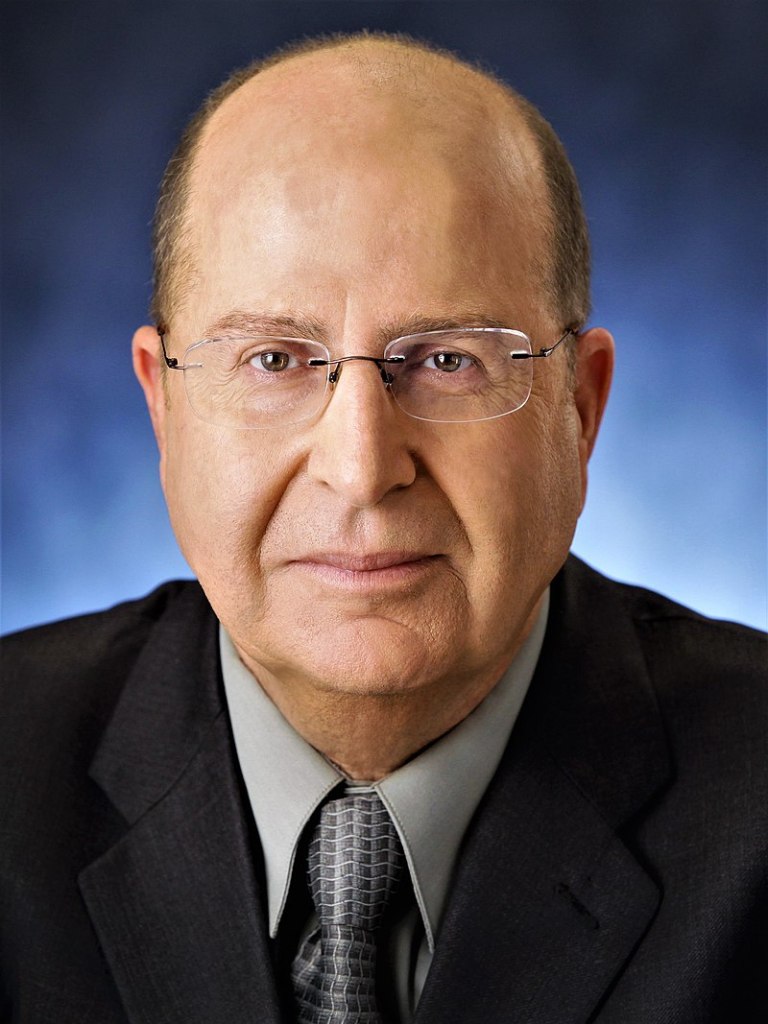
Moshe Yaalon, once Israel’s Chief of Staff and Defence Minister, has accused the current leadership of the Israeli Defence Forces (IDF) and security apparatus of committing war crimes, including ethnic cleansing and the abandonment of hostages.
The Statement and Its Origins
Yaalon’s post, written in Hebrew, is a stark condemnation of what he describes as systematic war crimes.
He alleges the forced evacuation of entire populations, the destruction of homes, and the confinement of people into a “humanitarian city” as part of a strategy for “voluntary deportation”.
He further accuses the leadership of starvation tactics and extrajudicial killings, labeling these actions as violations of both international law and Israeli moral values. “The abandonment of hostages to their fate,” he writes, “is a moral crime unimaginable for any government”
This is a direct critique of the current government under Prime Minister Benjamin Netanyahu, whom Yaalon served between 2013 and 2016 before becoming a vocal critic.
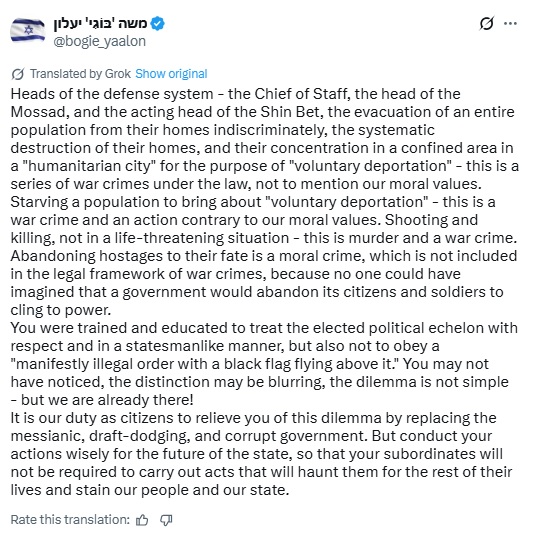
Ami Dar’s subsequent post frames Yaalon’s statement as a pivotal moment, challenging detractors to label the ex-minister a “traitor” or “antisemite”.
Dar’s inclusion of an image quoting Yaalon’s plea—“conduct your actions wisely for the future of the state, so that your subordinates will not be required to carry out acts that will haunt them for the rest of their lives”—has garnered 227 likes and 8,913 views, underscoring its resonance.
Who Is Moshe Yaalon?
Moshe “Bogie” Yaalon, born Moshe Smilansky in 1950, is a veteran of Israel’s security establishment with a storied career.
Yaalon’s father was a Haganah veteran, and his mother a Holocaust survivor who fought with partisans, shaping his early commitment to Israel’s defence. Rising through the IDF ranks, he served as Chief of Staff from 2002 to 2005 during the Second Intifada, a period marked by intense conflict with Palestinian groups. His tenure as Defence Minister under Netanyahu from 2013 to 2016 ended in resignation amid policy disagreements, notably over settlement expansion, which he opposed as destabilizing (Reuters, 1 December 2024).
Since then, Yaalon has positioned himself as a critic of Netanyahu’s government, aligning with centrist and opposition factions.
Yaalon’s military background lends his statements weight, rooted in decades of experience, including a 1992 operation where he killed an Islamic Jihad militant.
However, his critics argue this history undermines his current stance, pointing to his role in operations that also drew international scrutiny, such as the 2002 Jenin incursion, where human rights groups alleged excessive force.
Contextualising the Claims
Yaalon’s accusations align with recent developments in the Gaza Strip, where humanitarian conditions have deteriorated sharply.
On 20 July 2025, The New York Times reported that Israeli soldiers opened fire near the Zikim crossing, killing dozens of Palestinians gathered for UN aid distribution.
“People were simply trying to access food to feed themselves and their families on the brink of starvation,” the UN agency stated, condemning the “increasingly dangerous conditions” (NYT, 20 July 2025). This incident, occurring just hours before Yaalon’s post, lends urgency to his claims of starvation tactics as a tool of coercion.
The allegation of ethnic cleansing echoes a December 2024 statement by Yaalon, reported by Al Jazeera, where he accused Israel of “clearing northern Gaza of Arabs”, a charge mirroring International Criminal Court (ICC) arrest warrants issued against Netanyahu and former Defence Minister Yoav Gallant for war crimes and crimes against humanity (Al Jazeera, 2 December 2024).
The ICC’s findings, though contested by Israel, provide a legal framework that Yaalon appears to invoke, suggesting a pattern of state-sanctioned violence.
Historically, Yaalon’s credibility is bolstered by his tenure as IDF Chief of Staff, a period marked by adherence to the “purity of arms” doctrine, which emphasizes ethical conduct in warfare, as noted by the Carnegie Council (Carnegie Endowment, accessed 21 July 2025).
His current stance, however, marks a departure, reflecting growing unease among former insiders about the direction of Israeli policy.
The Ethical Dilemma for the Military
Central to Yaalon’s argument is the moral burden on IDF soldiers.
He urges military leaders to “calculate their actions wisely” to prevent subordinates from committing acts that could “stain our people and our state”.
This invokes the concept of a “blatantly illegal order”, a principle in Israeli military law where soldiers are not obligated to obey commands violating international humanitarian law.
The Institute for Palestine Studies highlights a shift in the IDF’s ethical code since 2005, which prioritizes Israeli combatants over noncitizen noncombatants, a move critics argue contravenes global norms (IPS, accessed 21 July 2025).
Yaalon’s warning suggests this code is being stretched to its limits.
The abandonment of hostages, a reference to those held by Hamas since the 7 October 2023 attack, adds another layer.
Yaalon implies that political motives—maintaining power—have superseded rescue efforts, a charge that resonates with families of the captives who have protested Netanyahu’s handling of negotiations. While not classified as a war crime under international law, this moral failing amplifies Yaalon’s call for governmental change.
Critiques of Yaalon’s Remarks
Yaalon’s remarks have drawn sharp criticism, both for their content and his perceived hypocrisy. Within Israel, Netanyahu’s Likud party labeled his statements “slanderous lies” that “aid Israel’s enemies”, with Foreign Minister Gideon Saar asserting they cause “irreparable damage” (Al Jazeera, 2 December 2024).
Critics like Ido Shiponi that Yaalon, as a former military leader, bears responsibility for past actions, such as the Jenin operation, which Amnesty International called a “war crime” in 2002 due to civilian casualties.
This history, they contend, disqualifies him from moral authority, framing his current stance as a politically motivated attack on Netanyahu.
Others question Yaalon’s timing, suggesting his remarks coincide with his alignment with opposition figures like Benny Gantz, hinting at a bid to regain political relevance.
The Jerusalem Post, in an editorial dated 21 July 2025, accuses him of “exploiting his military legacy for partisan gain”, noting his resignation in 2016 stemmed from disagreements over West Bank policy, not a sudden ethical awakening.
Furthermore, his call for citizens to oust the government is seen by some as incitement, risking civil unrest at a time of national security challenges.
Defenders counter that Yaalon’s insider perspective—gained through decades of service—lends authenticity to his critique.
The Carnegie Endowment suggests his shift reflects a broader trend among former security officials disillusioned with Netanyahu’s governance (Carnegie Endowment, accessed 21 July 2025).
Yet, the lack of concrete evidence in his X post, beyond rhetorical flourish, leaves it vulnerable to dismissal as opinion rather than fact, a point raised by Haaretz analysts on 21 July 2025.
Polarized Reactions and Political Fallout
Within Israel, Netanyahu’s allies have rejected Yaalon’s claims, while opposition movements, buoyed by his call to “replace the messianic, draft-dodging, corrupt government”, plan protests in Tel Aviv this week.
The Carnegie Endowment warns that such fractures could weaken Israel’s global standing (Carnegie Endowment, accessed 21 July 2025).
International Implications
Yaalon’s statement arrives at a critical juncture. The UN’s recent report on Gaza, citing over 40,000 Palestinian deaths since October 2023, has intensified calls for accountability (UN OCHA, 15 July 2025). His alignment with ICC findings could embolden international pressure, though the US remains silent post-Zikim, suggesting caution (NYT, 20 July 2025).
The Carnegie Endowment notes potential geopolitical shifts if dissent persists (Carnegie Endowment, accessed 21 July 2025).
The Human Cost and Moral Reckoning
Shadi al-Nazli, a 27-year-old Gazan, survived the Zikim shooting, describing aid-seekers’ desperation (NYT, 20 July 2025).
IDF veterans seeking psychological support post-service, per a 2024 Haaretz investigation, echo Yaalon’s concern about haunting acts.
His appeal to “citizen duty” risks polarization but resonates with those seeking pre-Netanyahu norms.
Conclusion: A Turning Point?
Moshe Yaalon’s warning is a clarion call that could reshape Israel’s narrative. With 8,913 views on Dar’s post, the war crimes and ethnic cleansing allegations, backed by events like Zikim, demand scrutiny.
Critiqued for hypocrisy and timing, Yaalon’s remarks nonetheless challenge the status quo. Whether they prompt reform, change, or intervention remains uncertain, but they mark a moment Israel cannot ignore.
Key Sources:
- Al Jazeera, “Israel committing Gaza war crimes and ethnic cleansing, says Moshe Yaalon”, 2 December 2024.
- The New York Times, “Dozens Are Killed at Aid Site Near Border, Gaza Health Officials Say”, 20 July 2025.
- Institute for Palestine Studies, “The Most Moral Army in the World”, accessed 21 July 2025.
- Carnegie Endowment for International Peace, various analyses, accessed 21 July 2025.
- UN OCHA, Gaza Humanitarian Update, 15 July 2025.
- Jerusalem Post, Editorial, 21 July 2025.
- Haaretz, Analysis, 21 July 2025.
- Wikipedia, “Moshe Yaalon”, updated 19 June 2025.



Leave a comment