
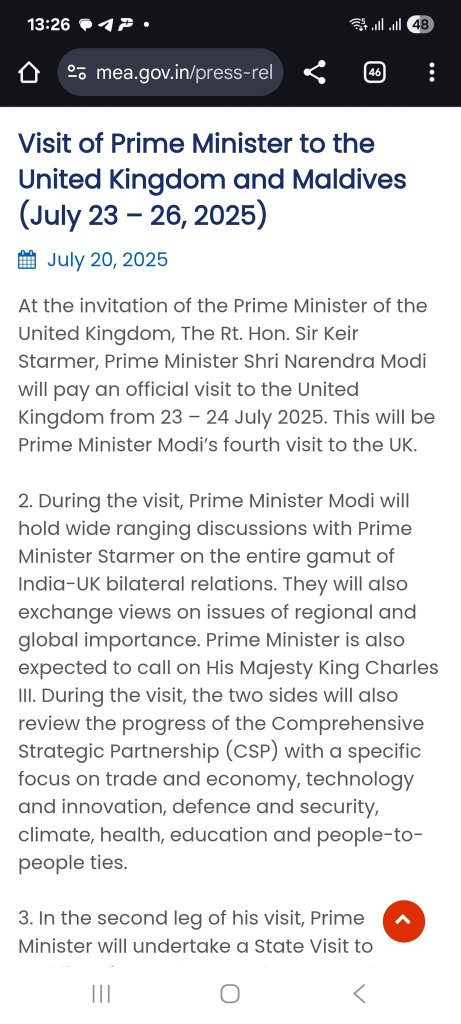
On July 23-24, 2025, Indian Prime Minister Narendra Modi is scheduled to visit the United Kingdom to formally sign the India-UK Free Trade Agreement (FTA) and strengthen bilateral ties.
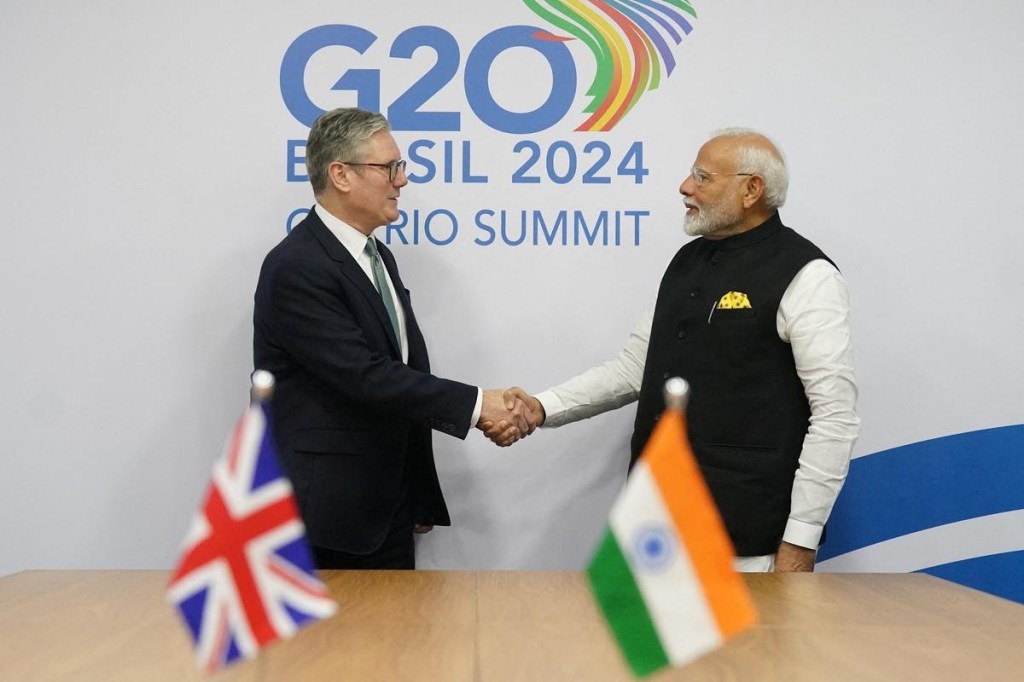
This visit marks a significant milestone in the evolving relationship between India and the UK, two nations with a shared history and a strategic partnership aimed at fostering economic growth, innovation, and global cooperation.
The FTA, finalized on May 6, 2025, after three years of negotiations, is described as a “historic milestone” by both PM Modi and UK Prime Minister Keir Starmer.
History of UK-India Trade Ties
The trade relationship between India and the UK is rooted in centuries of historical interaction, beginning with the establishment of the East India Company in 1600. During the colonial era, trade was heavily skewed in favor of Britain, with India serving as a supplier of raw materials like cotton, tea, and spices, while British manufactured goods dominated Indian markets. This extractive economic relationship left a complex legacy, shaping post-independence ties.
After India gained independence in 1947, trade relations evolved into a more equitable partnership. The UK remained a key trading partner, with bilateral trade focusing on textiles, machinery, and pharmaceuticals. By the late 20th century, the relationship expanded to include services, particularly IT and financial services, driven by India’s economic liberalization in 1991. The establishment of the India-UK Joint Economic and Trade Committee in 2005 and the Comprehensive Strategic Partnership in 2021 further solidified ties.
In 2024, bilateral trade in goods and services reached £42.6 billion, with Indian exports to the UK at £25.5 billion (up 10.1% from 2023) and UK exports to India at £17.1 billion (up 5.8%).
India is the UK’s 12th largest trading partner, while the UK is a significant destination for Indian investments, supporting over 600,000 jobs across both nations.
The 2030 Roadmap for India-UK Future Relations, announced in May 2021 by PM Modi and then-UK PM Boris Johnson, set ambitious goals to double trade by 2030, emphasizing sectors like technology, defense, and clean energy.
The FTA negotiations, launched in January 2022, were a cornerstone of this roadmap.
Despite delays due to political instability in the UK (with four prime ministers since 2022) and elections in both countries in 2024, the agreement was finalized in May 2025, marking a pivotal step in post-Brexit UK trade policy and India’s global economic strategy.
Indian Prime Ministers’ Visits to the UK
Since India’s independence, several Indian prime ministers have visited the UK to strengthen diplomatic and economic ties. Notable visits include:
- Jawaharlal Nehru (1947, 1953, 1956): India’s first prime minister visited the UK multiple times to attend Commonwealth meetings and foster post-independence relations.
- Indira Gandhi (1966, 1971, 1982): Gandhi’s visits focused on economic cooperation and India’s role in the Non-Aligned Movement.
- Rajiv Gandhi (1985, 1988): His visits emphasized technology transfers and trade partnerships.
- P.V. Narasimha Rao (1994): Rao’s visit aligned with India’s economic liberalization, promoting investment ties.
- Atal Bihari Vajpayee (2001): Vajpayee’s trip strengthened strategic and economic cooperation.
- Manmohan Singh (2004, 2006, 2009): Singh’s visits focused on trade, education, and counter-terrorism.
- Narendra Modi (2015, 2018): Modi’s previous UK visits addressed trade, investment, and the Indian diaspora, with the 2015 visit launching FTA talks and the 2018 visit reinforcing the Comprehensive Strategic Partnership.
Modi’s 2025 visit will be his third to the UK as prime minister and the first since 2018, underscoring its significance in finalizing the FTA and advancing bilateral goals.
Notably, no UK prime minister has visited India since Boris Johnson’s 2016 trip, highlighting a gap that Modi’s visit aims to bridge.
Importance of PM Modi’s 2025 UK Visit
The 2025 visit is a landmark event for several reasons:
- Formalizing the FTA: The signing of the FTA, concluded on May 6, 2025, is the centerpiece of the visit. Described as the UK’s most significant post-Brexit trade deal and India’s most ambitious with a European nation, it aims to double bilateral trade to $120 billion by 2030. The agreement eliminates tariffs on 99% of Indian exports and 90% of UK exports, boosting sectors like textiles, whisky, and automobiles.
- Geopolitical Context: The FTA comes amid global trade uncertainties, particularly due to U.S. President Donald Trump’s tariff policies in 2025. By strengthening ties with the UK, India hedges against potential disruptions in other markets, while the UK seeks to diversify trade post-Brexit. The deal also positions India favorably for negotiations with other partners like the EU and the US.
- Strategic Partnership: The visit reinforces the India-UK Comprehensive Strategic Partnership, encompassing defense, security, technology, and climate change. Discussions during the visit will likely advance cooperation in emerging technologies and cybersecurity, aligning with the 2030 Roadmap.
- Diaspora Engagement: The Indian diaspora, numbering 1.9 million in the UK, is a “living bridge” between the two nations. Modi’s engagement with this community during the visit will strengthen cultural and economic ties, leveraging their influence in British politics and business.
- Symbolic Milestone: The visit symbolizes a renewed commitment to bilateral relations, which had stagnated due to UK political turmoil and delayed FTA talks. It also marks a shift toward a more mature partnership beyond historical ties, focusing on mutual economic growth and global challenges.
The Indian Diaspora in the UK
The Indian diaspora in the UK, at 1.9 million according to the 2021 Census, is one of the largest and most influential ethnic communities in the country.
Comprising 3.1% of the UK population, it includes professionals in IT, healthcare, finance, and academia, as well as a significant business community. The diaspora contributes significantly to the UK economy, with Indian-owned businesses generating substantial revenue and jobs.
The diaspora serves as a cultural and economic bridge, fostering people-to-people ties.
Events like the “India/UK Together” program, launched in 2021 to celebrate India’s 75th independence anniversary, highlight its role in cultural exchange and education, with initiatives like scholarships for Indian students.
However, the diaspora also poses challenges, as tensions between Indian and other South Asian communities (e.g., the 2022 Leicester violence between Hindu and Muslim groups) can complicate UK-India relations. Modi’s engagement with the diaspora during his visit will likely focus on promoting unity and leveraging their economic contributions to strengthen bilateral ties.
Challenges of the Trip
Modi’s visit and the FTA implementation face several challenges:
- Political Sensitivities: The UK’s diverse South Asian population, including 1.2 million of Pakistani descent, requires careful diplomacy to avoid exacerbating community tensions. India’s strategic autonomy and tensions with Pakistan, particularly over Kashmir, could influence UK domestic politics.
- FTA Implementation: While the FTA has been signed, ratification by both parliaments is pending, with a timeline of 9-12 months. Administrative hurdles, limited awareness, and complex regulations have historically led to low FTA utilization in India, posing risks to maximizing benefits.
- Contentious Issues: Key sticking points, such as the UK’s proposed carbon tax on metal imports and auto import quotas, remain unresolved and are being addressed outside the FTA. These could create friction if not handled delicately during the visit.
- Domestic Opposition: In India, farmers and MSMEs have protested the FTA, fearing competition from UK agricultural and manufactured goods. The exclusion of sensitive items like dairy and apples aims to mitigate this, but political backlash could complicate implementation.
- Visa and Mobility Issues: While the FTA facilitates mobility for Indian professionals (e.g., IT and healthcare workers), the UK’s restrictive immigration policies post-Brexit remain a point of contention. The agreement’s provision for 100 new visas annually is modest compared to India’s initial demands, potentially limiting benefits.
- Global Trade Uncertainty: The shadow of U.S. tariffs and global trade wars adds pressure to ensure the FTA delivers tangible benefits quickly, as both nations seek to diversify trade partners.
Main Discussion Points for the Trip
The visit will focus on the following key discussion points:
- FTA Signing and Implementation: The formal signing of the FTA will be the centerpiece, with discussions on legal scrubbing, ratification timelines, and strategies to ensure effective implementation. Both leaders will likely outline measures to support businesses in leveraging the agreement.
- Defense and Security Cooperation: Modi and Starmer will explore expanding bilateral security ties, including cybersecurity, counter-terrorism, and maritime security in the Indo-Pacific. The 2030 Roadmap emphasizes a free and open Indo-Pacific, aligning with shared strategic interests.
- Technology and Innovation: The Technology Security Initiative, launched in July 2024, will be a focal point, with discussions on collaboration in AI, semiconductors, and green technology. The FTA’s provisions for digital trade and professional qualifications will also be highlighted.
- Economic and Trade Expansion: Beyond the FTA, talks will cover the Bilateral Investment Treaty (BIT) and strategies to double trade by 2030. Sectors like textiles, whisky, automobiles, and pharmaceuticals will be prioritized, with an emphasis on job creation and market access.
- Climate and Clean Energy: Both leaders will reaffirm commitments to the Paris Agreement and discuss joint initiatives in renewable energy and climate resilience, building on the 2030 Roadmap’s climate pillar.
- Diaspora Engagement: Modi will likely address the Indian diaspora, emphasizing their role in strengthening economic and cultural ties. Discussions may include educational exchanges and diaspora-led investment initiatives.
Objectives of the India-UK FTA and the Visit
The FTA and Modi’s visit aim to achieve the following objectives:
- Economic Growth: The FTA is projected to boost UK GDP by £4.8 billion annually by 2040 and enhance Indian exports by eliminating tariffs on 99% of tariff lines. It aims to double bilateral trade to $120 billion by 2030, supporting sectors like textiles, IT, and beverages.
- Market Access: The agreement reduces tariffs on 90% of UK exports to India (85% tariff-free within a decade) and 99% of Indian exports to the UK, benefiting Indian farmers, MSMEs, and innovators. Key UK exports like whisky (tariffs cut from 150% to 40% over 10 years) and automobiles (from 100% to 10% under quotas) gain access to India’s growing middle class.
- Job Creation and Innovation: The FTA is expected to create jobs in both nations, particularly in labor-intensive Indian sectors like textiles and IT, and UK sectors like whisky and aerospace. It promotes collaboration in technology and innovation, including fintech and green tech.
- Strategic Partnership: The visit and FTA strengthen the Comprehensive Strategic Partnership, aligning India and the UK on global issues like climate change, Indo-Pacific security, and digital infrastructure.
- Geopolitical Leverage: For India, the FTA enhances leverage in negotiations with the EU and US, while for the UK, it solidifies its post-Brexit trade strategy.
- Diaspora and Cultural Ties: The visit aims to deepen people-to-people ties through diaspora engagement, cultural exchanges, and educational initiatives, reinforcing the “living bridge.”
Conclusion
Prime Minister Narendra Modi’s visit to the UK on July 23-24, 2025, to sign the India-UK Free Trade Agreement marks a transformative moment in bilateral relations.
Building on centuries of trade ties, the FTA addresses modern economic needs by reducing tariffs, enhancing market access, and fostering innovation.
The visit’s significance lies in its potential to double trade by 2030, strengthen strategic cooperation, and engage the influential Indian diaspora.
Despite challenges like political sensitivities, implementation hurdles, and global trade uncertainties, the FTA and Modi’s visit set a new benchmark for equitable trade between two major economies.
By addressing key discussion points like defense, technology, and climate, the visit will cement the India-UK Comprehensive Strategic Partnership, positioning both nations for mutual prosperity in a rapidly changing global landscape.



Leave a comment