ACADEMIC PREMISE
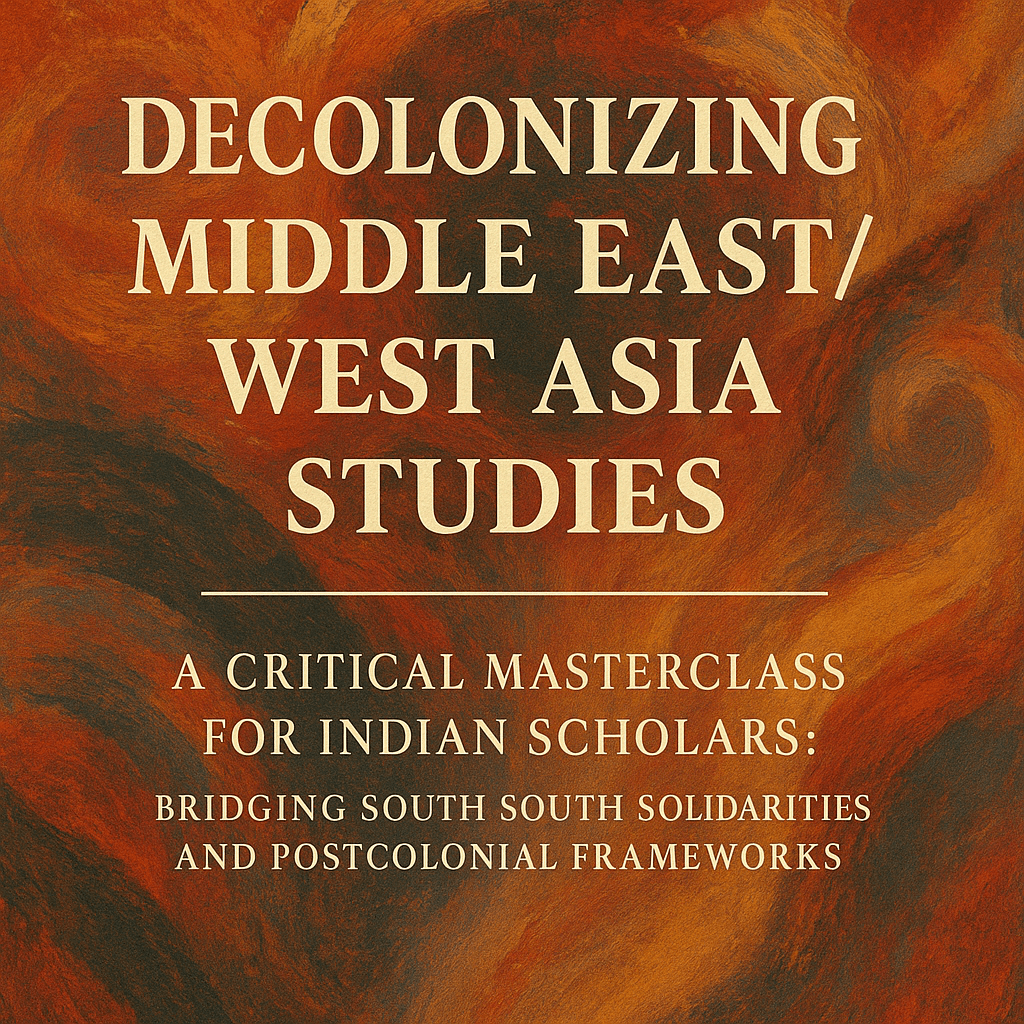
- This four-day scholarly masterclass reorients Middle East/West Asia studies by moving beyond Eurocentric lenses to embrace decolonial, postcolonial, and Global South frameworks.
- We draw on intellectual traditions from India and the wider Global South, situating Middle Eastern developments within anti-colonial struggles, subaltern resistance, and South-South cooperation.
Target Audience
Graduate students, early career scholars, faculty, policy analysts, and researchers in international relations, political science, postcolonial theory, area studies, and development.
DAY 1: Decolonizing Historical Narratives
Saturday, August 2, 2025 | 7:00–9:00 PM IST
Central Question:
How do we read Middle Eastern history through the lens of anti-colonial solidarity rather than imperial cartography?
Sessions:
From Sykes-Picot to Partition: Comparative Colonial Cartographies in Asia
The Balfour Declaration and Colonial Promises: From Palestine to Princely States
Subaltern Histories and Anti-Colonial Epistemologies
Required Readings:
- Frantz Fanon – The Wretched of the Earth (Chapters 1–2)
- Edward Said – Orientalism (Chapter 1: “The Scope of Orientalism”)
- Ranajit Guha – “On Some Aspects of the Historiography of Colonial India”
- Rashid Khalidi – Resurrecting Empire (Chapters 2–3)
- Joseph Massad – “The Persistence of the Palestinian Question”
DAY 2: Geopolitical Architectures and Non-Alignment
Sunday, August 3, 2025 | 7:00–9:00 PM IST
Central Question:
How can India’s Non-Aligned Movement legacy inform contemporary Middle Eastern geopolitics?
Sessions:
From Bandung to BRICS: India-Middle East Convergences in Multipolar Geopolitics
Understanding Conflicts Through Indian Strategic Culture
BRICS+ and West Asian Integration: India’s Mediatory Role
Required Readings:
- Vijay Prashad – The Darker Nations (Chapters 4–5)
- Amitav Acharya – The End of American World Order (Chapter 6)
- Anoushiravan Ehteshami – Dynamics of Change in the Persian Gulf (Chapters 3–4)
- Harsh Pant & Krzysztof Iwanek – “India’s Challenge in Balancing Iran and Saudi Arabia”
- Hamid Dabashi – The Arab Spring (Introduction and Chapter 1)
DAY 3: Political Economy and Developmental Trajectories
Saturday, August 9, 2025 | 7:00–9:00 PM IST
Central Question:
How do dependency theories develop in the Global South illuminate Middle Eastern economic structures?
Sessions:
- From Samir Amin to Gulf Rentierism: Dependency Theory and Resource Economics
- Labor Migration and Remittance Economies: South Asian Workers in Gulf States
- Resource Curse or South-South Opportunity? Comparative Development Strategies
Required Readings:
- Samir Amin – Unequal Development (Chapters 1–2)
- Adam Hanieh – Capitalism and Class in the Gulf Arab States (Chapters 4–5)
- Kiren Aziz Chaudhry – The Price of Wealth (Chapter 3)
- Jan Breman – Footloose Labour (Chapter 6)
- Timothy Mitchell – Carbon Democracy (Chapter 2)
DAY 4: Cultural Politics and Civilizational Dialogue
Sunday, August 10, 2025 | 7:00–9:00 PM IST
Central Question:
How can Indian pluralistic traditions inform contemporary Middle Eastern identity politics and cultural resistance?
Sessions:
Subaltern Cosmopolitanism: From Ganga-Jamuni Tehzeeb to Middle Eastern Pluralism
Digital Activism and Youth Movements: Arab Spring Through Indian Movement Studies
Cinema, Literature, and Resistance: Indo-Middle Eastern Artistic Solidarities
Required Readings:
- Lila Abu-Lughod – Do Muslim Women Need Saving? (Chapters 1–2)
- Homi K. Bhabha – The Location of Culture (Chapter 1)
- Gayatri Chakravorty Spivak – “Can the Subaltern Speak?”
- Talal Asad – Formations of the Secular (Chapter 1)
- Edward Said – Culture and Imperialism (Chapter 2)
Core Theoretical Frameworks
Postcolonial Theory: Spivak, Bhabha, Chakrabarty, Chatterjee
Subaltern Studies: Guha, Pandey, Amin, Dube
Dependency Theory: Amin, Prebisch, Frank, Rodney
South-South Cooperation: Prashad, Acharya, Dabashi
📜 DETAILS
Language: English
Mode: Online (Zoom)
Certification: Issued upon completion
📲 To Register, WhatsApp: +91 9654298758
Seats are limited – early registration recommended.
Fee: ₹3,000 (₹5,000 original tuition fee)



Leave a comment