
Course Overview
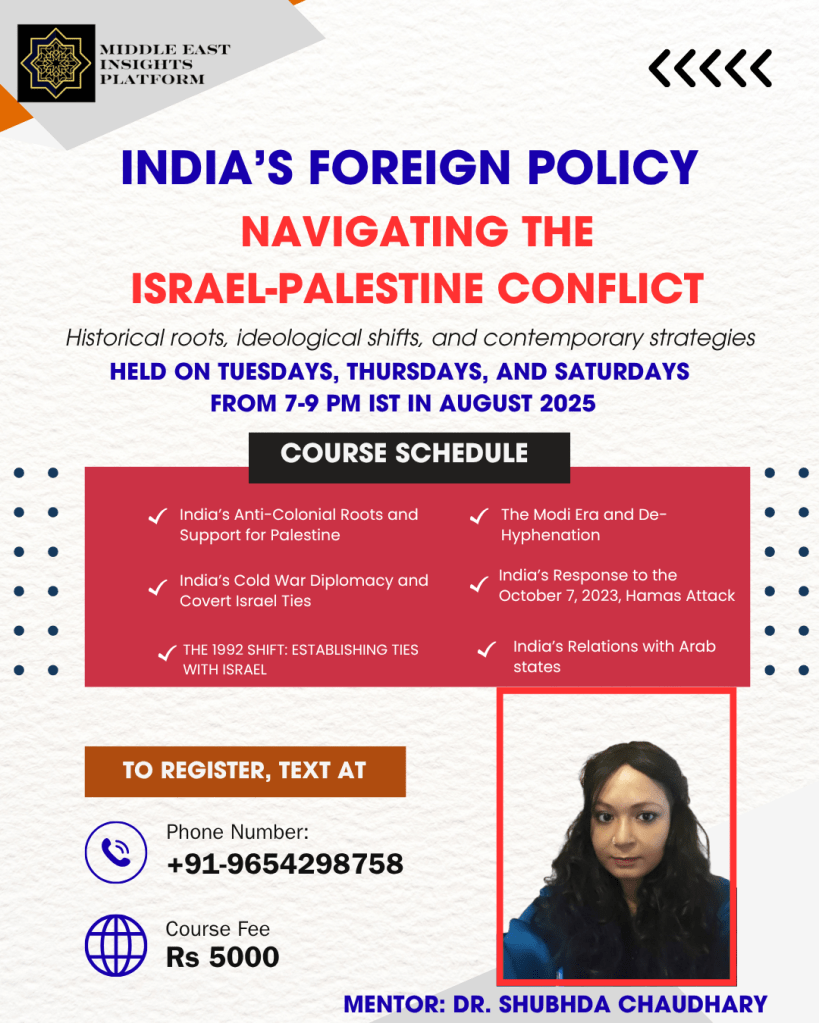
This one-month course explores India’s foreign policy toward the Israel-Palestine conflict, tracing its historical roots, ideological shifts, and contemporary strategies.
Held on Tuesdays, Thursdays, and Saturdays from 7-9 PM in August 2025, the course examines India’s balancing act between its historical support for Palestine and growing ties with Israel, highlighting lesser-known diplomatic maneuvers and challenges.
Through lectures, discussions, and primary source analysis, students will gain insights into India’s de-hyphenation policy, strategic interests, and role in West Asian geopolitics.
Register by July 30, 2025, at 9654298758 to secure your seat.
Recordings of all sessions will be available for enrolled participants.
Course Schedule
Week 1: Historical Foundations and Early Policy
Objective: Understand India’s post-independence stance on the Israel-Palestine conflict and its alignment with the Global South.
- Tuesday, August 5, 2025 (7-9 PM)
Topic: India’s Anti-Colonial Roots and Support for Palestine- Overview of the Israel-Palestine conflict (1947 UN Partition Plan, Balfour Declaration).
- India’s rejection of Israel’s recognition in 1948 and support for Palestinian self-determination.
- Gandhi and Nehru’s perspectives on Palestine as an Arab homeland.
- Discussion: How did India’s colonial experience shape its early foreign policy?
- Readings:
- Kumaraswamy, P. R. (2010). India’s Israel Policy. Columbia University Press (Ch. 1: “The Historical Context”).
- Khalidi, W. (1997). From Haven to Conquest: Readings in Zionism and the Palestine Problem Until 1948. Institute for Palestine Studies (Ch. 3: “The Partition Plan”).
- Brecher, M. (1963). “India’s Foreign Policy: An Interpretation.” Pacific Affairs, 36(2), 141-159.
- Thursday, August 7, 2025 (7-9 PM)
Topic: India’s Cold War Diplomacy and Covert Israel Ties- India’s recognition of Israel (1950) but delayed diplomatic relations until 1992.
- Covert military support from Israel during India’s wars (1962, 1965, 1971).
- India’s leadership in the Non-Aligned Movement and pro-Palestinian UN votes.
- Discussion: Why did India maintain a pro-Palestinian stance publicly while engaging Israel covertly?
- Readings:
- Kumaraswamy, P. R. (2010). India’s Israel Policy. Columbia University Press (Ch. 2: “The Cold War Years”). .
- Blarel, N. (2015). The Evolution of India’s Israel Policy: Continuity, Change, and Compromise. Oxford University Press (Ch. 3: “Covert Contacts”).
- Heptulla, N. (1991). Indo-West Asian Relations: The Nehru Era. Asian Studies Review, 15(1), 45-60.
- Saturday, August 9, 2025 (7-9 PM)
Topic: The 1992 Shift: Establishing Ties with Israel- Post-Cold War pivot to the US and Israel after the Soviet Union’s collapse.
- Economic and strategic drivers: Israel’s defence tech and India’s liberalization.
- India’s recognition of Palestine (1988) and continued UN support.
- Discussion: How did global geopolitical changes influence India’s policy shift?
- Readings:
- Blarel, N. (2015). The Evolution of India’s Israel Policy: Continuity, Change, and Compromise. Oxford University Press (Ch. 5: “The 1992 Breakthrough”).
- Pethiyagoda, K. (2017). “India’s West Asia Policy: Balancing Act in a Turbulent Region.” Asian Survey, 57(5), 843-865.
- Rajiv, S. S. C. (2014). “India and Israel: The Making of a Strategic Partnership.” India Quarterly, 70(4), 279-294.
Week 2: The Modi Era and De-Hyphenation
Objective: Analyze India’s shift toward a de-hyphenated policy under Modi and its implications.
- Tuesday, August 12, 2025 (7-9 PM)
Topic: Modi’s Pro-Israel Tilt and Strategic Alignment- Modi’s 2017 Israel visit: First Indian PM to visit Israel without Palestine.
- Growth in bilateral trade (~$10B by 2024) and defence cooperation (e.g., Barak missiles).
- Alignment with Israel’s counterterrorism narrative and US strategic interests.
- Discussion: Does Modi’s ideology drive India’s pro-Israel shift?
- Readings:
- Pant, H. V., & Thorat, A. (2019). “India’s Emerging Ties with Israel: Opportunities and Challenges.” Strategic Analysis, 43(6), 512-526.
- Jaffrelot, C. (2021). Modi’s India: Hindu Nationalism and the Rise of Ethnic Democracy. Princeton University Press (Ch. 8: “Foreign Policy and Nationalism”).
- Inbar, E., & Ningthoujam, A. S. (2012). “Indo-Israeli Defense Cooperation: The Road Ahead.” Israel Journal of Foreign Affairs, 6(3), 85-95.
- Thursday, August 14, 2025 (7-9 PM)
Topic: De-Hyphenation: Balancing Israel and Palestine- India’s “de-hyphenation” policy: Treating Israel and Palestine as separate entities.
- Continued UN votes for Palestinian rights (e.g., condemning Israeli settlements).
- Lesser-known: India’s technical aid to Palestine and diplomatic tightrope with Arab states.
- Discussion: Is de-hyphenation pragmatic or opportunistic?
- Readings:
- Blarel, N. (2017). “India’s Israel Policy: The Evolution of a Strategic Partnership.” India Review, 16(1), 44-68.
- Kumaraswamy, P. R. (2018). India’s New Israel Policy: De-Hyphenation and Beyond. Middle East Institute (Policy Paper Series).
- Moolakkattu, J. S. (2018). “India and the Palestinian Cause: A Study in Contradictions.” Third World Quarterly, 39(8), 1567-1583.
- Saturday, August 16, 2025 (7-9 PM)
Topic: India’s Response to the October 7, 2023, Hamas Attack- Modi’s immediate condemnation of Hamas and solidarity with Israel.
- India’s abstention on UN ceasefire resolutions unless Hamas is criticized.
- Sending 100,000+ Indian laborers to Israel post-October 7.
- Discussion: How does India’s response reflect its domestic and global priorities?
- Readings:
- Hroub, K. (2010). Hamas: A Beginner’s Guide (2nd ed., Ch. 3).
- Ganguly, S. (2023). “India’s Strategic Calculus in the Israel-Hamas Conflict.” India Quarterly, 79(4), 501-518.
Week 3: Strategic and Domestic Considerations
Objective: Explore the strategic and domestic factors shaping India’s Israel-Palestine policy.
- Tuesday, August 19, 2025 (7-9 PM)
Topic: Defence and Economic Ties with Israel- India’s $2B+ annual arms purchases from Israel (e.g., drones, missile systems).
- Lesser-known: Joint ventures in cybersecurity and agricultural tech (e.g., drip irrigation).
- Impact of the Abraham Accords on India’s West Asia strategy.
- Discussion: How do India-Israel ties influence India’s regional influence?
- Readings:
- Rajiv, S. S. C. (2020). “India-Israel Relations: Strategic and Economic Dimensions.” Orbis, 64(4), 587-603.
- Gans, C. (2008). Just Zionism: On the Morality of the Jewish State (Ch. 2).
- Abhyankar, R. M. (2018). “India’s West Asia Policy: Thinking Beyond Oil.” Strategic Analysis, 42(4), 343-357.
- Thursday, August 21, 2025 (7-9 PM)
Topic: India’s Relations with Arab States and Iran- Balancing Israel ties with Gulf relations (e.g., UAE, Saudi Arabia).
- India’s energy dependence on the Gulf (40% of oil imports) and strategic rivalry with China.
- Iran’s support for Palestine as a challenge to India’s neutrality.
- Discussion: Can India maintain neutrality in a polarized West Asia?
- Readings:
- Pethiyagoda, K. (2017). “India’s West Asia Policy: Balancing Act in a Turbulent Region.” Asian Survey, 57(5), 843-865.
- Alam, A. (2021). “India’s Relations with the Gulf: Economic and Strategic Imperatives.” Journal of Strategic Studies, 44(3), 321-340.
- Quamar, M. M. (2020). India and the Gulf: A New Strategic Partnership. Palgrave Macmillan (Ch. 4: “The Palestinian Factor”).
- Saturday, August 23, 2025 (7-9 PM)
Topic: Domestic Politics and the Muslim Vote- BJP’s pro-Israel stance and its impact on India’s 200M+ Muslim population.
- Lesser-known: India’s media and social media’s pro-Israel bias post-October 2023.
- Historical Congress-era calibration for domestic Muslim support.
- Discussion: How do domestic politics shape India’s foreign policy?
- Readings:
- Jaffrelot, C. (2021). “Hindutva and the Muslim Question in Indian Foreign Policy.” India Quarterly, 77(2), 189-205.
- Said, E. (1992). The Question of Palestine (Ch. 1).
- Noorani, A. G. (2019). “India, Palestine, and the Politics of Domestic Consensus.” Economic and Political Weekly, 54(12), 23-30.
Week 4: Challenges and Future Directions
Objective: Assess the challenges and future prospects of India’s Israel-Palestine policy.
- Tuesday, August 26, 2025 (7-9 PM)
Topic: Challenges: UN Voting and Moral Leadership- India’s abstentions on UN ceasefire resolutions (e.g., June 2024) and criticism for abandoning Palestine.
- Tension between moral leadership (Global South) and strategic pragmatism.
- Lesser-known: India’s bid for UNSC permanent membership requires Arab support.
- Discussion: Is India’s moral leadership at stake?
- Readings:
- Ganguly, S., & Blarel, N. (2020). “India’s Role in Global Governance: The UNSC Bid.” Foreign Policy Analysis, 16(3), 401-419.
- Moolakkattu, J. S. (2018). “India and the Palestinian Cause: A Study in Contradictions.” Third World Quarterly, 39(8), 1567-1583.
- Kumar, S. (2022). “India’s Foreign Policy in West Asia: Towards a Multi-Alignment Strategy.” Journal of Asian Security and International Affairs, 9(2), 178-196.
- Thursday, August 28, 2025 (7-9 PM)
Topic: Regional Instability and India’s Role- Impact of the 2025 Gaza ceasefire collapse and Israel’s renewed offensive.
- India’s potential as a mediator in West Asia, as urged by Palestine at COP26.
- Lesser-known: India’s quiet humanitarian aid to Gaza via UNRWA ($5M annually).
- Discussion: Can India play a stabilizing role in West Asia?
- Readings:
- Abhyankar, R. M. (2018). “India’s West Asia Policy: Thinking Beyond Oil.” Strategic Analysis, 42(4), 343-357.
- Quamar, M. M. (2023). “India’s Evolving Role in Middle East Conflicts.” Middle East Institute (Policy Paper Series).
- Roy, A. (2020). “India’s Global South Leadership and the Israel-Palestine Question.” Global Policy, 11(3), 345-352.
- Saturday, August 30, 2025 (7-9 PM)
Topic: Future of India’s Israel-Palestine Policy- Prospects for India’s de-hyphenation in a post-Trump global order.
- Balancing US-Israel ties with India’s Global South leadership.
- Course wrap-up: Scenarios for India’s role in a two-state solution.
- Discussion: What should India’s long-term strategy be?
- Readings:
- Kumaraswamy, P. R. (2018). India’s New Israel Policy: De-Hyphenation and Beyond. Middle East Institute (Policy Paper Series).
- Parry, W. (2011). Against the Wall: The Art of Resistance in Palestine (Ch. 4).
- Ganguly, S. (2021). “India’s Multi-Alignment Strategy in a Changing Middle East.” India Review, 20(5), 489-507.
Course Format
- Lectures: 1 hour 30 minutes per session to cover key topics and historical context.
- Discussions: 30 minutes for interactive Q&A and analysis of primary sources.
Notes
- Registration: Secure your seat by July 30, 2025, by WhatsApp texting at 9654298758.
- Recordings: All sessions will be recorded and available to enrolled participants for review.
- Readings: Academic sources (books and journals) are accessible. Students will receive digital access to selected chapters where possible.
- Sessions: Conducted virtually via zoom.
- Prerequisites: Basic knowledge of international relations is helpful but not required; open to all levels.
About the Mentor
Dr. Shubhda Chaudhary, the instructor for India’s Evolving Foreign Policy: Navigating the Israel-Palestine Conflict, is an esteemed scholar and commentator specializing in West Asian politics and India’s foreign policy. As the Founder and Director of Middle East Insights, she fosters critical dialogue among scholars and practitioners across South Asia, the Middle East, and Africa.
Dr. Chaudhary holds a Ph.D. and M.Phil. in West Asian Politics from Jawaharlal Nehru University (JNU), New Delhi, and an M.A. in International Journalism from the University of Westminster, London. Her extensive fieldwork in United States, United Kingdom, South Africa, Egypt, Oman, Palestine, Saudi Arabia, and Jordan provides deep insights into the sociopolitical and cultural dynamics of the Israel-Palestine conflict and India’s strategic engagement in the region.
Her research, published by leading presses such as Routledge, I.B. Tauris, and SAGE, explores Indian foreign policy toward West Asia, Arab media politics, and transregional Global South dynamics. She serves on the editorial boards of a few peer-reviewed journals, ensuring access to cutting-edge academic resources for course participants. Dr. Chaudhary’s interdisciplinary approach, blending political science, area studies, and media theory, enriches the course’s analysis of India’s de-hyphenation policy and its balancing act between Israel and Palestine.
Dr. Chaudhary has delivered invited lectures at prestigious institutions, including the University of Cambridge (UK), University of Connecticut (USA), and University of West Florida (USA), and represented India in academic diplomacy programs like the Study of the U.S. Institutes (SUSI) on Journalism and Media. Her frequent commentary on platforms like Doordarshan, TV9, Hindustan Times, BBC Hindi, NDTV, and Times Now offers incisive perspectives on India-Middle East relations, enhancing classroom discussions with real-world relevance.



Leave a comment