
On 1 August 2025, US President Donald Trump imposed a 25% tariff on Indian goods, with an additional unspecified “penalty” for India’s trade with Russia, effective 7 August.

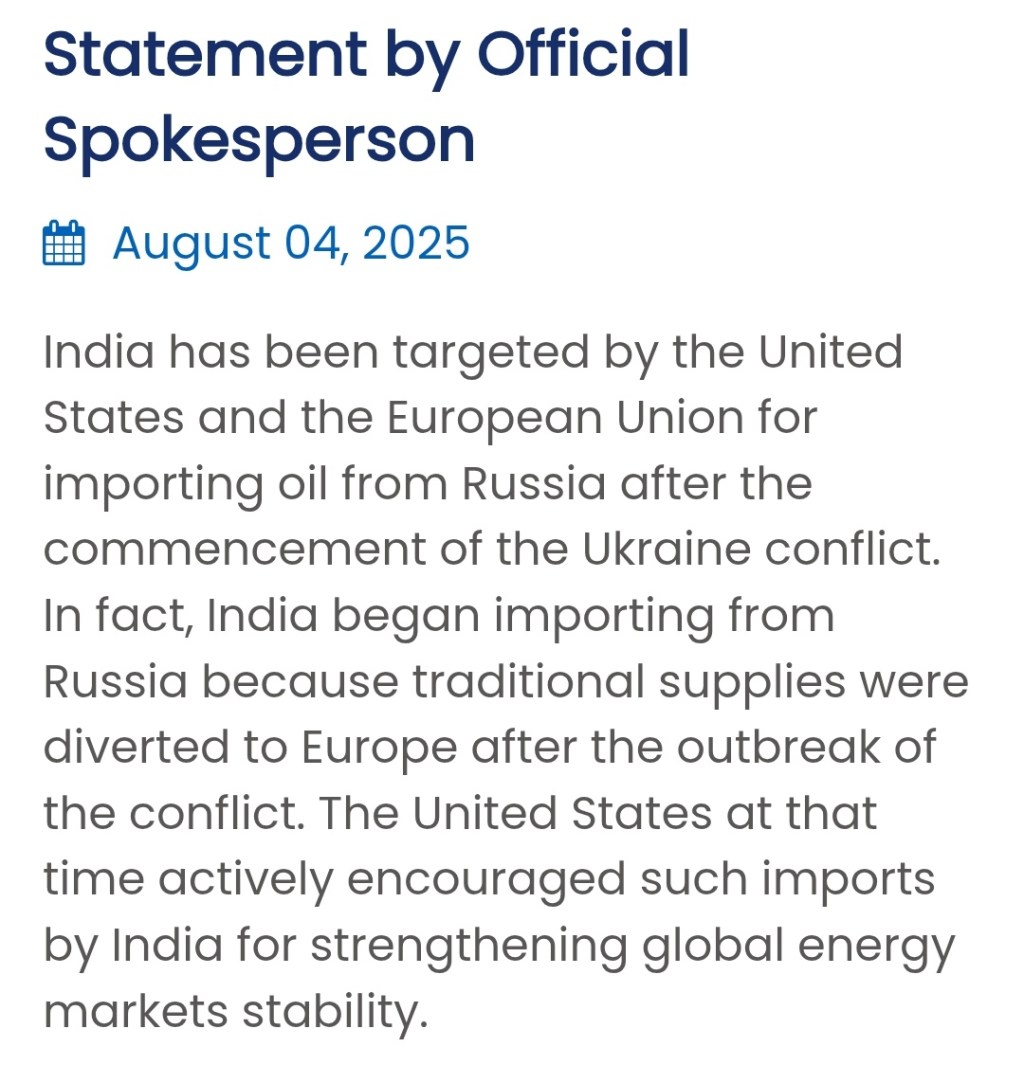
India’s Ministry of External Affairs (MEA) swiftly branded the tariffs “unjustified and unreasonable,” accusing the US and EU of double standards in their own trade with Russia.
As bilateral trade talks falter, the tariffs threaten India’s $85 billion export market to the US and strain a once-warming US-India relationship.
Why Is the US Targeting India?
1. India’s Trade with Russia
The US has singled out India’s purchase of Russian crude oil and military equipment as a primary justification for the tariffs.
India, now the largest buyer of seaborne Russian crude, imported 1.75 million barrels per day in the first half of 2025, a 1% increase from 2024, worth $50.2 billion annually. This trade surged after Russia’s 2022 invasion of Ukraine, when Western sanctions diverted traditional oil supplies to Europe, prompting India to buy discounted Russian crude to stabilize domestic energy prices.
Trump has accused India of “fuelling the Russian war machine” by reselling refined oil for profit, a claim disputed by India’s Global Trade Research Initiative (GTRI), which notes India exports only refined petroleum products, not crude, as standard practice for energy-importing nations.
The US’s frustration stems from its push to isolate Russia economically to pressure President Vladimir Putin into a Ukraine ceasefire.
Trump’s 8 August deadline for Russia to de-escalate or face sanctions on its energy exports has put India in the crosshairs, despite former US Ambassador Eric Garcetti’s 2024 statement that Washington encouraged India’s oil purchases to cap global prices.
India argues it prevented a price shock, with Energy Minister Hardeep Singh Puri noting that without India’s imports, oil could have hit $130 per barrel.
2. India’s High Tariffs and Trade Barriers
Trump has repeatedly called India the “tariff king,” criticizing its high import duties, among the world’s highest, and “strenuous and obnoxious” non-monetary trade barriers.
India’s average applied tariff rate is 17%, with peaks of 150% on agricultural goods to protect its 50% agrarian workforce.
The US, facing a $45.8 billion trade deficit with India in 2024, seeks greater market access for its agricultural and dairy products, which India resists due to economic and political sensitivities.
Trump’s tariffs aim to pressure India into a trade deal, with White House economic adviser Kevin Hassett suggesting they could force India to “reconsider its practices.”
3. The Adani Connection
The Adani Group, led by billionaire Gautam Adani, has emerged as a flashpoint in US-India relations.
In November 2024, US prosecutors indicted Adani and associates for a $265 million bribery scheme to secure solar energy contracts, alongside allegations of sanctions violations involving Iranian LPG imports via Adani Ports.
The scandal led to a $34 billion market value loss for Adani companies and the cancellation of $2.6 billion in Kenyan infrastructure deals.
The US views Adani’s operations as emblematic of India’s lax corporate governance, amplifying calls for sanctions.
This has fueled perceptions that the tariffs partly target India’s business elite, closely tied to Prime Minister Narendra Modi, to signal disapproval of crony capitalism.
4. The Pakistan Angle
Trump’s recent overtures to Pakistan, India’s arch-rival, have added a geopolitical sting. In 2025, Trump hosted Pakistan’s army chief and announced a trade framework to develop Pakistan’s “massive oil reserves,” taunting India with the prospect of Pakistan exporting oil to it. Pakistan faces a lower 19% tariff compared to India’s 25%, raising concerns in New Delhi about a US tilt toward Islamabad. Trump’s claim of brokering an India-Pakistan ceasefire in May 2025, which India denies, further strains trust. Analysts suggest Trump is leveraging Pakistan to counter India’s non-alignment and pressure it on Russia.
5. Cryptocurrency’s Role
Cryptocurrency has emerged as a quiet but significant irritant.
The US alleges that India’s lax regulation of digital currencies facilitates trade with sanctioned entities like Russia, bypassing dollar-based financial systems.
India’s push for de-dollarization via BRICS aligns with its crypto-friendly stance, raising US concerns about undermining the dollar’s dominance. India’s 2022 crypto tax framework, while strict, has not curbed blockchain-based trade, prompting US scrutiny amid fears of sanctions evasion.
6. Lack of a US Ambassador to India
The absence of a US ambassador to India since Eric Garcetti’s departure in 2024 has hampered diplomacy.
With no high-level envoy to navigate trade talks or clarify misunderstandings, miscommunications have escalated.
The vacancy, amid Trump’s focus on domestic priorities, signals a lack of urgency in US-India relations, leaving India feeling sidelined as Trump engages directly with rivals like Pakistan.
7. Trump’s QUAD Uncertainty
Trump’s ambivalence toward the Quadrilateral Security Dialogue (QUAD), comprising the US, India, Japan, and Australia, adds complexity.
His potential absence from QUAD summits, citing scheduling conflicts, has raised doubts about US commitment to countering China, India’s strategic rival.
India, a linchpin in QUAD, fears Trump’s tariffs and criticism of its Russia ties could weaken the alliance, especially as India balances its historic Russia relationship with Western partnerships.
8. Russia-Ukraine War and India’s Role
The US sees India’s Russia ties as undermining efforts to end the Russia-Ukraine war, now in its third year.
Trump’s frustration with Putin’s refusal to de-escalate has led to secondary sanctions threats against Russia’s trading partners.
India’s $68.7 billion trade with Russia in 2024-25, including $50.2 billion in oil, is viewed as sustaining Moscow’s war economy.
Yet, India argues its purchases are market-driven, not political, and points to the EU’s €78.1 billion trade with Russia and US imports of Russian uranium and palladium as evidence of Western hypocrisy.
India’s Response: Defiance and Diplomacy
India has responded with a blend of defiance and strategic restraint.
The MEA’s six-point rebuttal on 5 August 2025 called out the US and EU’s “double standards,” noting their own trade with Russia lacks India’s “vital national compulsion.”
India emphasized that its oil imports stabilized global markets, a role encouraged by the US in 2022. Prime Minister Modi has doubled down on the “Make in India” campaign, urging domestic consumption to counter tariff impacts.
The government is also pushing exporters to build global brands and explore niche markets to reduce reliance on the US, which accounts for 20% of India’s exports.
India’s refusal to halt Russian oil purchases reflects its non-aligned foreign policy and economic priorities.
Despite pressure, Modi has not ordered refineries to stop imports, though some public-sector refiners reduced purchases in July 2025 due to market uncertainties.
India’s commerce ministry insists on a “fair, balanced, and mutually beneficial” trade deal, rejecting US demands to open its agriculture and dairy sectors, which employ half its population.
Analysts like Ajay Srivastava of GTRI argue India’s principled stand avoids a “one-sided deal,” preserving sovereignty.
Both Sides of the Coin
The US Perspective
The US justifies its tariffs as a tool to address trade imbalances and geopolitical misalignment. The $45.8 billion trade deficit with India, coupled with India’s high tariffs, frustrates US businesses seeking market access. Trump’s administration views India’s Russia trade as a direct challenge to Western sanctions, undermining efforts to pressure Putin. The Adani scandal reinforces perceptions of systemic corruption, while India’s crypto policies raise concerns about financial transparency. By cozying up to Pakistan, the US aims to leverage regional rivalries to nudge India toward compliance. The ambassadorial vacancy and QUAD uncertainties reflect Trump’s prioritization of domestic economic goals over multilateral diplomacy.
India’s Perspective
India sees the tariffs as an unfair attempt to coerce it into abandoning its non-aligned foreign policy. The MEA argues that its Russia trade is a pragmatic response to global market disruptions, not an endorsement of Moscow’s actions. India highlights Western hypocrisy, noting the EU’s €78.1 billion trade with Russia and US imports of critical commodities. The Adani case, while damaging, is viewed as a US overreach into India’s domestic affairs. Trump’s Pakistan overtures are perceived as a provocative shift, undermining decades of US-India rapprochement. The lack of a US ambassador and Trump’s QUAD hesitancy signal a lack of respect for India’s strategic role, prompting calls for stronger BRICS cooperation and de-dollarization.
Impact on the Common Indian: The Rupee-Dollar Nexus
The tariffs threaten significant economic fallout for India’s 1.4 billion citizens, particularly through the rupee’s volatility against the dollar.
On 4 August 2025, the rupee hit a record low, closing at 87.25 after a 0.17% drop, despite RBI interventions and falling oil prices. The BSE Sensex fell 0.38%, and foreign institutional investors sold ₹5,600 crore in equities, reflecting tariff-related uncertainty. A 25% tariff could disrupt nearly half of India’s $85 billion US exports, impacting sectors like textiles, pharmaceuticals, and IT, which employ millions.
For the common Indian, this translates to higher costs.
A weaker rupee increases import prices for essentials like oil (70% imported), electronics, and medical equipment, fueling inflation. With 60% of Indians spending over half their income on food and fuel, tariff-induced price hikes could squeeze household budgets.
For example, a 10% rupee depreciation could raise petrol prices by ₹5-7 per litre, hitting small businesses and daily wage earners hardest. Conversely, exporters may gain from a weaker rupee, but only if they pivot to non-US markets, a process requiring time and investment.
The Adani scandal indirectly affects citizens through market instability.
Adani’s dominance in ports and energy means stock crashes ripple across supply chains, potentially raising logistics and electricity costs. The lack of a US ambassador delays resolution, prolonging economic uncertainty, while Trump’s QUAD waffling undermines India’s global standing, affecting investor confidence.
Policy Recommendations
- Diversify Energy Sources: India should accelerate renewable energy adoption and diversify oil imports (e.g., from Saudi Arabia, UAE) to reduce reliance on Russia, mitigating sanctions risks without compromising energy security.
- Strengthen Trade Resilience: India should fast-track FTAs with the EU, UK, and ASEAN to offset US market losses. Promoting “Make in India” brands globally can reduce export vulnerabilities.
- Enhance Corporate Governance: To counter perceptions of cronyism, India must enforce stricter anti-corruption laws and transparent bidding for PPPs, addressing concerns raised by the Adani case.
- Crypto Regulation: India should clarify its cryptocurrency policies, aligning with FATF standards to prevent sanctions evasion while fostering blockchain innovation.
- Diplomatic Engagement: India should push for a US ambassador appointment and engage QUAD allies to reinforce its strategic role, countering Trump’s Pakistan tilt.
- Rupee Stabilization: The RBI should expand forex reserves and explore bilateral trade in local currencies (e.g., rupee-rouble) to cushion tariff shocks.
- US Policy Shift: The US should prioritize dialogue over tariffs, appointing an ambassador to rebuild trust and clarify India’s role in global energy stability.
The Road Ahead
The US-India trade spat reflects deeper geopolitical tensions, with India caught between its non-aligned legacy and Western expectations.
Trump’s tariffs aim to reshape global trade and pressure Russia, but risk alienating a key ally. India’s defiance safeguards its sovereignty but invites economic pain, particularly for ordinary citizens facing rising costs.
The absence of diplomatic channels and Trump’s erratic signals—on Pakistan, QUAD, and Russia—complicate resolution.
As Dhruva Jaishankar of the Observer Research Foundation notes, “Trump’s approach threatens two decades of US-India progress.”
Yet, India’s resilient economy and strategic balancing may weather the storm, provided it diversifies and reforms.
For the common Indian, the immediate challenge is clear: a weaker rupee and higher prices loom, testing the nation’s economic grit.
Sources: Reuters, BBC, The Indian Express, Times of India, India Today, NPR, CNBC, The Guardian, AP News, Hindustan Times, Al Jazeera, NBC News, GTRI Reports, X Posts



Leave a comment