
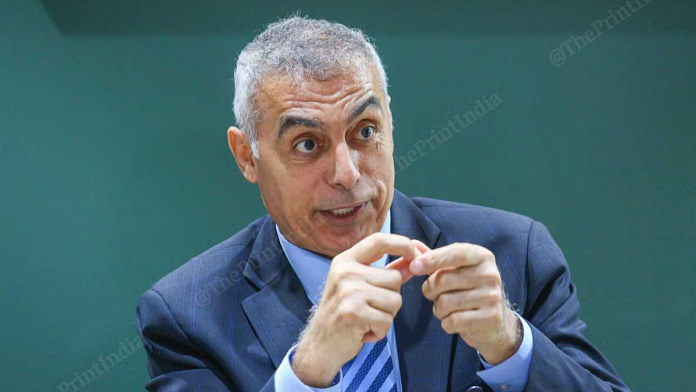
From the Shores of Gaza to the Corridors of Global Diplomacy
In the narrow, crowded streets of Gaza, where the Mediterranean Sea meets the dreams and struggles of nearly two million souls, a boy was born who would one day carry the voice of Palestine to the far corners of the world.
Abdullah Abu Shawesh’s story begins in this slender strip of occupied land, a place that would forever shape his understanding of resilience, hope, and the unyielding human spirit in the face of seemingly impossible odds.
The Gaza Genesis: Roots in Sacred Soil
To be born in Gaza is to inherit a legacy written in both blood and beauty, in the salt of tears and the salt of the sea. Abdullah Abu Shawesh entered this world in a place where every dawn carries the possibility of both profound loss and miraculous survival, where children learn to dream between the sound of waves and the echo of conflict.
Gaza in the years of Shawesh’s youth was a crucible of Palestinian identity.
The narrow coastal enclave, measuring just 365 square kilometers, contained within its borders the concentrated essence of the Palestinian experience—refugee camps that had become permanent communities, families whose keys still opened doors in villages that existed now only in memory, and a people who refused to let their national identity dissolve despite decades of displacement and hardship.
Growing up in this environment meant that young Abdullah’s earliest lessons were not just in mathematics and language, but in the complex arithmetic of survival and the grammar of resistance. Every Gaza child learns early that their personal story is inseparable from their people’s story, that their individual dreams must somehow align with collective aspirations for freedom and dignity.
The boy who would become Ambassador Shawesh absorbed these lessons not through formal instruction but through the lived reality of Gaza life. He witnessed the daily heroism of mothers stretching meager resources to feed their families, fathers maintaining dignity despite the crushing limitations of economic blockade, and teachers who continued to nurture young minds even when the schools themselves became targets of conflict.
The Scholar’s Path: Birzeit University and the Formation of a Mind
In 1993, as the Oslo Accords sparked hope across the Palestinian territories that a new chapter might be beginning,Abdullah Abu Shawesh embarked on his own new chapter, leaving Gaza for the hills of Ramallah to attend Birzeit University.
The timing was symbolic—as Palestinian leaders negotiated for political autonomy, young Palestinians like Shawesh were pursuing the educational foundations that would be necessary to build whatever state structure might emerge.
Birzeit University, perched on the hills outside Ramallah, represented something profound in the Palestinian imagination. Founded in 1924, it had become not just an institution of higher learning but a symbol of Palestinian intellectual resistance and cultural preservation. For a young man from Gaza, walking its campus meant stepping into the broader Palestinian national narrative, meeting students from across the West Bank, East Jerusalem, and other parts of the diaspora.
The Faculty of Economics and Commerce where Shawesh enrolled was more than an academic department—it was a laboratory for understanding the complex economic challenges that would face any future Palestinian state. His professors, many of them trained at universities around the world but committed to serving their homeland, brought global perspectives to bear on distinctly Palestinian problems.
During his undergraduate years from 1993 to 1997, Shawesh pursued his Bachelor’s degree in Economics with a minor in Business Administration while the Palestinian territories experienced the euphoria and gradual disillusionment of the Oslo period. These were years when Palestinian Authority ministries were being established, when Palestinian flags flew openly for the first time in decades, and when young Palestinians dared to imagine careers in the civil service of their own emerging state.
But these were also years of increasing friction, as the promise of Oslo began to collide with the reality of continued settlement expansion, restricted movement, and economic stagnation.
For economics students like Shawesh, the gap between theoretical models and Palestinian economic reality provided harsh lessons in how political constraints shape economic possibilities.
The classroom discussions during this period must have been intense, as professors and students grappled with questions that extended far beyond traditional economic theory.
How do you build an economy when your territory is fragmented by checkpoints and settlements?
How do you plan fiscal policy when you cannot control your own borders or currency?
How do you create employment when movement restrictions prevent workers from reaching job sites?
These questions were not abstract academic exercises for Shawesh and his classmates—they were the fundamental challenges that would define their professional lives and their nation’s future. Every economic principle they studied had to be filtered through the lens of occupation, every business case study had to account for political variables that don’t appear in standard textbooks.
The Formative Years: Ministry of Planning and the Architecture of Hope
Upon completing his undergraduate degree in 1997, Abdullah Abu Shawesh made a choice that would define the trajectory of his life. Rather than pursuing private sector opportunities or emigrating to seek better prospects abroad—choices made by many talented young Palestinians—he joined the Ministry of Planning and International Cooperation as a Deputy Logistics Officer in 1998.
This decision placed him at the very heart of Palestinian state-building efforts during one of the most critical periods in Palestinian history.
The Ministry of Planning was not just another government department but the nerve center of Palestinian efforts to transform political autonomy into economic development and social progress.
Working as a Deputy Logistics Officer, Shawesh found himself coordinating the practical details that made Palestinian development projects possible. Every meeting arranged, every document processed, every logistical challenge resolved contributed to the larger project of building Palestinian institutions and infrastructure.
But these were years when the optimism of Oslo was being tested by harsh realities on the ground. The period of Shawesh’s early career in the Ministry coincided with the breakdown of the Camp David negotiations in 2000 and the outbreak of the Second Intifada. Suddenly, the young logistics officer found himself working not just to coordinate development projects but to maintain basic services under conditions of curfew, closure, and military reoccupation.
The contrast between the Ministry’s planning documents and the reality outside its offices must have been stark. Plans for economic development zones had to be shelved as areas came under Israeli military control. Coordination meetings with international donors became exercises in explaining why projects were delayed by checkpoints, why materials couldn’t reach work sites, why Palestinian officials couldn’t travel to meetings in their own territory.
For Shawesh, these experiences provided an education that no university could offer—an understanding of how political constraints shape every aspect of Palestinian life, and how the work of building Palestinian institutions requires not just technical expertise but extraordinary perseverance and creativity.
The Scholar Returns: Deepening Understanding Through Graduate Study
Recognizing that the challenges facing Palestine required deeper analytical tools, Shawesh returned to Birzeit University in 1999 to pursue a Master’s degree in Economics. This decision to combine practical experience with advanced academic study reflected a mature understanding that effective public service requires both hands-on experience and theoretical sophistication.
His graduate studies from 1999 to 2003 took place during some of the darkest years of the Second Intifada. As he analyzed economic models and development theories in the classroom, Israeli tanks were rolling through Palestinian cities, curfews were paralyzing economic life, and the infrastructure that the Palestinian Authority had spent the 1990s building was being systematically destroyed.
The juxtaposition must have been surreal and heartbreaking.
Here was a young man studying sophisticated economic theories while his homeland was being reoccupied, analyzing development strategies while Palestinian institutions were being dismantled, exploring models of international cooperation while his people were being isolated behind walls and checkpoints.
Yet these experiences also deepened his understanding of the relationship between politics and economics, between security and development, between national liberation and practical governance. The theories he studied took on immediate relevance as he witnessed their application—or impossible implementation—in real time.
His Master’s thesis research, conducted during this period, must have grappled with questions that were both academically rigorous and personally urgent. How do you measure economic development under occupation? What are the implications of political dependency for economic planning? How do national liberation movements transition from resistance to governance?
The completion of his MA in Economics in 2003 coincided with the death of Yasser Arafat and another moment of potential transition in Palestinian politics. Once again, Shawesh’s educational achievements aligned with broader historical moments, positioning him to contribute to whatever new phase of Palestinian development might emerge.
The Professional Deepens: Marketing Expertise and Project Management
Understanding that the Palestinian national project required not just economic expertise but sophisticated communication and management skills, Shawesh pursued additional professional development in the mid-2000s. His enrollment in a Professional Diploma in Marketing at Birzeit University in 2006-2007 reflected a recognition that Palestinian state-building was not just a technical challenge but a communication challenge—how to effectively present Palestinian needs and capabilities to international audiences.
The marketing diploma was followed immediately by a Full Training Course in Project Management Professional (PMP) in Ramallah in 2007. This combination of marketing and project management expertise would prove crucial for his later diplomatic career, providing him with the skills to effectively present Palestinian positions and to coordinate complex international initiatives.
These were years when Palestinian civil society was adapting to new realities. The Second Intifada had ended, but its aftermath left Palestinian society more fragmented than ever. Gaza was increasingly isolated, the West Bank was divided by settlements and checkpoints, and Palestinian political unity had fractured with the division between Fatah and Hamas.
For professionals like Shawesh, working in Palestinian institutions during this period required extraordinary adaptability and resilience. Projects had to be designed around political constraints, communication strategies had to account for multiple audiences with conflicting interests, and professional development had to prepare for an uncertain future.
The UN Years: From Ramallah to the World Stage
In 2014, Abdullah Abu Shawesh’s career took a dramatic turn that would transform him from a Palestinian civil servant into a global diplomatic voice. His appointment to the Ministry of Foreign Affairs of the State of Palestine, specifically to serve with the Permanent Observer Mission of Palestine to the United Nations in New York, represented both personal advancement and national recognition of his skills and dedication.
The Palestine Mission to the UN occupies a unique place in Palestinian institutional life. As Palestine’s primary interface with the international community, it serves as both an embassy to the world and a symbol of Palestinian diplomatic aspirations. For Shawesh, joining this mission meant stepping onto the world stage at one of the most critical moments in recent Palestinian history.
The eight years from 2014 to 2022 that Shawesh spent at the UN Mission coincided with a period of intense international focus on Palestinian issues. These were the years of multiple Gaza wars, escalating settlement construction, the Trump administration’s dramatic policy shifts on Israeli-Palestinian issues, and growing international recognition of Palestinian statehood rights.
Working at the UN during this period meant being at the center of every major crisis and opportunity in Palestinian international relations. When Israeli military operations devastated Gaza, it was officials like Shawesh who briefed international media, coordinated with UN agencies, and worked to mobilize international response. When settlement announcements threatened to eliminate prospects for Palestinian statehood, it was Palestinian UN representatives who worked to maintain international focus and pressure.
The personal cost of this work must have been enormous.
Every day brought reports of Palestinian casualties, destroyed homes, detained activists, and violated rights. For someone whose own family and friends remained in Gaza and the West Bank, following these events from New York while working to mobilize international response must have created extraordinary emotional strain.
Yet these years also provided Shawesh with an invaluable education in international diplomacy and global politics. Working at the UN meant interacting with representatives from every nation on earth, understanding how different countries approach the Palestinian question, and learning to craft arguments that could resonate with diverse cultural and political perspectives.
The skills he had developed in economics, marketing, and project management found direct application in this environment. Understanding economic impacts helped him present Palestinian concerns in terms that resonated with donor countries. Marketing expertise enabled him to effectively communicate Palestinian positions to media and civil society. Project management skills proved crucial for coordinating complex diplomatic initiatives involving multiple countries and organizations.
The African Chapter: Ambassador to Nigeria
In 2022, Abdullah Abu Shawesh’s diplomatic career reached a new pinnacle with his appointment as Ambassador Extraordinary and Plenipotentiary to Nigeria. This posting represented not just personal advancement but strategic Palestinian outreach to one of Africa’s most important nations.
Nigeria, with its population of over 200 million people and its position as Africa’s largest economy, offered unique opportunities for Palestinian diplomacy. The country’s history of supporting liberation movements, its significant Muslim population, and its growing international influence made it a crucial partner for Palestinian diplomatic efforts.
For Shawesh, the transition from multilateral diplomacy at the UN to bilateral diplomacy in Nigeria required adapting his skills to a new context. Instead of addressing the entire international community, he now focused on building deep relationships with Nigerian political, business, and civil society leaders.
The timing of his Nigerian appointment was significant. These were years when the Abraham Accords were reshaping Middle Eastern diplomatic relationships, when some Arab countries were establishing ties with Israel, and when Palestinian diplomacy was working to maintain international support despite these changing regional dynamics.
In Nigeria, Shawesh found an audience that remained deeply sympathetic to Palestinian concerns. Nigeria’s own history of struggling against colonial domination, its experience with religious and ethnic tensions, and its commitment to supporting liberation movements globally created natural bonds with Palestinian aspirations.
His work in Nigeria during this period focused on deepening these natural sympathies into concrete support. This meant not just maintaining Nigeria’s traditional diplomatic support for Palestinian positions but also exploring new areas of cooperation in trade, education, and cultural exchange.
The human dimension of his work in Nigeria became particularly evident during periods of crisis in Palestine. When military operations in Gaza dominated international headlines, Ambassador Shawesh became a familiar figure in Nigerian media, providing context and analysis that helped Nigerian audiences understand Palestinian perspectives on unfolding events.
His statements during these crises revealed the deep personal investment he brought to his diplomatic role. Speaking about Palestinian casualties, he conveyed not just official Palestinian positions but genuine emotion and commitment that resonated with Nigerian audiences who had their own experiences with injustice and suffering.
The Indian Mission: A New Challenge in Complex Times
In February 2025, Abdullah Abu Shawesh was appointed Ambassador Extraordinary and Plenipotentiary to India, marking another significant chapter in his diplomatic career. The appointment came at a crucial moment both for Palestinian diplomacy and for India’s evolving Middle Eastern relationships.
India represents perhaps the most complex and important bilateral relationship in contemporary Palestinian diplomacy. The country’s 1.4 billion people, rapidly growing economy, and increasing global influence make it a crucial partner for Palestinian aspirations. Yet India’s relationship with Israel has also grown significantly in recent years, creating a diplomatic environment that requires exceptional skill and sensitivity to navigate.
For Shawesh, the Indian appointment builds on his previous diplomatic experiences while presenting entirely new challenges. Unlike Nigeria, where Palestinian positions generally align with domestic political sentiment, India requires balancing historical sympathy for Palestinian causes with contemporary strategic interests that sometimes conflict with Palestinian preferences.
The Ambassador’s approach to this challenge has emphasized finding common ground while respecting India’s sovereign right to pursue its own interests. Rather than demanding that India choose between Palestinian and Israeli relationships, he has worked to demonstrate how supporting Palestinian rights aligns with India’s own historical values and contemporary interests in international law and multilateral cooperation.
His public statements in India have shown remarkable diplomatic sophistication, acknowledging India’s growing relationships across the Middle East while arguing that supporting Palestinian rights remains consistent with India’s broader international positions. This approach reflects lessons learned from his previous postings about the importance of respecting host country perspectives while effectively advocating Palestinian positions.
The Personal Dimension: Carrying Gaza in His Heart
Throughout his diplomatic career, Abdullah Abu Shawesh has never forgotten his origins in Gaza. Every professional achievement, every diplomatic success, every moment of international recognition has been measured against the ongoing struggles of the place that shaped him.
Gaza during the years of Shawesh’s career has experienced repeated military conflicts, an increasingly severe economic blockade, and growing international isolation. For someone representing Palestine on the world stage, each crisis in Gaza has represented both professional challenge and personal anguish.
The 2008-2009 Gaza War occurred during his early career in Palestinian civil service. The 2012 conflict happened as he was preparing for his UN mission. The 2014 war took place during his first year at the Palestine UN Mission, requiring him to coordinate international response while worrying about family and friends under bombardment. The 2021 escalation occurred during his time as Ambassador to Nigeria, forcing him to explain Palestinian positions to African audiences while processing his own emotional responses to events in his homeland.
Each of these crises tested not just his diplomatic skills but his psychological resilience. How does one maintain professional composure while describing the destruction of familiar neighborhoods? How does one present balanced analysis while processing reports of civilian casualties that might include people one knows personally?
For Shawesh, the answer seems to have been channeling personal pain into professional commitment. Rather than being paralyzed by the emotional weight of representing Gaza on the world stage, he has transformed that connection into a source of authenticity and passion that makes his diplomatic advocacy more effective.
His statements about Palestinian suffering carry a weight that comes only from personal knowledge. When he describes the impact of blockade on Gaza’s economy, he speaks with the authority of someone who has witnessed that impact firsthand. When he discusses the psychological toll of repeated military conflicts, his words carry the credibility of someone whose own family has lived through those experiences.
The Advocate for Truth: Defending Palestinian Journalists
One of the most passionate aspects of Ambassador Shawesh’s recent diplomatic work has been his advocacy for Palestinian journalists who have faced targeting during recent conflicts. This advocacy reflects not just professional duty but personal understanding of the crucial role that truth-telling plays in Palestinian resistance to oppression.
Growing up in Gaza, Shawesh would have witnessed how controlling information and narrative has been central to Palestinian oppression. The boy who became a diplomat understood early that Palestinian liberation required not just political and economic change but also the right to tell their own story, to bear witness to their own experience, to control their own narrative.
His passionate defense of journalists like Anas al-Sharif reflects this deep understanding. “Palestinian journalists are being targeted for a long time,” he has declared, his voice carrying not just official concern but personal outrage at attempts to silence Palestinian voices.
For Shawesh, the targeting of Palestinian journalists represents an attack on something fundamental to Palestinian identity and resistance. These journalists don’t just report news—they preserve Palestinian memory, document Palestinian experience, and ensure that Palestinian perspectives reach global audiences despite systematic attempts at silencing.
His advocacy for these journalists also reflects professional understanding of how contemporary conflicts are fought as much through information as through military means. In an era when controlling narrative can be as important as controlling territory, the systematic targeting of Palestinian journalists represents a strategic assault on Palestinian political aspirations.
When he speaks about threats to Palestinian media personnel, Ambassador Shawesh brings together his personal connection to Palestinian experience, his professional understanding of international law, and his diplomatic skills in mobilizing international concern. The result is advocacy that is both emotionally compelling and strategically effective.
The Weight of Representation: Carrying a People’s Dreams
To understand Abdullah Abu Shawesh fully requires appreciating the unique psychological burden of Palestinian diplomatic representation. Unlike ambassadors from established states who represent recognized governments with secure territories and defined populations, Palestinian diplomats operate in a liminal space—advocating for a state that exists in aspiration and law but remains constrained by occupation and political reality.
Every morning, Ambassador Shawesh wakes not just to routine diplomatic responsibilities but to the knowledge that millions of Palestinians in Gaza, the West Bank, and the diaspora look to voices like his for progress, for hope, for evidence that their struggle has not been forgotten by the world.
This burden is particularly acute for someone from Gaza. The coastal enclave has become increasingly isolated in recent years, with travel restrictions making it nearly impossible for most Gazans to leave even temporarily. For many in Gaza, diplomats like Shawesh represent their primary connection to the outside world, their main hope that someone with access to international forums is speaking for their concerns.
The emotional weight of this representation becomes evident in Shawesh’s most passionate public statements. When discussing the humanitarian situation in Gaza or the targeting of Palestinian civilians, his diplomatic composure occasionally gives way to raw emotion—the carefully constructed language of international relations cracking to reveal the human being beneath, a man who carries the pain of his people as a physical weight.
Yet rather than being crushed by this burden, Shawesh seems to have been strengthened by it. The responsibility of representation has focused his energies, clarified his priorities, and provided him with a moral clarity that cuts through the often murky world of international diplomacy.
Building Bridges in Turbulent Times
One of Ambassador Shawesh’s most remarkable diplomatic qualities has been his ability to build and maintain relationships even as geopolitical currents shift around Palestinian issues. In India, where the government seeks to balance historical support for Palestine with growing strategic partnerships with Israel, Shawesh has had to navigate increasingly complex waters.
His approach has emphasized finding common ground rather than forcing choices. In meetings with Indian officials and parliamentarians, he consistently focuses on shared values—justice, self-determination, respect for international law, opposition to colonialism—rather than demanding that India choose between Palestinian and Israeli relationships.
This diplomatic wisdom reflects lessons learned throughout his career about how power operates in democratic societies and how lasting change happens through persuasion rather than pressure. Rather than issuing ultimatums or making demands, Shawesh has worked to build genuine relationships based on mutual respect and shared principles.
His success in this approach has been evident in continued Indian parliamentary support for Palestinian positions and in India’s maintenance of its traditional diplomatic support for Palestinian statehood even as other aspects of Indian Middle East policy have evolved.
The Strategic Mind: Lessons from Economics and Project Management
Throughout his diplomatic career, Abdullah Abu Shawesh has drawn on the analytical tools and strategic approaches he developed during his academic and early professional years. His background in economics provides him with frameworks for understanding how political decisions create economic consequences, while his training in marketing and project management offers practical tools for effective advocacy and coordination.
This multidisciplinary background distinguishes him from diplomats who follow more traditional career paths. Where some ambassadors rely primarily on political instincts or cultural knowledge, Shawesh brings systematic analytical tools to bear on diplomatic challenges.
His economic training helps him present Palestinian concerns in terms that resonate with officials focused on development and prosperity. When discussing the impact of occupation on Palestinian economic development, he can speak with authority about specific mechanisms—how restrictions on movement affect productivity, how limitations on imports and exports distort market development, how political uncertainty discourages investment.
His marketing background enables him to craft messages that resonate with different audiences. The same basic Palestinian concern—say, the need for international protection of Palestinian civilians—can be presented differently to African audiences (emphasizing anti-colonial solidarity), Indian audiences (emphasizing shared commitment to international law), or UN audiences (emphasizing humanitarian obligations).
His project management training provides practical tools for coordinating complex diplomatic initiatives that require collaboration among multiple actors. Whether organizing international conferences, coordinating donor meetings, or managing multi-country advocacy campaigns, his PMP training offers systematic approaches to achieving diplomatic objectives.
The Voice of Moral Clarity
In an era when diplomatic language often obscures rather than illuminates truth, Abdullah Abu Shawesh has emerged as a voice of moral clarity that cuts through euphemisms and technical jargon. His willingness to speak directly about suffering, injustice, and the human cost of political decisions has made him a compelling advocate for Palestinian concerns.
This moral clarity does not reflect simplistic thinking or lack of nuance. Rather, it emerges from deep conviction that some issues are fundamentally about right and wrong, and that diplomatic effectiveness sometimes requires abandoning comfortable ambiguity in favor of clear moral positions.
For Shawesh, Palestinian concerns are not primarily technical disputes about borders or legal questions about sovereignty—they are questions of basic human dignity and fundamental rights. This perspective shapes how he approaches diplomatic challenges, leading him to frame Palestinian issues in terms of universal human values rather than narrow political interests.
His approach challenges other diplomatic actors to move beyond comfortable abstractions to confront the human reality of Palestinian experience. When he speaks about the targeting of Palestinian journalists, he doesn’t offer technical discussions of press freedom law but direct moral challenges about the right of Palestinians to tell their own stories.
The Future Bearer: Carrying Forward Palestinian Dreams
As Abdullah Abu Shawesh continues his diplomatic mission from New Delhi, he carries not just the hopes of current Palestinian generations but the dreams of those yet unborn. His work today shapes the international environment that future Palestinian leaders will inherit, and the relationships he builds provide foundations for whatever political resolution eventually emerges.
This future-oriented perspective adds another dimension to his sense of responsibility. He advocates not just for immediate relief or current political positions but works to create conditions that will make Palestinian dignity and statehood possible for generations to come.
The intensity with which he approaches current responsibilities reflects understanding that history will judge Palestinian diplomatic efforts not just by immediate results but by their contribution to ultimate Palestinian liberation. For Shawesh, every diplomatic interaction builds toward that distant but never-abandoned goal.
His personal journey from a boy in Gaza to a global diplomatic voice embodies the broader Palestinian journey from dispossession toward self-determination. The same resilience, creativity, and determination that enabled his individual success reflect the qualities that have enabled Palestinian survival and resistance over decades of challenge.
A Legacy Still Unfolding
Abdullah Abu Shawesh’s biography remains a work in progress, each diplomatic engagement adding new chapters to a story that began in the crowded streets of Gaza and now spans continents. His journey from economics student to UN representative to ambassador reflects both personal achievement and the evolution of Palestinian diplomacy in an increasingly complex global environment.
What emerges from his public record is a portrait of someone who has refused to allow the weight of representing an occupied people to diminish his effectiveness or crush his spirit. Instead, he has transformed that responsibility into a source of strength, using his platform to ensure that Palestinian voices reach audiences that might otherwise remain deaf to Palestinian concerns.
His legacy, still being forged through daily acts of diplomatic courage and strategic wisdom, will ultimately be measured by its contribution to Palestinian liberation and dignity. But already, in the relationships built, awareness raised, and hope sustained, Abdullah Abu Shawesh has established himself as one of the most important Palestinian diplomatic voices of his generation.
The boy from Gaza who became a global advocate carries within his voice not just his own dreams but the collective aspirations of a people who have refused to abandon hope despite decades of disappointment. His continuing journey from New Delhi and beyond represents the ongoing Palestinian journey toward justice, dignity, and peace—a journey that began long before his birth and will continue long after his diplomatic career ends, but to which his voice has added an essential and unforgettable chapter.
In the end, Ambassador Abdullah Abu Shawesh’s life story is inseparable from the larger Palestinian story—marked by extraordinary challenges, sustained by unshakeable conviction, and aimed always toward the distant but never-abandoned dream of return, recognition, and justice for his people.
As he continues his diplomatic mission, he carries with him not just the formal authority of his credentials but the moral weight of Gaza’s hopes and the unfinished business of Palestinian liberation itself.
From the Shores of Gaza to the Corridors of Global Diplomacy



Leave a comment