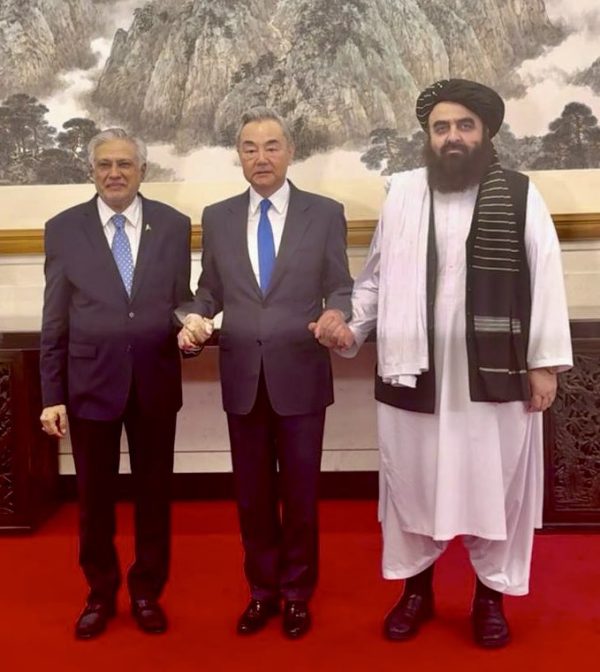
On August 20, 2025, Kabul hosted a historic trilateral meeting between the foreign ministers of Pakistan (Ishaq Dar), China (Wang Yi), and the Taliban-led Afghan government (Amir Khan Muttaqi).
This marks the first high-level summit of its kind in the Afghan capital since the Taliban’s return to power in August 2021.
The discussions, centered on political cooperation, counterterrorism, and the potential extension of the China-Pakistan Economic Corridor (CPEC) to Afghanistan, signal a pivotal moment for the Taliban’s pursuit of international legitimacy and regional integration.
Diplomatic Milestone for the Taliban
The Kabul meeting represents a significant step in the Taliban’s quest for international legitimacy.
Since their takeover, the Taliban has struggled to gain formal recognition from the global community, largely due to their restrictive policies, particularly on women’s rights and education.
No country, including Pakistan and China, has officially recognized the Taliban as Afghanistan’s legitimate government.
However, both nations have engaged pragmatically, with China accepting a Taliban-appointed ambassador in 2023 and Pakistan maintaining open channels despite strained relations.
Hosting this trilateral summit in Kabul elevates the Taliban’s diplomatic profile, showcasing their ability to convene major regional powers.
The meeting builds on prior engagements, such as the May 2025 trilateral talks in Beijing, but its location in Kabul carries symbolic weight.
For the Taliban, it is a chance to project governance capacity and assert Afghanistan’s role in regional affairs. The agenda, which includes discussions on trade, connectivity, and security, reflects the Taliban’s desire to move beyond isolation and integrate Afghanistan into regional frameworks. However, the absence of formal recognition and ongoing international sanctions complicate this ambition, as frozen Afghan assets and reduced foreign aid continue to cripple the economy.
Economic Opportunities: Extending CPEC to Afghanistan
A central focus of the meeting is the potential inclusion of Afghanistan in the China-Pakistan Economic Corridor, a flagship project of China’s Belt and Road Initiative (BRI).
CPEC, which connects Pakistan’s Gwadar Port to China’s Xinjiang region through infrastructure and energy projects, has already transformed Pakistan’s economic landscape.

Extending CPEC to Afghanistan could bring much-needed investment, infrastructure development, and job creation to a country grappling with economic collapse.
Since 2021, Afghanistan’s GDP has contracted significantly, with unemployment and poverty rates soaring due to the loss of Western aid and banking restrictions.
For the Taliban, CPEC offers a lifeline.
Projects such as road networks, energy pipelines, and trade corridors could integrate Afghanistan into regional markets, particularly with Central Asia and China.
The Taliban has already initiated small-scale infrastructure projects, such as road repairs and irrigation systems, but lacks the capital and expertise for large-scale development.
China’s investment, coupled with Pakistan’s logistical support, could address these gaps. For China, extending CPEC aligns with its strategic goal of expanding influence in Central Asia, securing trade routes, and accessing Afghanistan’s untapped mineral resources, estimated to be worth over $1 trillion.
However, economic cooperation faces hurdles.
Afghanistan’s unstable security environment, coupled with the Taliban’s limited administrative capacity, raises concerns about project feasibility. Corruption, mismanagement, and the risk of militant attacks on infrastructure could deter investors.
Moreover, the Taliban’s failure to address human rights issues, particularly restrictions on women’s participation in the workforce, may limit the inclusivity and sustainability of economic gains. International donors and institutions, wary of legitimizing the Taliban, may also hesitate to support CPEC projects in Afghanistan.
Security Cooperation and the TTP Challenge
Security remains a critical agenda item, particularly for Pakistan, which has faced a surge in attacks by the Tehreek-e-Taliban Pakistan (TTP) since 2021.
In 2024 alone, Pakistan recorded 521 TTP-related attacks, resulting in significant casualties and economic disruption.
Pakistan has repeatedly accused the Taliban of failing to curb TTP activities, alleging that the group operates from Afghan soil. The Kabul meeting saw the Taliban reaffirm commitments to prevent Afghanistan from being used as a base for terrorism, a promise central to securing Pakistan’s cooperation.
For China, security is equally critical.
Chinese nationals and projects in Pakistan, including CPEC infrastructure, have been targeted by militants, some allegedly linked to Afghan-based groups.
The Kabul talks aim to establish a coordinated counterterrorism framework, with intelligence-sharing and joint operations under discussion.
However, mistrust between Pakistan and the Taliban complicates these efforts.
Historical tensions, including Pakistan’s support for the Taliban in the 1990s contrasted with its alignment with the U.S. post-9/11, have left lingering suspicions. The Taliban’s reluctance to crack down on TTP, possibly due to ideological or tribal affiliations, further strains relations.
Geopolitical Dynamics: Countering India’s Influence
The trilateral meeting also reflects a broader geopolitical contest in South Asia, particularly the rivalry between Pakistan, China, and India.
India has recently deepened its engagement with the Taliban, with high-level meetings in May 2025 signaling a pragmatic shift in New Delhi’s policy.
India’s investments in Afghanistan, including infrastructure and humanitarian aid, aim to maintain influence and counterbalance Pakistan and China. The Kabul meeting, therefore, serves as a strategic move by Pakistan and China to limit India’s foothold in Afghanistan.
For Pakistan, the stakes are high.
A stable Afghanistan aligned with Pakistan and China could reduce India’s regional influence and secure Pakistan’s western border.
For China, Afghanistan’s inclusion in CPEC strengthens its strategic position against India, particularly in the context of ongoing border disputes.
However, the Taliban’s engagement with India suggests a balancing act, as Kabul seeks to diversify partnerships to avoid over-reliance on any single power.
This dynamic underscores the complex interplay of cooperation and competition shaping Afghanistan’s foreign relations.
Challenges and Criticisms
Despite the meeting’s potential, significant challenges loom.
The Taliban’s governance record, particularly its restrictions on women’s rights and education, remains a major obstacle to international acceptance.
The United Nations and human rights organizations have documented severe setbacks, including bans on girls’ secondary education and women’s employment in public sectors. These policies not only alienate global stakeholders but also limit Afghanistan’s ability to build a capable workforce for economic projects like CPEC.
Mistrust between the Taliban and Pakistan persists, particularly over the TTP issue.
Pakistan’s demands for decisive action against TTP sanctuaries are met with Taliban assurances, but implementation remains uncertain.
Economic constraints, including Afghanistan’s frozen assets and lack of access to global financial systems, further complicate development goals.
Additionally, the Taliban’s narrative of progress—emphasizing infrastructure and stability—often clashes with international perceptions of repression and instability.
Conclusion
The trilateral meeting in Kabul on August 20, 2025, marks a turning point for Afghanistan’s regional engagement.
For the Taliban, it is an opportunity to gain legitimacy, attract investment, and assert influence in South Asia. For Pakistan and China, it strengthens strategic partnerships and counters India’s growing presence.
The potential extension of CPEC to Afghanistan could transform the region’s economic landscape, while coordinated counterterrorism efforts aim to address shared security threats.
However, the success of these initiatives hinges on overcoming mistrust, addressing human rights concerns, and navigating geopolitical rivalries.
As Afghanistan stands at this crossroads, the Kabul meeting underscores both the promise and the peril of its reintegration into the regional order.
The international community, particularly Western powers, will watch closely to see whether the Taliban can balance pragmatic diplomacy with domestic reforms to secure a stable and prosperous future.


Leave a comment