
In the shadow of the snow-capped Himalayas, Nepal – a nation long synonymous with political fragility and youthful aspiration – has been thrust into turmoil once again.
As of September 13, 2025, the streets of Kathmandu are slowly returning to a semblance of normalcy, but the scars of the past week’s violence linger.
Parliament House lies in ruins, its charred remains a stark symbol of a Gen Z-led revolt that has toppled a prime minister, dissolved the legislature, and installed the country’s first female leader in an unprecedented online poll.
What began as a protest against a draconian social media ban has ballooned into a broader cry for accountability, exposing deep-seated frustrations over corruption, nepotism, and economic despair. At least 30 people have died, over 1,000 injured, and the economy – already battered by remittances-dependent growth – teeters on the brink
This uprising, dubbed the “Gen Z Revolution,” marks a pivotal moment for Nepal, a country that has cycled through 14 governments since the abolition of its monarchy in 2008.
Led by young people aged 13 to 28, who organised via banned platforms using VPNs and Discord servers, the protests have forced Prime Minister KP Sharma Oli’s resignation and the swearing-in of former Chief Justice Sushila Karki as interim prime minister on September 12.

Yet, even as curfews lift and the international airport reopens, demonstrators vow to continue, demanding not just a new face in power but systemic change.
“We have not yet won the war,” says 24-year-old protester Yujan Rajbhandari, encapsulating the movement’s unyielding spirit.
The immediate catalyst for the 2025 protests was the Nepalese government’s abrupt suspension of 26 social media platforms on September 4, 2025. Platforms including Facebook, Instagram, YouTube, WhatsApp, X (formerly Twitter), WeChat, VK, and LINE were blocked, ostensibly for failing to comply with new registration requirements under the Ministry of Communication and Information Technology.
Officials claimed the move aimed to curb misinformation and foreign interference, but critics decried it as a blatant attempt to silence dissent amid mounting public anger over elite corruption.
For Nepal’s Gen Z – a demographic comprising nearly 40% of the population and facing youth unemployment rates exceeding 20% – social media was more than a tool for entertainment; it was a lifeline to the world.
With one-third of the GDP reliant on remittances from migrant workers abroad, many young Nepalis use these platforms to stay connected with family, seek job opportunities, and amplify grievances against a political class accused of nepotism.
The ban, enforced without viable domestic alternatives, evoked comparisons to China’s Great Firewall, isolating a generation already marginalised by economic stagnation.
Beneath this trigger lay deeper fissures. Protests had been simmering since early 2025, fuelled by exposés of politicians’ children – dubbed “Nepo Kids” – flaunting luxury lifestyles on Instagram, from private jets to designer wardrobes, while ordinary citizens grappled with inflation and joblessness.

Filmmaker and protester Pramin captured the sentiment: “Social media is the only platform where we can talk and share and follow the global media. Most of our friends, our families, our brothers, are outside the country so that was the medium of communication.” The ban was the “last straw,” as Sareesha Shrestha, a young demonstrator, put it, igniting a movement that bypassed traditional opposition parties
Economically, Nepal’s woes are structural.
Post-COVID recovery has been uneven, with tourism – a key sector – still lagging and agriculture employing over 60% of the workforce amid climate vulnerabilities.
Corruption scandals, including allegations against Oli’s coalition for siphoning public funds, have eroded trust. Transparency International ranks Nepal 110th out of 180 countries in its 2024 Corruption Perceptions Index, a decline from previous years. Youth, educated yet underemployed, see little prospect for change in a system where political dynasties dominate.
The ban’s rollout exacerbated these tensions.
Protesters, using VPNs to circumvent blocks, shared videos of police crackdowns, turning local outrage into a viral phenomenon.
By September 8, thousands gathered in Kathmandu’s Maitighar Mandala, a symbolic site near the federal parliament, marking the protests’ formal launch. What started as chants for “justice and jobs” quickly escalated, as the government’s heavy-handed response – including arrests of student leaders – only swelled the crowds.
Analysts note parallels with global youth movements, where digital tools democratise dissent. In Nepal, however, the stakes are higher: without social media, the opposition’s fragmented parties lacked coordination, leaving Gen Z to fill the void. This grassroots surge highlights a generational shift, where memes and live streams challenge entrenched power more effectively than ballots in a flawed democracy.
Yet, the ban’s lift on September 9 – just days after Oli’s resignation – underscores its tactical miscalculation.
It failed to quell unrest, instead galvanising a tech-savvy cohort determined to reclaim their voice.
As Shree Gurung, another protester, lamented: “(Gen Z) demanded accountability… But unfortunately, what we saw (was) the government using excessive forces and killing, murdering these youths.” The spark had ignited a firestorm, revealing Nepal’s youth as both victims and architects of change.
A History of Unrest: Nepal’s Turbulent Politics
Nepal’s propensity for protest is woven into its political fabric, a legacy of monarchy, civil war, and fragile federalism. To understand the 2025 Gen Z uprising, one must trace back to the seismic shifts of the early 21st century.
The turning point came in 2001 with the Nepalese royal massacre, when Crown Prince Dipendra gunned down nine members of the royal family, including his father, King Birendra.
The tragedy destabilised the Shah dynasty, paving the way for Maoist insurgents who waged a decade-long civil war (1996-2006) that claimed over 17,000 lives. The conflict ended with a peace accord, but not before exposing the monarchy’s irrelevance and the state’s failure to address rural poverty and ethnic marginalisation.
By 2008, a constituent assembly abolished the 240-year-old monarchy, ushering in a secular republic under a new constitution in 2015.
This document promised federalism and inclusion for Nepal’s diverse ethnic groups, but implementation faltered.
Power concentrated in Kathmandu, fuelling regional discontent in the Terai plains and hill districts. Since then, no government has completed a full five-year term; 14 administrations have risen and fallen under a carousel of prime ministers: KP Sharma Oli (Communist Party of Nepal-Unified Marxist-Leninist), Pushpa Kamal Dahal (Maoist Centre), and Sher Bahadur Deuba (Nepali Congress).
This instability stems from coalition politics in a multi-party system prone to horse-trading.
Oli, a veteran strongman who dissolved parliament twice in 2020-2021 (rulings later overturned by the Supreme Court), epitomised the era’s authoritarian leanings.
His 2024 return to power via a UML-Maoist alliance was marred by corruption allegations, including misuse of earthquake relief funds and border disputes with India.
Pro-monarchy rallies earlier in 2025, demanding a Hindu state, highlighted elite frustrations but were overshadowed by youth anger at systemic graft.
Protests have been a recurring motif.
The 2006 People’s Movement (Jana Andolan II) ousted King Gyanendra’s direct rule, restoring parliament.
In 2015, Madhesi agitations against the constitution blocked borders, causing shortages.
More recently, 2022 student protests against Oli’s COVID mismanagement echoed today’s cries.
Each wave exposed fault lines: ethnic federalism’s uneven rollout, gender disparities (women hold just 33% of parliamentary seats), and economic inequality, with the Gini coefficient at 0.32 indicating moderate but persistent divides.
Gen Z’s role marks a departure.
Unlike predecessors tied to ideological factions, these protesters – many first-time voters – are apolitical, driven by lived realities.
Sahadev Khatry, a lawyer involved, noted: “I think Nepal is ready to see the young faces along with the experienced ones.” Their movement bypasses parties, using digital tools to demand transparency, a novelty in a nation where patronage networks thrive.
Historically, such unrest has yielded mixed results.
The 2006 movement birthed democracy but entrenched elite capture.
Today’s crisis, amid climate threats like glacial lake outbursts and post-2015 earthquake rebuilding delays, risks derailing progress. Fitch Ratings recently upgraded Nepal’s growth forecast to 4.5% for 2026, but protests could shave 1-2% off GDP through tourism losses and investor flight. Nepal’s history teaches that protests catalyse change but often at great cost, leaving a vacuum for opportunists.
The Protests Unfold: From Peace to Chaos
The sequence of events from September 8 to 12, 2025, unfolded with breathtaking speed, transforming peaceful gatherings into a national inferno.
It began on Monday, September 8, when thousands of young demonstrators, many in school uniforms, converged on Maitighar Mandala in central Kathmandu. Organised via encrypted Discord channels and VPN-accessed social media, the initial protests were disciplined: chants of “End Corruption!” and “Lift the Ban!” echoed without incident.

By evening, crowds swelled to tens of thousands, spilling into major cities like Pokhara and Biratnagar. Students from Tribhuvan University led marches, holding placards decrying “Nepo Kids” and elite excess.
The turning point came the next day.
As protesters approached federal parliament, police erected barricades.
What followed was chaos: demonstrators breached lines, prompting officers to deploy tear gas, water cannons, rubber bullets, and – horrifically – live ammunition.
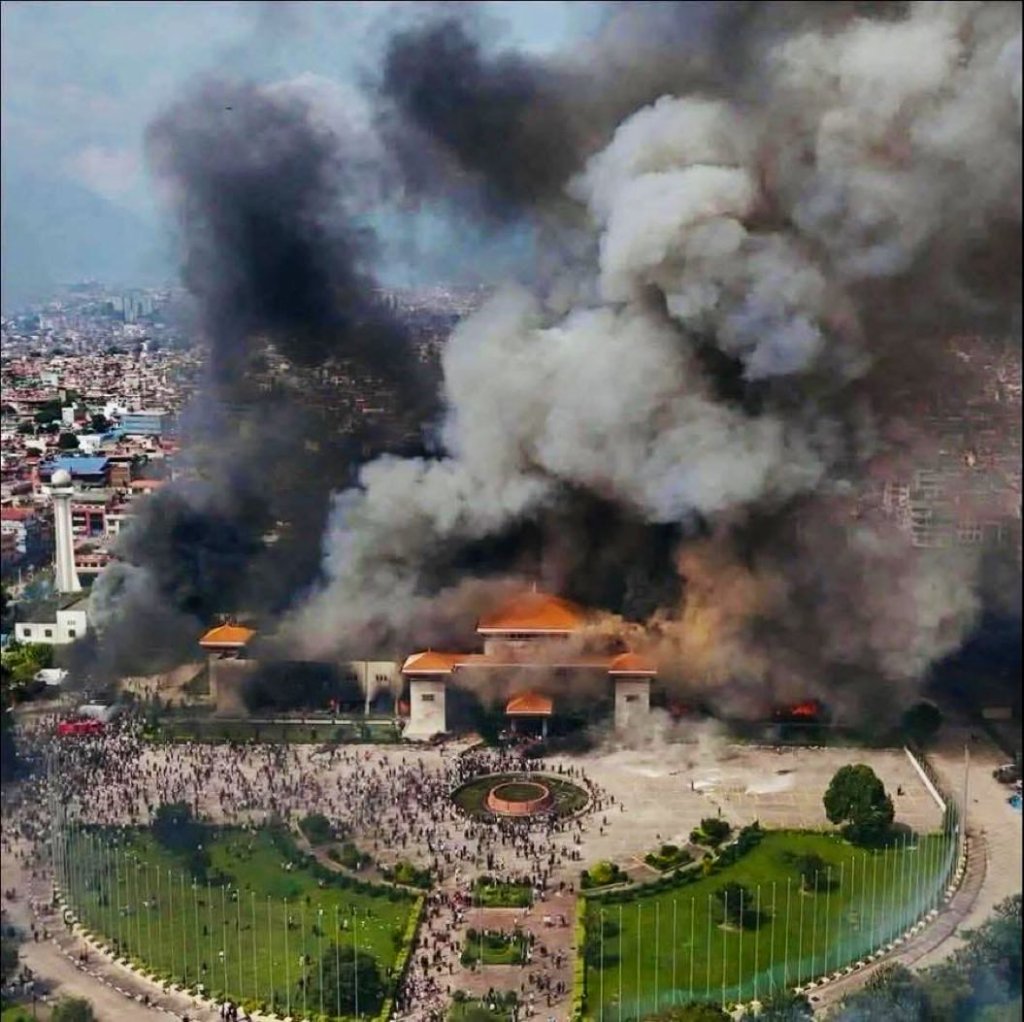
At least 19 youths aged 12-24 were killed in the initial clashes, with health ministry figures rising to 30 deaths and over 1,000 injuries by mid-week.
Eyewitnesses described scenes of pandemonium: “They destroyed everything,” said Khatry, referring to the burning of parliament, the Supreme Court, and Singha Durbar, the government’s administrative hub.
Tuesday, September 9, saw escalation.
Defying partial curfews, crowds looted businesses and torched vehicles, including at Oli’s private residence. The international airport shut for 24 hours amid fears of sabotage.
Social media, though banned, buzzed with smuggled videos; a Discord server with 145,000 members became a virtual war room, coordinating aid and nominating leaders. By evening, Oli announced his resignation in a letter citing an “extraordinary situation,” posted online by an aide.
Wednesday brought military intervention.
The Nepali Army, deployed nationwide, imposed a full curfew, patrolling with checkpoints in the Kathmandu Valley. President Ramchandra Paudel appealed for dialogue: “Come to talk,” he urged youth leaders. The ban was lifted that day, but damage was done: important judicial records were nearly destroyed in the Supreme Court fire, as the court later confirmed.
By Thursday, September 12, parliament was dissolved, and Sushila Karki – a 73-year-old anti-corruption crusader and former Chief Justice – was sworn in as interim PM, selected via the Discord poll.
Celebrations mixed with sorrow; Saraswati Mahara, mother of an injured protester, said: “We should fight against injustice. If we do not raise voice, then who will?”
The violence’s toll is profound.
Fires ravaged historic sites, symbolising not just rage but a rejection of institutions. Police excesses drew UN condemnation, with Secretary-General António Guterres calling for investigations and human rights compliance.
Some protesters distanced from the destruction, blaming “opportunists,” as Shrestha noted: “They’re not just buildings… They carry our history, our legacy.”
This rapid descent reflects Nepal’s volatility, where peaceful dissent often meets force, amplifying grievances. The army’s restraint – appealing for “peaceful solution through dialogue” – averted worse bloodshed, but the episode underscores the fragility of civil-military relations in a republic born of conflict.
The Fall of Oli and Rise of Karki
KP Sharma Oli’s downfall was as swift as it was inevitable. The veteran leader, who had weathered scandals and court battles, resigned amid the inferno engulfing his symbols of power. His coalition’s collapse left a void, filled innovatively by Gen Z.
Oli’s tenure, marked by border brinkmanship with India and constitutional overreach, alienated youth. The social media ban, perceived as a ploy to muzzle anti-corruption campaigns, sealed his fate. Resignation came not from parliament but street pressure, a first in modern Nepal.
Enter Sushila Karki, whose ascent via Discord – amassing the most votes in a poll – blends digital democracy with judicial gravitas. As Chief Justice (2019-2023), she spearheaded anti-graft drives, earning bipartisan respect. Her swearing-in as Nepal’s first woman PM is historic, symbolising gender progress in a male-dominated polity. Vowing an “anti-corruption crackdown,” Karki faces immense pressure to deliver elections by March 5, 2026.
Critics question the process’s legitimacy: Is a chat app “election” democratic? Yet, it reflects Gen Z’s ingenuity, bypassing elite gatekeepers. Karki’s mandate includes rebuilding institutions and addressing youth demands, but her age and establishment ties may test alliances.
Voices from the Streets: Gen Z’s Demands
At the heart of the protests are voices like Yujan Rajbhandari’s: “We have lost time, development and political stability.” Demands centre on corruption-free governance, youth quotas in politics, and constitutional reforms to curb elite power. Organised non-hierarchically, the movement unified diverse groups – students, migrants’ kin, ethnic minorities – via online forums.
Anonymous voices on X highlight fears: A 24-year-old law student shared, “This is very chaotic… We are scared that students who protested peacefully will also be targeted.” Yet, optimism persists; protesters see Karki as a bridge to fair elections.
Opposition figures like Govinda Raj Pokharel warn of “political immaturity,” urging mature negotiation for stability. Gen Z’s raw energy promises renewal but risks fragmentation without structure.
International Echoes and Regional Stakes
The UN’s call for calm underscores global concern, with Guterres demanding probes into violence. Neighbours India and China watch closely; India fears spillover instability, while China eyes digital control models. Remittance flows from Gulf states could falter if unrest persists, impacting South Asia’s economy.
What Next? Challenges and Hopes
Rebuilding awaits:
Ruined infrastructure demands billions, with tourism – 8% of GDP – halted. Karki must navigate army oversight, elite backlash, and youth expectations for jobs and inclusion. Protests continue, pushing for amendments against nepotism.
Hopes lie in Gen Z’s mobilisation, potentially fostering inclusive democracy. As Rajbhandari vows: “We’ll make all the sacrifices justifiable.” Yet, without dialogue, Nepal risks cycles of unrest.
The uprising could herald renewal or deepen divides – the coming months will tell



Leave a comment